
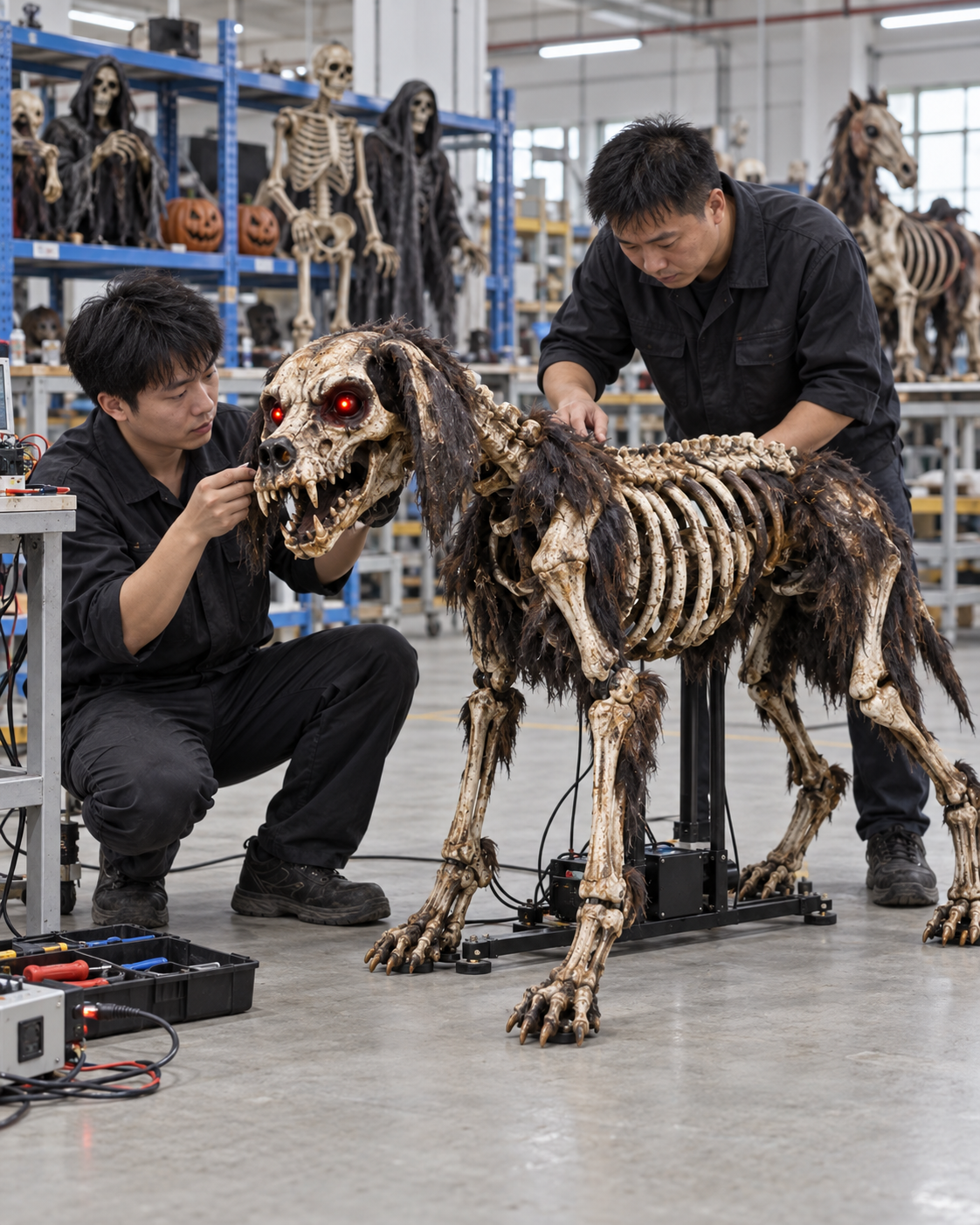
Commercial Halloween animatronics and static props solve different display problems. An animatronic is useful when a venue needs a timed character moment, visible movement or a controlled surprise. A static prop is useful when the priority is scale, atmosphere, durability or a repeatable scene element. The better choice is the one that fits the visitor journey, not the one with the longest feature list.
For attractions, malls, retailers and event operators, the comparison should include more than appearance. Consider the product application, how people approach the display, available power, maintenance access, installation preparation, packing constraints and the evidence needed at factory testing and shipment inspection. This guide explains how to make that comparison in a practical way.
1. Start with the role the prop must play
The first question is not ‘Should it move?’ but ‘What must visitors notice or do here?’ Entrance pieces need visibility from a distance. Queue-line props need to keep a scene coherent without blocking movement. A focal character may need a short, repeatable performance that rewards a closer look. When the role is clear, the appropriate level of interactivity becomes easier to specify.
Static props are usually the strongest foundation for a scene because they establish silhouette, texture and scale continuously. Tombstones, gates, spiders, pumpkins and set pieces can frame sightlines throughout opening hours. They are also useful where visitors move quickly or where the venue wants a consistent visual result in daylight and after dark.
Animatronics are best treated as deliberate moments within that foundation. A moving witch, skeletal dog or creature can turn an otherwise passive scene into an encounter. However, a character with movement, light or sound also needs an agreed trigger method, operating cycle, power arrangement and practical access for setup and checks.
Project checklist
- Map the visitor path before selecting a focal prop
- Identify whether the prop is a landmark, scene dressing or interaction moment
- Confirm the available footprint, clearance and access route
- List any required power, trigger, sound or lighting conditions
2. Compare visual impact against operating complexity
Animatronics can create a stronger single moment because movement draws attention. This is especially useful in haunted attractions, family entertainment centres and event routes where the scene has a clear pause point. The trade-off is that movement is only valuable when visitors can see it, hear it or respond to it safely. A poorly located animated prop may add cost without improving the experience.
Static props offer continuous impact with fewer operating dependencies. A large spider can define a retail atrium, while a graveyard set can fill a photo zone without requiring control hardware. For venues with limited technical staff, static pieces can reduce daily opening checks and make the installation easier to reset after cleaning, transport or visitor activity.
A mixed approach is often more effective than choosing only one category. Use static pieces to create the environment, then use one or two animatronics where the visitor path supports a purposeful reveal. This gives the project a clearer hierarchy and keeps factory testing focused on the functions that matter most.
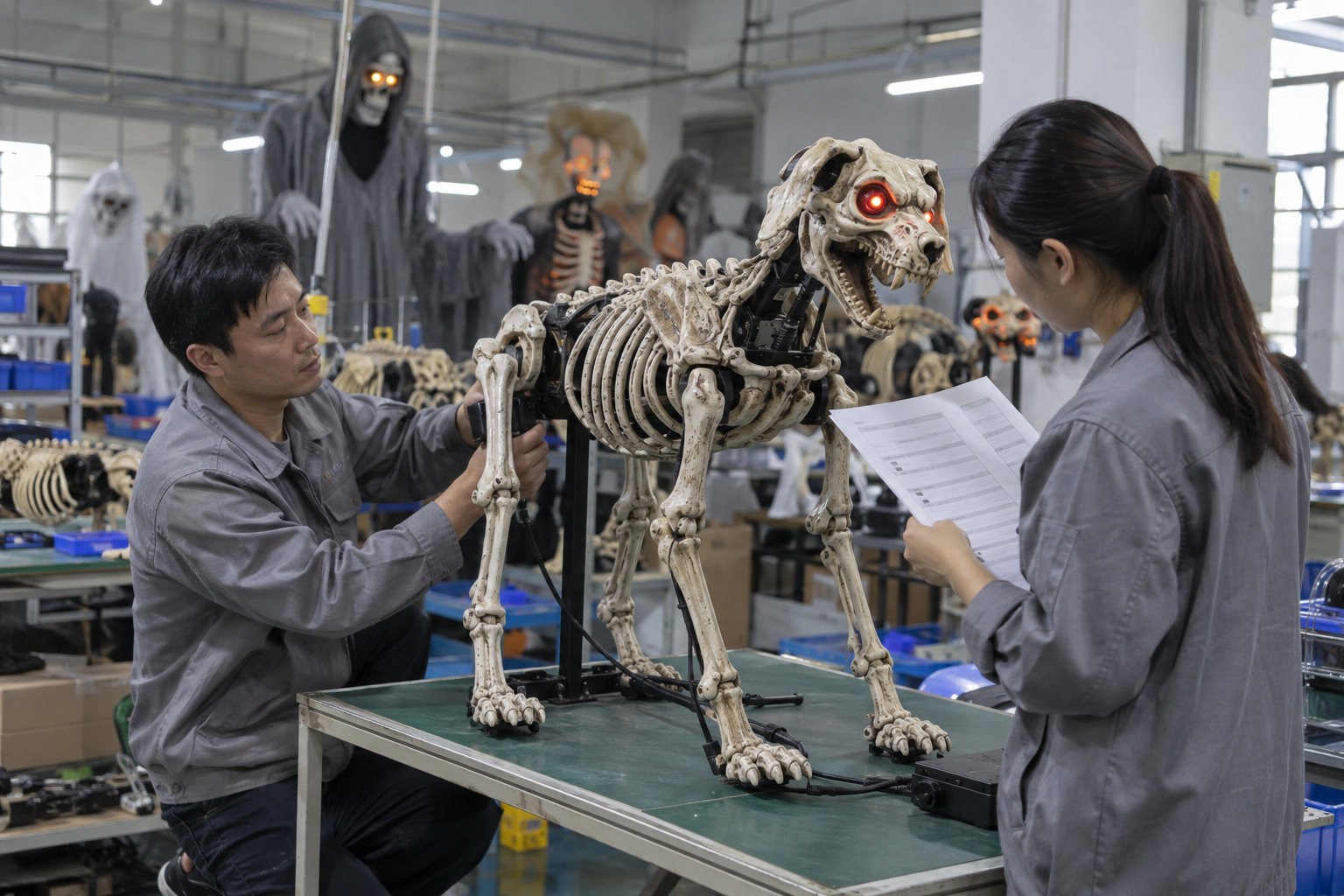
For related product directions, explore BooAri's Halloween prop collection, discuss a custom project or review the factory workflow.
3. Review materials, functions and maintenance access together
The visible finish is only one part of an animated product. Buyers should ask how costume layers, mechanical components, lighting, speaker placement and access panels are arranged. The answer should reflect the agreed product application. An indoor attraction scene and a sheltered retail activation can have different expectations for cleaning, handling and daily checks.
For static products, discuss the base, centre of gravity, joining points and surface finish. A gate or large spider needs a plan for how it will arrive, stand, be secured and be broken down. For a themed set, clarify whether each item is independently packed and labelled for installation preparation.
Avoid assuming that a prop is suitable for a particular environment from a product photo alone. Share whether it is indoors, covered, exposed to weather or in a high-contact public area. The factory can then review the relevant material and construction choices before the order reaches production.
4. Build factory testing into the buying decision
Factory testing should be connected to the approved product requirements, not treated as a generic final photo opportunity. For an animatronic, buyers can agree which visible movement, lighting, sound or trigger actions should be demonstrated. For a static display, inspection can focus on finish, item count, assembly points and the condition of included accessories.
A useful test record identifies the product revision and shows the agreed function under a realistic operating sequence. It does not guarantee performance in every venue, because final site conditions, installation and power arrangements remain relevant. It does provide a clearer reference before the goods leave the factory.
At shipment inspection, review the same decision points alongside packing. Confirm the item count, visible condition, agreed accessories and the packing method for the shipment. This is particularly important for mixed displays where a missing small component can delay the final installation.
5. Decide with a simple venue scorecard
Use a scorecard that compares visual priority, visitor dwell time, technical support, maintenance access, installation complexity and budget allocation. If the venue scores highly for visitor dwell time and technical support, an animatronic may be a strong choice. If it scores highly for long viewing distances, repeated deployment or quick setup, static display props may deliver better value.
The scorecard is not a substitute for a product quotation. It is a way to make customer requirements visible before the supplier recommends a configuration. It also creates a useful internal record for marketing, operations and procurement teams who may evaluate the same scene differently.
BooAri can use this decision context to suggest a relevant starting point from the Halloween prop collection or a custom build direction. Final specifications are confirmed before production, including dimensions, finishes, functions, packing and commercial terms.
Conclusion
Send your venue layout, target quantity and desired visitor experience to BooAri for a practical prop-direction discussion. Clear customer requirements, a documented product direction and a planned inspection sequence give the buying team a stronger basis for the next step.
Frequently asked questions
Are animatronics always better for haunted attractions?
No. Animatronics are strongest at deliberate visitor moments. Static props often provide the scene scale, texture and repeatable atmosphere that make the animated moment effective.
Can static props include lighting?
Yes. Light-up features can be discussed separately from movement. Confirm the desired visual effect, power arrangement, control method and installation context before production.
What should be checked before an animatronic ships?
Agree the visible operating functions, item condition, accessories and packing approach. Shipment inspection should reference the final approved product requirements.
Can one scene mix custom and catalogue props?
Yes. Existing product styles can form a starting point while scale, finish, lighting or complementary set pieces are developed for the project.
Further reading
Use these external resources alongside your local market, venue and professional safety requirements:
READY TO START A PROJECT?