

A golden sample is an identified, approved reference for what a production order is supposed to become. For a Halloween prop, it may establish character proportions, visible finish, costume placement, movement, light, sound and accessories. It should not be treated as a magic guarantee: the buyer still needs production controls, measurable requirements and an inspection plan. Its value lies in making disagreements about 'the approved look' much easier to resolve.
This guide is written for overseas buyers commissioning custom or modified props, including animated characters and multi-part display sets. It describes a proposed approval method, not a claim that a particular BooAri order used it. A useful reference must identify the exact revision, where it is kept, which features it controls, and what evidence will be used if the physical sample cannot travel to every inspector.
Decide what the golden sample actually represents
Start with the orderable unit. Is the approved object one assembled witch, a set of three graveyard pieces or a retail carton containing several variants? A photograph of the hero item cannot represent a whole set unless the other components are separately documented. State the SKU, variant, dimensions, finish references, electrical configuration if applicable, supplied accessories and packing version on an approval sheet attached to the sample record.
Separate visual direction from acceptance criteria. A dramatic studio photograph may communicate mood but hide rear finishing, base construction or cable routing. A retained sample allows inspectors to view the physical object; a written specification tells them which observed characteristics are requirements and which are incidental. If the sample has a hand-painted mark that was never intended for every unit, annotate that explicitly before production.
Agree whether the production sample is made with the same materials and process intended for the bulk run. An early concept may use a convenient substitute to establish silhouette; it is useful for design but not a complete manufacturing master. Name the stage clearly: concept model, functional prototype, pre-production sample or final retained reference. Do not call an unfinished prototype a golden sample simply to meet a schedule milestone.
Build a reference pack alongside the object
The pack should include dated photographs of front, sides, rear, base and close-up finish zones; a dimension drawing; approved artwork files; function settings; accessory list; and a packing diagram. Use one version identifier across these items. Photograph the sample under neutral light as well as the intended display light, because colour and texture can appear different in a themed scene. If the buyer approves by video, include a continuous view of the full operating cycle, not only a short attractive clip.
Define controlled features and permissible variation
Some features are binary: a light turns on, a switch operates, a named accessory is included, or the prop fits within an agreed shipping dimension. Other features need an agreed range or example. Hand finishing can create natural variation, but the permitted character of that variation should be made visible. Use annotated photographs to mark front-facing focal areas, hidden backs, natural texture areas and any details that cannot vary without changing the product identity.
Avoid demanding impossible pixel-level matching from manual finishes while leaving functional requirements vague. Instead, decide which visual relationships matter: eye colour relative to the face, depth of weathering, alignment of costume trim, silhouette at the expected viewing distance and consistency within a retail set. If a small touch-up is acceptable in a hidden area but not on a face, write that down. The same observed mark can carry different commercial consequences depending on location.
Dimensions should be measured from declared points. For a tall figure, distinguish overall standing height from carton height and base footprint. For articulated limbs, specify the pose used during measurement. If the intended product application requires a height clearance, state the maximum allowed installed dimension. A photograph beside a worker is not a measurement reference.
Test the function that customers will actually see
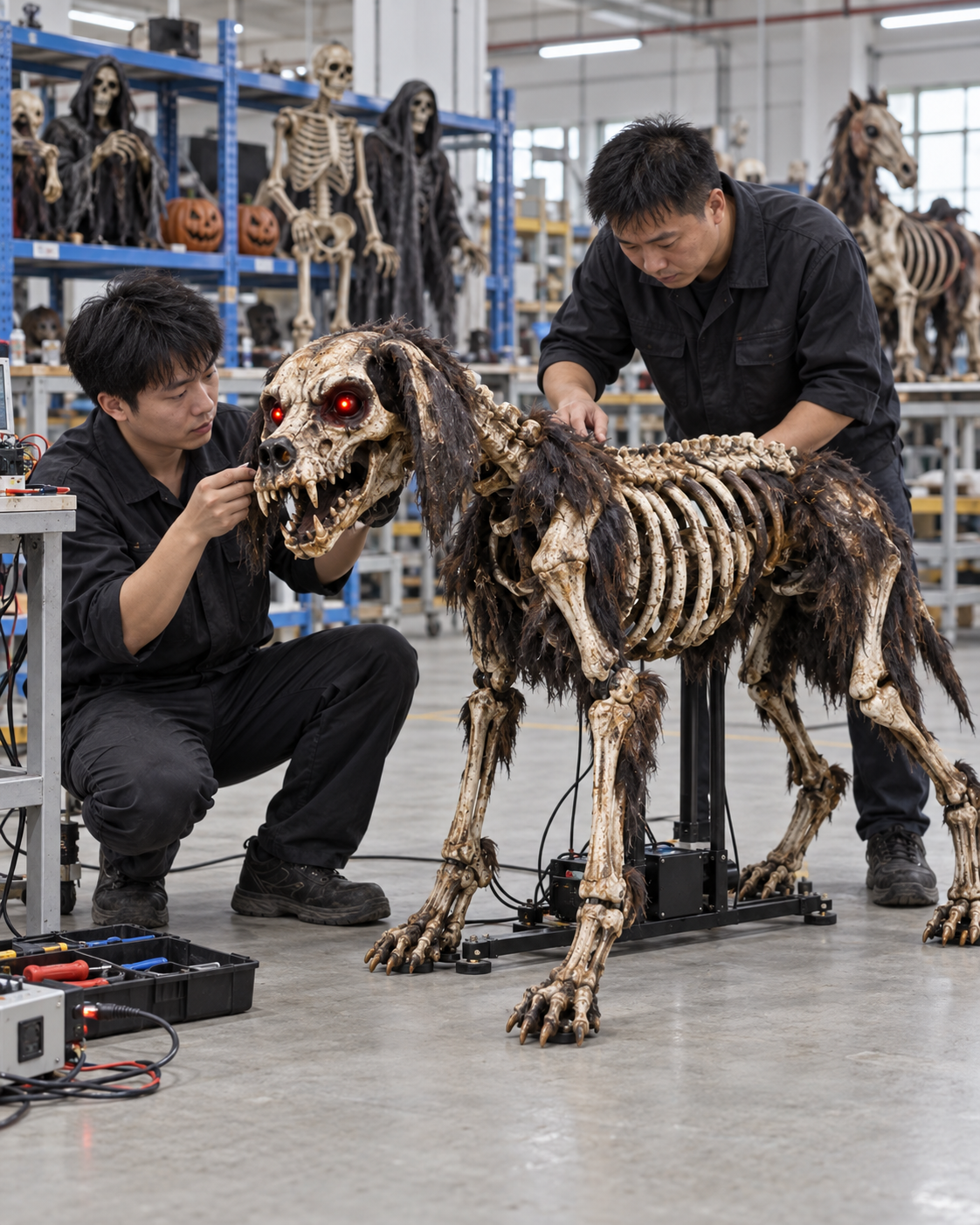
An animatronic sample approval should identify the controller revision, trigger, supply arrangement and sequence being demonstrated. Record the motion from rest through activation, return and reset. If sound and light are part of the product, describe their timing relative to movement. A clip showing one second of motion does not establish reliable completion of the sequence. The buyer and supplier should agree which settings are fixed for the production order and which are adjusted at the venue.
Static props need their own function checks. A gate may need to stand in the approved assembly state; a modular graveyard set needs complete parts and compatible connectors; a hanging prop needs a clear product attachment description for the venue's qualified rigging team. A sample should be reviewed for the actual product application, not only its appearance on a clean studio floor.
Establish custody and revision control
Determine who holds the physical reference. A supplier-held sample can be available to production and inspection staff, while a buyer-held sample helps the buyer compare later deliveries. For important custom programs, two identified references may be useful if they are genuinely equivalent. If only one sample exists, make high-quality images and measurements accessible to the people who will judge production. Record any damage to the reference itself so it does not become an unreliable standard.
Approve changes formally. If the buyer requests a different costume colour, base or light effect after sign-off, issue a revised record and determine whether a new sample or targeted component approval is needed. Do not silently alter the old sample and keep using the previous version number. A revision log should identify the reason, approving person, date, affected products and inspection evidence. This protects the supplier as well as the buyer from checking production against contradictory instructions.
The custom project page can be used to start a specification discussion. The factory workflow is a useful reference for the kinds of assembly, function and packing questions to include. Neither page replaces a signed order-specific approval record.
Compare production at meaningful checkpoints
An approved reference is most valuable when production teams can use it before final packing. Identify a first-article or initial production comparison for the visible finish and function. If that reveals a systematic difference, a correction made early is more practical than sorting finished cartons. Later checks should confirm that the corrected process remains aligned with the same reference. The buyer can request photographs or an independent visit, depending on the risk and order value.
For a set, compare several units, not only the most attractive one selected by production. Look at batch consistency in the buyer's important zones. Record observed deviations with location and severity, then decide whether they are acceptable variation, rework, or a reason to stop and investigate. A useful quality record ties every observation to the approved revision and the units examined. CPSC manufacturing best practices provide a broader reminder that product quality and safety are process questions, not merely end-of-line photographs.
If materials or components change, revisit the reference. A replacement fabric that looks close under factory light may hang differently. A substituted controller may produce a different cycle. A changed protective insert may shift the costume or expose a painted edge in transit. Decide whether the original approval still represents the shipped product before allowing the change to flow into volume production.
Connect the reference to shipment inspection
Shipment inspection should compare a defined selection of production units with the approved sample and order record. Confirm identity, appearance, dimensions, function where relevant, accessories, labels and packing. A physical sample may not be present at the export warehouse; then the dated reference pack must be clear enough to support an honest comparison. Inspectors should be told what they are authorized to decide and which deviations require buyer approval.
Opening a carton for inspection can alter packing. Record how inspected units are repacked and sealed so the evidence does not create a shipment risk. Check that the production packing revision matches the reference pack. A finished-product golden sample does not validate an unapproved carton, especially for irregular or fragile props.
No practical sample can prove every unit is identical. Sampling results support a defined conclusion about the inspected lot under an agreed plan. They do not guarantee zero defects in unseen cartons. When the buyer's risk is high, increase scrutiny of critical functions or add process controls rather than relying on an exaggerated claim that the sample 'passed everything'.
Decision example: a witch figure with a revised face
Imagine a fictional retailer approves a pre-production witch. The approved photograph shows a dark green face under warm showroom light. During the first production review, an inspector sees a brighter finish under neutral light and reports a mismatch. The buyer asks for a side-by-side comparison of the retained sample and production piece under both lighting conditions, with the same camera exposure. This reveals whether the difference is a camera effect, a paint-mix change or an approved variation.
Suppose the colour really changed because a paint batch was substituted. The supplier does not need to promise that no variation will ever occur. It needs to identify affected units, restore the approved direction or obtain a documented buyer approval for the new finish. The buyer can then decide whether the finished stock fits its display. The example illustrates a controlled decision, not a BooAri quality incident.
The same logic applies to movement. If the sample's arm pauses at the top of the cycle but production units return immediately, compare controller settings and mechanical revisions. A factory testing video should show the complete approved sequence. Shipment inspection can then check that the units presented for release match that sequence. Without an identified reference, each team may reasonably remember a different version.
Buyer worksheet: define the approval package
Create a one-page cover sheet with SKU, product title, revision, date, order number, approver and location of the physical sample. List the attachments that form the reference: drawing, finish images, functional video, artwork, accessory bill and packing drawing. Mark each attachment with the same revision. If one item is not final, say so and set an approval gate before production rather than implying the whole package is complete.
For each controlled feature, write the inspection method. Examples include a tape measurement from named points, a count against the accessory list, a continuous demonstration of one full trigger and reset sequence, or a visual comparison at a stated viewing distance and light. Set criteria before seeing the production result. Otherwise the team may unconsciously move the goalposts after a delay or commercial pressure emerges.
Finally, assign decision authority. A factory technician may identify a discrepancy, a quality lead may authorize routine rework, and the buyer may need to approve a visible design change. Record how urgent questions are escalated and when a revised sample is necessary. This short governance section often matters more than an elaborate photograph gallery.
Audit the handoff between reference and production team
A golden sample may be documented perfectly in the buyer's drive but invisible on the factory floor. Ask how production staff obtain the current reference. Is there a protected physical master near the line, a controlled image set, an inspection card or a combination? Who withdraws old photographs after a change? The correct answer depends on the process, but there must be a method that prevents two revisions from being treated as equally approved.
Run a short transfer test. Give the reference pack to a quality reviewer who was not in the original design meeting. Ask them to identify the required finish, key dimensions, function sequence, accessory count and packing method. If they need a long verbal explanation, the record is incomplete. Update the pack while the sample is still available. This is a practical way to check whether the approval can survive staff turnover and a later reorder.
For repeated production, consider a boundary sample. A buyer may approve one intentionally distressed face with a range of acceptable weathering. A second panel can show the outer edge of that range. The boundary is not permission for unrelated defects; it helps distinguish natural variation from a changed look. Label every panel with its revision, material and approval date. If it becomes damaged, replace it under a documented approval instead of treating a degraded panel as the new standard.
Before release, compare the first packed production unit with the reference pack as an integrated product: visible object, functions, accessories and protection. A sample may fit the intended carton when costume fabric is new and carefully arranged, but production handling can reveal pressure points. If the packing solution changes, update the reference. The buyer's real purchase is a shipped, installable prop, not a workshop display.
Questions for the first production review
Ask whether the reviewer can locate the current retained sample without help, whether the sample and order share the same revision, and whether there are approved boundary examples for hand finishing. Select an early production unit and compare its most important visible and functional characteristics with that reference. Record any difference before the run becomes large.
Also ask who owns changes after approval. If a component becomes unavailable, production should not substitute it silently. The buyer needs to know which performance or appearance evidence will be repeated and whether packing changes as a result. A golden sample is valuable because it anchors a managed decision process, not because it removes the need for judgment.
Frequently asked questions
Is one golden sample enough for every variant?
Not usually. Shared construction may be represented by one master, but colourways, artwork, accessories or operating functions need variant-specific records. State which characteristics are common and which require their own sample or approved image set.
Can I approve a sample by video alone?
Remote video can support a decision if it shows identification, measurements, all visible sides and complete functions. It cannot convey texture, weight or every colour nuance perfectly. If those features are critical, request a physical sample or an additional independent review.
What if the retained sample is damaged?
Document the damage and stop using the affected feature as an unquestioned standard. Compare it with the dated approval pack and decide whether a replacement reference must be made and signed off. Do not let an altered sample quietly redefine the order.
Does a passed sample mean the entire shipment is accepted?
No. The sample approves a target configuration. Production and shipment checks must still establish whether the actual units and packs match that target under the agreed inspection scope.
Should packing be part of sample approval?
Yes, if the shipped configuration matters. Approve protective materials, carton or crate design, accessory placement and assembly state separately from the visual product. Recheck if the product revision changes dimensions or fragile features.
Conclusion
A golden sample works when it is an identified product revision supported by drawings, images, function records, controlled variation and custody rules. Compare production early, document changes and carry the same reference into shipment inspection. It makes buyer and factory decisions more repeatable without pretending that a single perfect object guarantees an entire batch.
Send BooAri your approved references, target quantity and destination through the project enquiry form. Ask for a sample approval plan that states what will be demonstrated, retained and checked before your bulk order ships.
Further reading
Use these external resources alongside your local market, venue and professional safety requirements:
READY TO START A PROJECT?