
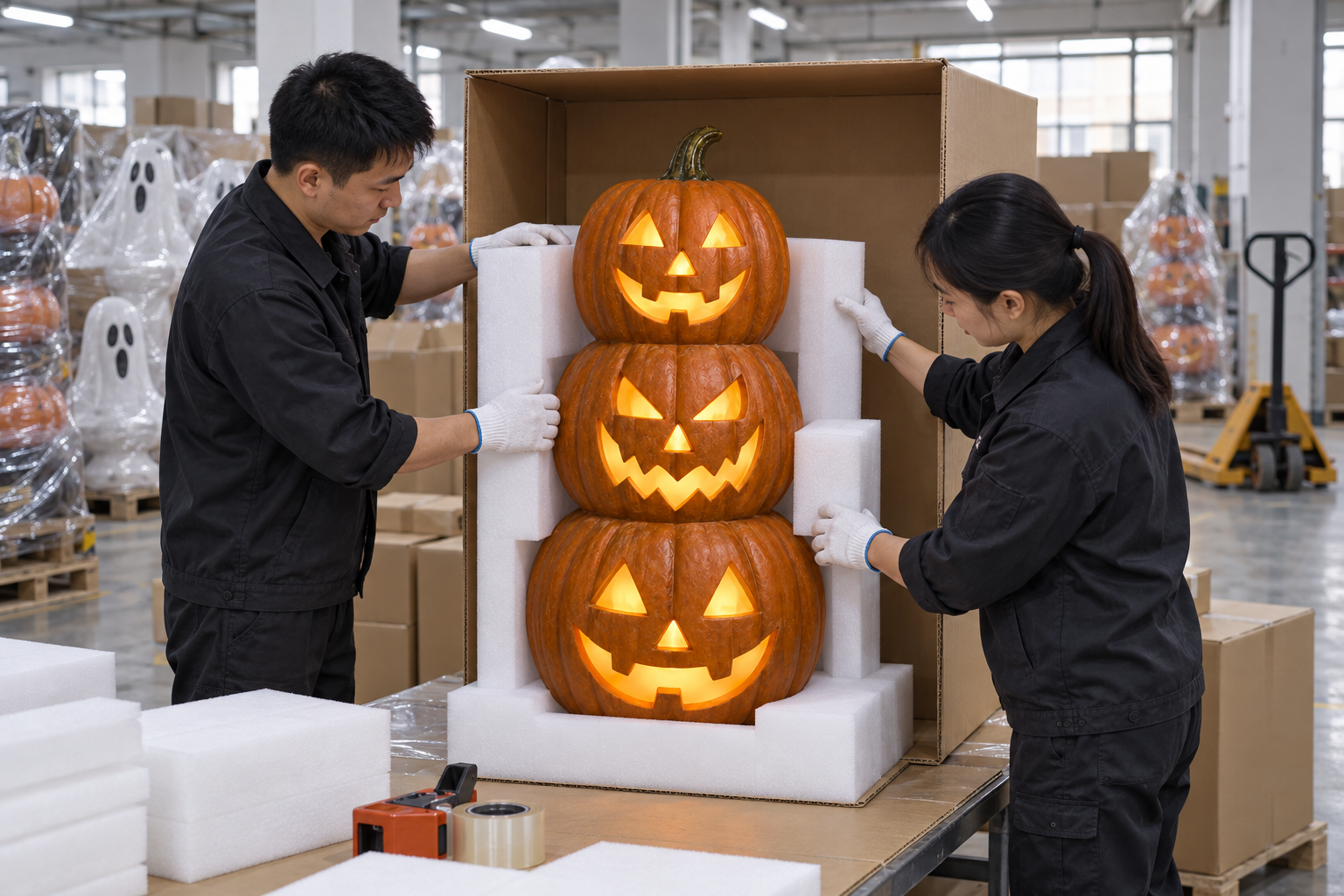
A pre-shipment inspection is useful only when its selection and acceptance rules are agreed before the inspector sees the goods. Opening a few attractive cartons chosen by the factory is not the same as checking a defined shipment lot. Conversely, an inspection sample cannot prove that every unexamined Halloween prop is defect-free. The buyer needs a scope proportionate to the product risk and an honest interpretation of the result.
This guide is for importers and commercial venue buyers who want to design an inspection sampling plan for seasonal props. It does not prescribe one universal AQL number or claim that an inspection certifies legal compliance. Sampling schemes, market requirements and safety tests are distinct questions. Qualified inspection, product and compliance professionals should help set the actual plan for the ordered goods.
Define the lot before choosing a sample
The lot is the population from which the sample is drawn. State which purchase order, SKU, variant, production batch and packing revision it includes. If an order has animated dogs, static spiders and pumpkin lights, do not treat all units as one homogeneous population for every check. Different functions and failure modes may justify separate strata. If the supplier changes a component or production line mid-run, determine whether those units belong in the same lot.
The unit of inspection also matters. A retail pumpkin may be checked as one sellable item. A graveyard scene may have three cartons that together make one sellable set. If the inspector randomly opens only one of the three cartons, set completeness cannot be established. State whether the plan samples individual items, complete sets, cartons or palletized shipping units for each question.
Record quantities available at the inspection point. Inspecting before goods are fully produced or packed can make the sample unrepresentative of the final shipment. The buyer may still choose an in-process inspection, but it should be named as such. A final shipment inspection should identify finished units and packing that actually correspond to the release decision.
Make random selection practical
Ask for access to the full identified lot and a carton list before selection. The inspector should choose units across accessible positions rather than accepting a pre-arranged display of the best samples. If only front-row cartons can be reached, record that limitation and decide whether to move stock or narrow the conclusion. 'Random' is not credible when the selection pool is controlled invisibly by the party being inspected.
Separate product, function and packing questions
A Halloween prop inspection can have several layers. Product identity asks whether the unit matches the approved SKU, size, finish and variant. Function asks whether lights, movement, sound or triggers perform under the agreed setup. Packing asks whether components, accessories, protection and marks match the approved carton design. Documentation asks whether counted quantities and item descriptions agree with the purchase order and packing list.
One sampling rate does not automatically suit every layer. A buyer may inspect an entire small set for completeness while function-testing a defined portion of identical animated units. Another may check all cartons externally and open a smaller selection for product condition. Write the method for each layer so the report does not say only that 'inspection passed' while omitting what was never checked.
Some characteristics merit 100 percent verification or a process control, especially where a failure would prevent installation or create a safety concern. A missing main base or wrong power configuration cannot be treated merely as a harmless visual blemish. The appropriate depth depends on the product and target market. The CPSC's general-use product guidance distinguishes regulatory testing and certification from routine commercial inspections; buyers should not confuse the two.
Write defect classes before the inspector arrives
Define critical, major and minor categories against the actual prop. A critical category might cover a condition that presents a serious safety risk or makes the product unsuitable for lawful use, subject to qualified assessment. A major category might include an inoperative central movement, missing key accessory or visibly incorrect character variant. A minor category might cover a small cosmetic difference outside a focal zone. Do not copy generic examples without reviewing the product application.
For a purposely distressed prop, the visual criteria must distinguish design from damage. Attach sample photographs and an approved finish range. For an animatronic, identify what constitutes a failed cycle: no activation, incomplete return, unacceptable sound or an accessory coming loose. A report should capture observed facts and reference the agreed criteria, not silently create a new standard at the factory.
If using an AQL-based scheme, have the buyer's quality lead or an independent inspection provider define the standard, inspection level, sample size, acceptance numbers and defect classes. AQL is a statistical decision rule, not a promise that a certain percentage of defective pieces is acceptable to the customer. Do not publish one universal number as if it applies to every Halloween product.
Build a function test that fits the actual unit
Set up each sampled animated prop under the documented power, controller and trigger conditions. Run enough of the complete cycle to observe activation, main movement, return and reset. Record settings and any adjustments made. If a tester has to repair, reposition or restart a unit, the report should say so. A short clip of the most dramatic movement does not show whether the product can repeat the agreed action.
Static products also have relevant checks. Assemble a representative multi-part gate according to the supplied instruction, verify connector identification and inspect the final pose. For a product with lighting but no movement, review the agreed modes and supplied power components. The test follows the quotation and approved sample; it should not assume a feature from a marketing image.
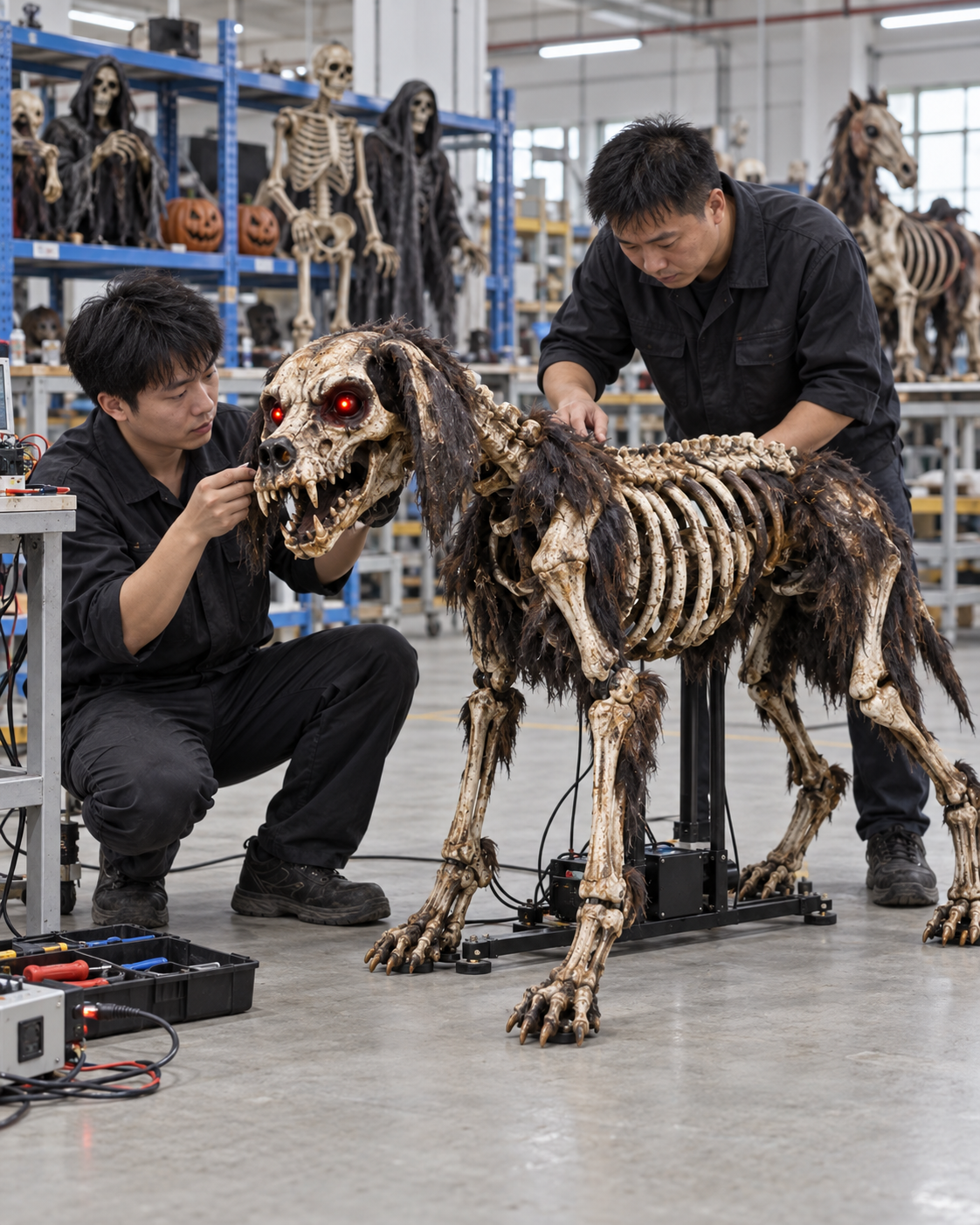
The factory overview helps buyers formulate questions about assembly and functional checking. The specific order needs a documented procedure and an inspector who can safely operate the relevant unit. Destination installation and local electrical work remain separate responsibilities.
Inspect the shipping configuration without ruining it
When selected cartons are opened, record the unopened condition first: marks, seals, visible damage and carton identifiers. Photograph the internal arrangement before removing parts. Check whether heavy pieces are isolated from delicate surfaces, accessories are findable and the contents list reflects the actual set. After product checks, repack using the approved method and record any replacement seal or protective material. An inspection that leaves cartons less protected changes the shipment risk.
For large props, inspect the crate or pallet interface as well as the item. Does the shipping unit correspond to the measured packing list? Are multiple cartons for one set clearly linked? Can the receiving team identify which piece opens first? Some handling questions cannot be answered by viewing one small accessory carton. Choose units according to the packaging risk.
Shipment inspection should compare against a known packing revision. If inserts changed after a transit trial, the buyer should decide whether old evidence still applies. The inspection can establish that production uses the approved configuration; it cannot by itself simulate the complete journey. A separate packed-product test may be appropriate when the route and product justify it.
Report observations, not just a pass/fail label
A useful report identifies lot size, sample selection, date, product revision, criteria, units inspected, defects found, photographs and unresolved questions. It should separate observed counts from the inspector's decision under the plan. If access was restricted or a function could not be tested, mark it unverified. A green summary badge without exceptions is a weak release record.
Ask whether the report includes the exact packing list count and label checks. Receiving teams need to know what is coming. If one product variant has a defect while others do not, record the variant-level result rather than hiding it in an order average. A buyer may choose to hold that variant while releasing unaffected goods, but only if segregation and traceability are clear.
The inspector should not promise a warranty outcome, legal compliance or the absence of defects in uninspected units. Their evidence supports a purchasing decision. The buyer retains the responsibility to interpret the result, obtain required compliance documents and decide whether to accept, rework, reinspect or delay shipment.
Decision example: mixed static and animated items
Imagine a fictional order with eighty static tombstones and twenty animated skeletons. The cartons are ready at one warehouse. If the buyer draws a sample from all one hundred units without stratification, the sample could contain very few animated skeletons. The resulting 'pass' would say little about the function that carries the highest technical risk. The buyer instead specifies separate selection and checks for each SKU group.
The static group receives visual, dimension, component and packing checks. The animated group receives those checks plus the complete cycle under documented settings. The buyer also identifies whether every unit's power label or controller identity must be verified. These decisions are not universal sampling numbers; they follow the actual product and risk. The example is hypothetical, not a BooAri order.
Suppose a sampled skeleton fails to return fully. The report records its identifier, test setup and observed behaviour. The supplier investigates whether the issue is isolated or systemic, segregates affected stock and proposes correction. A reinspection plan is agreed before the buyer authorizes shipment. Simply replacing the failed sample with a working unit would not answer the original concern.
Buyer worksheet: specify inspection in one page
List each SKU, variant and lot quantity. For every characteristic, define the reference document, inspection unit, selection method, test setup and acceptance rule. Separate product identity, appearance, function, accessories, packing and marks. State whether the inspector may open production cartons and how those cartons must be reclosed. Include access requirements so the chosen units can be reached.
Specify the reporting package: itemized defect log, overall photographs, close-ups, complete function clips where useful, counted quantities and a clear list of unverified items. Decide who receives the report, who can authorize rework and who can release goods. Set a lead time between inspection and vessel or courier booking so the result can change the shipping decision rather than arrive after departure.
Finally, define what happens on failure. Will the supplier rework all affected units, sort the lot, produce replacement components or request a buyer concession? What evidence will close the issue, and who selects the reinspection sample? This protocol makes inspection a controlled gate instead of a ceremonial final visit.
Design the reinspection before a failure occurs
A failed initial inspection should trigger a defined response, not an improvised argument about whether to test again. State in advance who investigates, how affected units are identified, what sorting or rework evidence is required and how a new sample will be selected. If the defect is a missing accessory in a multi-carton set, a targeted 100 percent reconciliation may be more useful than repeating only a cosmetic sample. If the defect is inconsistent paint, the supplier may need to isolate a production period or material batch.
Do not allow a corrected unit to erase the original observation from the report. The record should show the defect, root-cause hypothesis, corrective action and recheck result. If a product is reworked, confirm that packing was restored and labels remain accurate. A hurried repair near a shipping deadline can create a different problem, such as an accessory put in the wrong carton or a surface touched before curing.
The buyer should determine whether a reinspection applies to the original lot, a sorted subset or a newly produced replacement batch. The populations are different. A report that says 'passed on second visit' without explaining what stock was presented gives weak assurance. Record quantities, identifiers and whether previously inspected units were included. This makes the result interpretable to people who were not at the factory.
Finally, maintain a shipment decision log. The buyer may release unaffected SKUs, hold one variant or revise the delivery schedule. The inspector's report informs that decision; it does not automatically make it. Communicate the chosen action to freight and receiving teams before bookings proceed. Seasonal urgency is real, but an ambiguous release can move the problem from a controllable factory floor to an expensive destination warehouse.
Questions for the inspection booking
Ask whether the finished lot will be accessible, who chooses sample units, how multi-carton sets are represented and which functions require a full-cycle demonstration. Confirm that the inspector receives the approved sample, defect definitions, carton matrix and safe test instructions before arriving. An inspection booked without those references can generate many photographs but little decision value.
Reserve time for a failed result. Who can authorize sorting, rework and a second visit? Will freight be booked only after release? A sampling plan is operationally useful when its outcome can change what ships. If shipment departs while exceptions remain unresolved, the report has become an archive rather than a gate.
Frequently asked questions
Does AQL mean the buyer accepts defective products?
No. An AQL-based plan is a defined sampling decision method. The buyer should agree defect categories and acceptance rules for the particular order. It does not mean that every defect is permissible or that unseen units are guaranteed good.
Can the factory select samples for the inspector?
The inspector should select from an identified accessible lot under the agreed method. Factory staff may safely move cartons, but the selection should not be reduced to a prearranged display of preferred units. Record access limits transparently.
Is a final inspection the same as regulatory certification?
No. Commercial product and packing checks are distinct from testing and certification required by a destination market. The buyer and qualified compliance advisers must determine applicable rules and evidence for the actual product.
How many cycles should an animatronic be tested for?
Agree a product-specific demonstration that shows activation, action, return and reset under recorded settings. More cycles may be appropriate for a particular risk, but a blog cannot set a universal number. Record any interruption or adjustment.
What happens if inspected cartons are opened?
Document the original pack, perform the check, repack with the approved materials and identify resealed cartons. Inspection should not leave the shipment with less protection than before it began.
Conclusion
Halloween prop inspection sampling works when the buyer defines the lot, selects units credibly, separates checks by risk and writes defect and release rules before the visit. A transparent report supports a decision while acknowledging what was not examined. That is more valuable than an unqualified promise that a handful of samples represents perfection.
Send your SKU list, quantities, product application and approved samples through BooAri's enquiry form. Ask for an inspection access and demonstration plan early enough to influence production and shipment timing.
Further reading
Use these external resources alongside your local market, venue and professional safety requirements:
READY TO START A PROJECT?