

MOQ and lead time are not fixed labels that apply to every Halloween prop. They depend on the product type, stock status, requested finish, packaging, quantity, sample work and destination. Buyers get better quotation information when they explain the commercial goal behind the request.
This guide shows how to plan a seasonal Halloween order from the launch or receiving date backwards, with enough room for product approval, production, inspection, packing and transport.
1. Understand what changes MOQ
A stock catalogue product may have a different minimum from a custom colour, new package, branded label, new mould or specialised function. Ask which part of the request drives the minimum quantity for the exact product direction.
Where a first order needs flexibility, a mixed catalogue assortment may be more practical than applying custom changes across every item. Keep custom development focused on the products that carry the strongest commercial value.
2. Begin with the required receiving date
Work backwards from the date the goods must be available for store allocation, event installation or attraction opening. Allow time for buyer approvals, factory production, shipment inspection, export packing, transport and the buyer's receiving work.
A production estimate is only one milestone. The overall schedule should identify which information the buyer needs to provide, including artwork, labels, destination details and any sample approval.
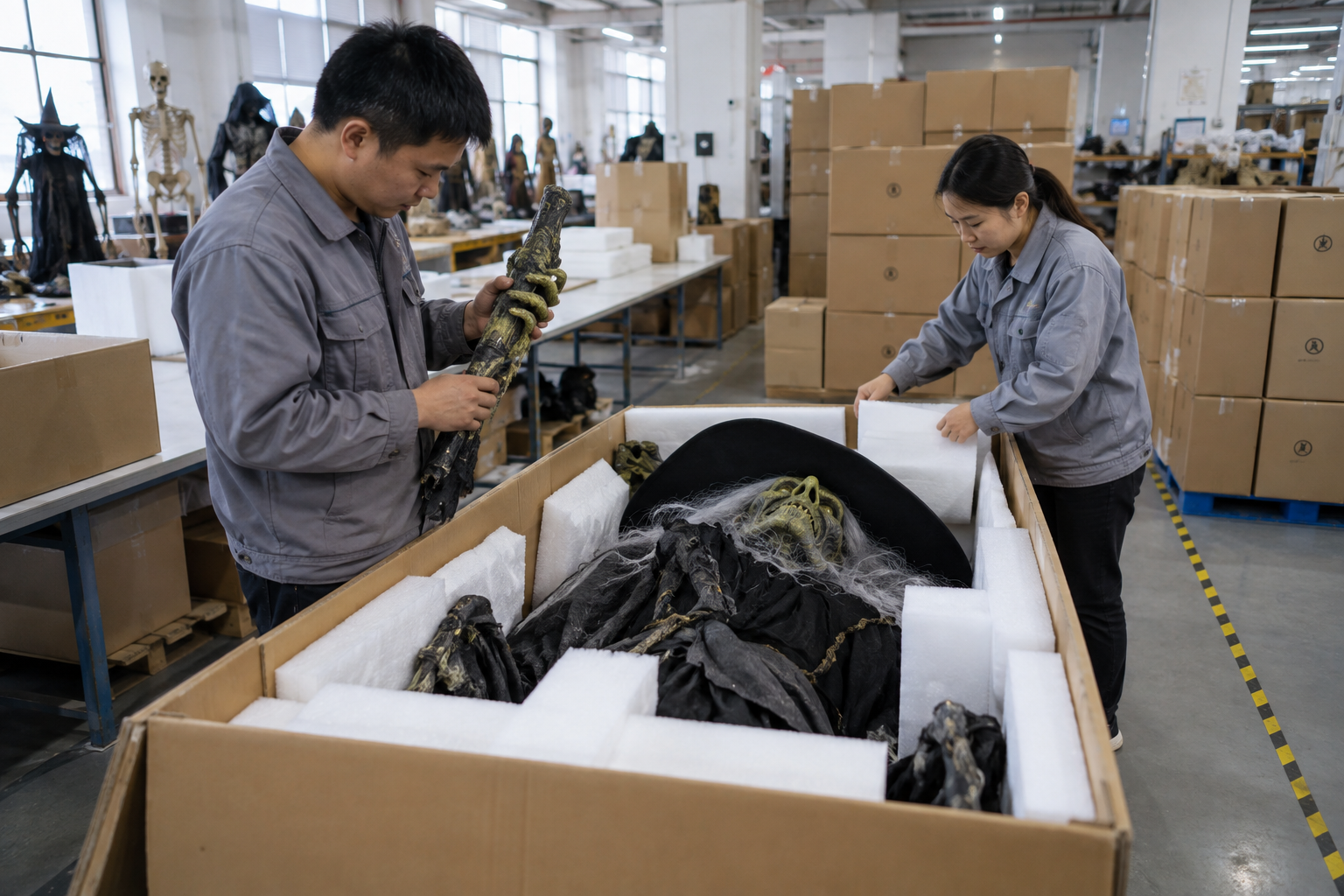
For related product directions, explore BooAri's Halloween prop collection, discuss a custom project or review the factory workflow.
3. Use samples to protect the seasonal timeline
For custom props, a sample should answer clear approval questions about finish, scale, function or packaging. Keep the approved reference traceable so production does not move forward on an outdated concept.
If a buyer changes a feature after approval, review the effect on production and transport timing before confirming the revision. Seasonal projects benefit from visible decisions rather than optimistic assumptions.
4. Include inspection and packing in the plan
Agree what factory testing and shipment inspection should cover. For a mixed order, review item count, visible condition, accessories and packing. For a function product, agree the visible operation to be demonstrated.
Packing should be reviewed as part of the schedule because it affects delivery readiness and the installation or retail receiving process at destination.
5. Give the supplier a usable quotation brief
Provide product type, quantity, market, target receiving date, sample requirement, packaging needs and relevant application details. This gives the supplier a basis for discussing a realistic MOQ and delivery plan.
A detailed inquiry saves time for both sides and produces a more useful commercial response than asking for a generic lowest price.
Conclusion
Send your target quantity, product list and required receiving date for a practical MOQ and lead-time discussion. Clear customer requirements, a documented product direction and a planned inspection sequence give the buying team a stronger basis for the next step.
Frequently asked questions
Why does MOQ vary for Halloween props?
MOQ can change with product type, stock status, custom materials, colour, packaging, tooling, function and production setup.
How should I plan lead time?
Start with the destination receiving date and allow for approvals, production, testing, inspection, packing, transport and your own installation or allocation time.
Can a buyer mix products in one order?
Often yes for catalogue assortments, but each item may have its own commercial minimum and packing requirements.
What information helps a supplier quote accurately?
Include product direction, quantity, target market, receiving date, packaging needs, sample expectation and application context.
Further reading
Use these external resources alongside your local market, venue and professional safety requirements:
READY TO START A PROJECT?