
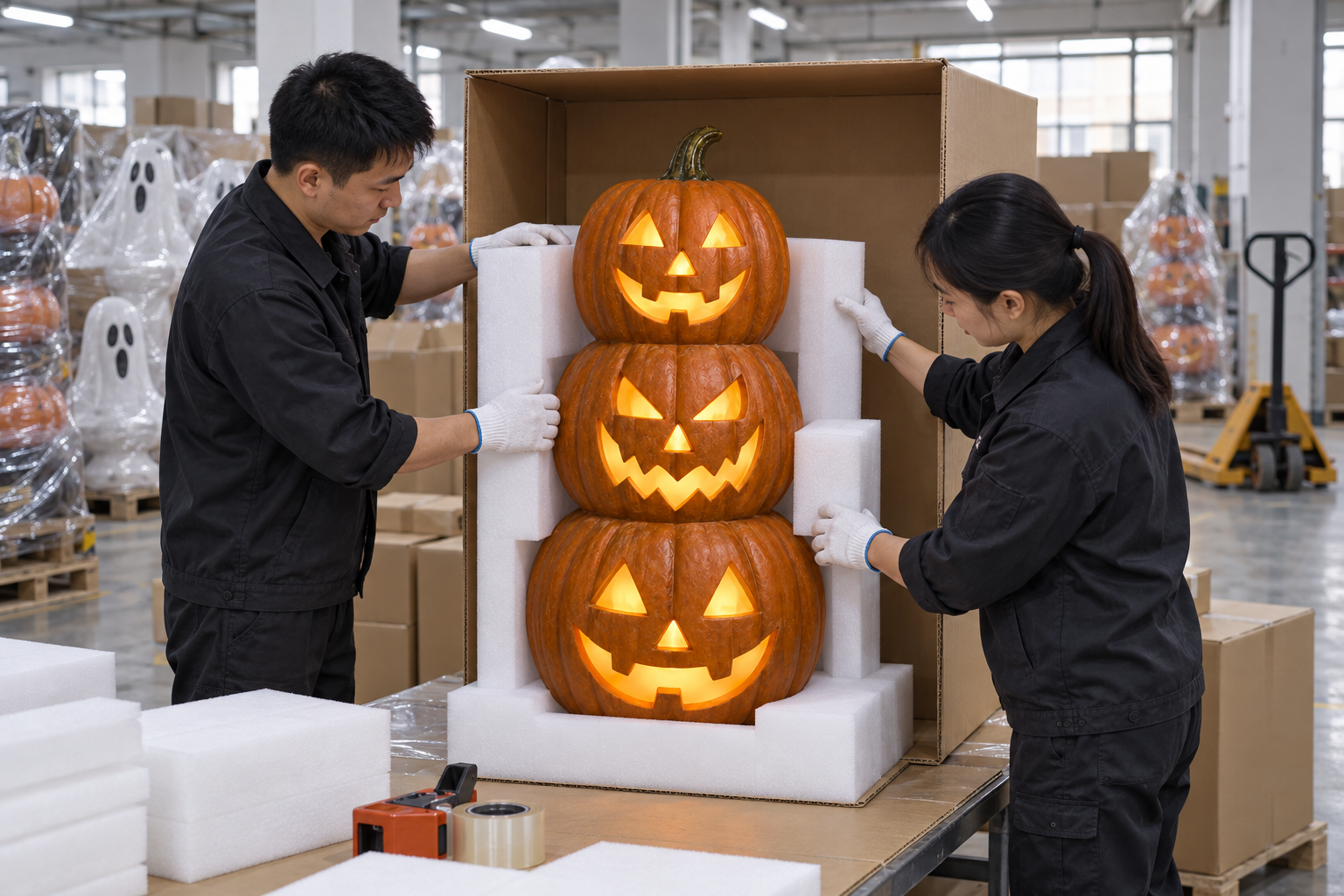
The purchase value of a commercial Halloween prop often depends on using it for more than one season. Reuse is not automatic. A display can finish October in working condition but return next year with crushed costume fabric, missing connectors, corrosion, warped panels or a damaged carton. Off-season storage therefore needs a condition record and a deliberate release gate, not only a warehouse shelf.
This guide addresses operations teams storing commercial Halloween scenery and animatronics. It does not prescribe one temperature or humidity range for every mixed-material product. Follow the actual manufacturer's care instructions and the venue's facilities guidance. Smithsonian collections-care advice is a general reminder to avoid damaging extremes of light, moisture and temperature; commercial props have their own material and electrical requirements.
Inspect before packing the season away
Schedule a condition check immediately after load-out, while the operating team remembers issues. Record product identity, revision, visible damage, function status, missing accessories and any field repair. Do not close a case marked 'ready' merely because the prop was still standing on the last night. A loose joint or intermittent light can become harder to diagnose months later.
Separate dirt from damage. Cleaning methods depend on material: a painted rigid shell, fabric costume and electronic control box may require different treatment. Ask the supplier for care instructions for the actual build. Test any new cleaning method on a representative area before applying it to a focal finish. Do not use an unapproved chemical simply because the prop is seasonal and will be hidden in storage.
Dry and inspect components before enclosing them. Packing damp fabric against a painted surface or sealing an item with moisture inside can create avoidable problems. The warehouse team should check its environment and material instructions rather than relying on a blog's universal drying time. Record any item that must remain open or isolated pending service.
Use a condition classification
Mark each asset as ready for storage, needs routine service, hold for technical review or withdraw from use. A prop with a damaged structural base or electrical concern belongs in a hold state until qualified assessment. Do not label it 'cosmetic repair later' to clear warehouse space. The classification should trigger an owner and due date.
Disassemble and pack by product revision
Use the approved disassembly sequence. Photograph the assembled pose and the order of removed parts if the original instruction is unclear. Label connectors and hardware to their asset and revision. A screw that seems interchangeable may have a different length or thread in another prop. Keep small parts in identified containers, not loose at the bottom of a shared carton.
Protect finish surfaces from pressure and abrasion. A heavy base should not rest on a sculpted hand, and a costume should not be compressed by a rigid frame unless the design specifically allows it. If the original export insert is damaged, replace it with a supported equivalent before storage. Do not assume a carton that survived one international trip is still suitable for years of stacking.
For battery-powered or electronic components, follow the product manufacturer's storage procedure and applicable local rules. Some systems require batteries or power components to be disconnected or stored separately; the exact method depends on the device. Record what was done so the next crew does not guess when preparing the prop for reuse.
The reusable-connection guide addresses joints that undergo repeated assembly. Storage adds the condition of those joints between seasons. Mark any part that no longer fits cleanly before it disappears into a crate.
Choose the storage location deliberately
Avoid locations prone to water ingress, large temperature swings, direct sun, pests or uncontrolled handling. The right environment depends on materials and the facility, so consult care instructions. Keep cases off vulnerable floors and protected from unrelated stock. Do not stack beyond the packaging's supported arrangement. A visually sturdy Halloween gate case may contain a delicate scenic top panel.
Create a map of where each complete kit is stored. A set can be physically safe but operationally lost if its three cartons are scattered through the warehouse without a location record. Keep the case label readable and maintain a digital or paper register that connects the complete prop to all components. Update the register when parts are removed for repair or used as spares.
Consider access frequency. A buyer may need samples for sales meetings during the off-season. If the only approved sample is buried under pallets, the team may open a production case and repack it poorly. Store reference samples and service spares separately from general rental or event inventory, with clear custody records.
Monitor rather than assume stability
Facilities teams can monitor known environmental risks and inspect the storage area periodically. The scope should reflect the material mix and local climate. A one-time check on the day of storage cannot establish conditions for the next ten months. Look for signs of moisture, pests, case damage, shifted stacks or unauthorized movement. Record findings and corrective action.
Do not confuse a warehouse reading with product condition. A stable room can still contain a case packed damp or a fabric item compressed incorrectly. Conversely, a product that appears fine may have an internal component issue after long storage. Both location monitoring and asset-level checks are needed before reuse.
If the operator moves stock between facilities, treat it as a controlled transport event. Update location, case condition and responsible party. A prop that is 'in storage' without a specific site and shelf is hard to plan for next season.
Recommission before the next season
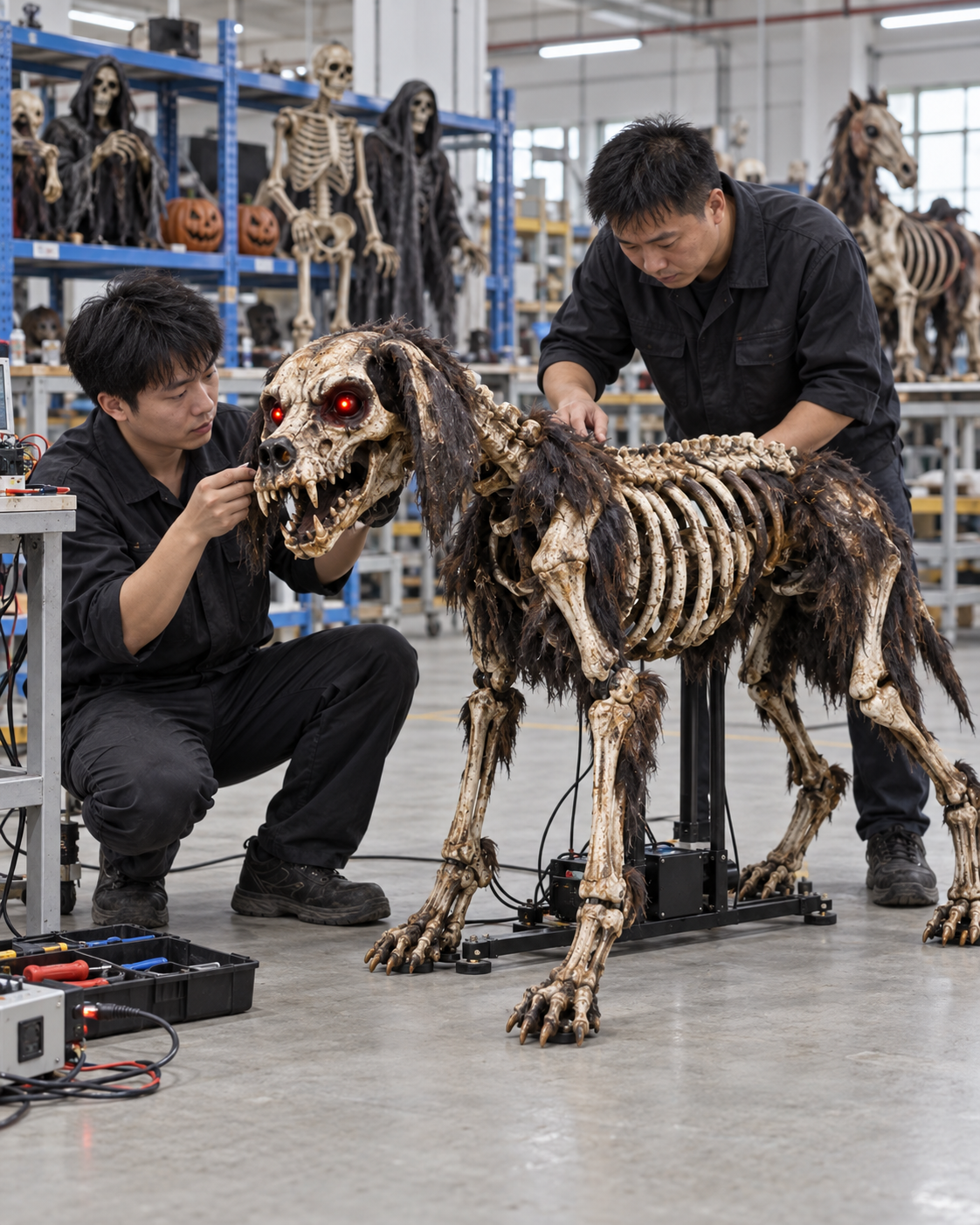
Set a reuse gate well before opening. Retrieve the identified kit, verify every component, unpack using the approved sequence, inspect condition and assemble a representative or complete unit as appropriate. Check functions under documented settings. An animatronic should complete its intended action and reset; a static scene should stand and fit as specified. Qualified local teams must review final site installation separately.
Compare the prop with last season's condition record. Did a repair hold close? Are accessories still present? Has the venue changed its route, lighting or exposure so the old product configuration needs review? A successful test last October does not automatically approve a different installation this year.
At this stage, decide whether to service, replace a component, revise the product or retire it. Avoid an opening-week emergency by setting the review date far enough ahead for supported parts and transport. The supplier's ability to provide a replacement may depend on revision and current availability; ask early rather than promising a universal spare.
Decision example: a witch prop that looks ready
Imagine a fictional venue placing an animated witch in its original carton after the season. Ten months later the costume looks clean, but a connector is missing and the return movement is hesitant. The prop was marked 'ready' based on its appearance at load-out. This is a hypothetical workflow problem, not a BooAri customer record.
A better process would identify the missing connector at disassembly, hold the asset for service and record the needed part before storage. During recommissioning, the venue would perform a complete function check before transporting the witch to the final scene. The asset might still be usable, but the decision would not depend on an improvised installation-day repair.
Suppose the original carton is crushed. The venue should replace the protective system or confirm a supported alternative before moving the prop again. Reuse is an operational capability built from packaging, records and early checks, not simply from the original product's sturdiness.
Buyer worksheet: storage and release record
For each asset, record SKU, revision, condition at load-out, cleaning completed, removed components, hardware location, case ID, storage location, environmental concerns and service owner. Attach photographs of the packed state. Keep the manufacturer's care instructions and assembly guide accessible under the same asset number.
Set inspection dates during storage and a recommissioning date before the next season. When staff remove a component, record where it went and whether the kit remains complete. Do not allow a service part borrowed for another prop to disappear from the manifest.
At the reuse gate, document a component count, surface condition, assembly check, function test, packing condition and site-specific approval still required. Release the asset only for the use reviewed. A different outdoor location or high-contact public application may need a new specification discussion.
Build the storage plan into the original quotation
Buyers often ask about reuse after a prop has already been designed for one export and one event. Raise the question at procurement. If the product is expected to be stored and reinstalled, ask how it disassembles, what its protected storage state is, which parts are likely to be serviced and whether the carton is intended for repeat use. The supplier can quote a more durable case, spare hardware or clearer labels when those needs are known in advance. The buyer can compare that cost with its actual storage and handling plan.
Decide who holds the asset. A distributor may store inventory centrally, while a venue stores its own display in a local warehouse. The storage environment and available equipment differ. Record maximum shipping unit size and mass as well as installed size. A prop that fits the event space may not fit a standard rack or service lift when packed for the off-season. The receiving team should be consulted before a reusable crate is approved.
Give stored samples a different status from service stock. A retained approved sample helps compare the next production run and should not be cannibalized for parts. If it must be used in an event, document that decision and replace the reference through a controlled approval. Similarly, a prop marked 'ready for reuse' should not be used to supply an emergency spare without updating the asset register. Clear custody prevents a healthy inventory count from hiding incomplete kits.
During the off-season, review insurance or asset-accounting needs with the buyer's own advisers if the inventory is valuable. A blog cannot specify coverage, but the operational record should identify what exists and where it is. Maintain photographs, purchase revision and condition notes. If a leak, fire or relocation occurs, the team can respond with facts rather than reconstructing the collection from memory.
At the next-season release gate, verify that the new application still matches the original product specification. A covered entrance moved to an exposed forecourt may require a different product or a qualified site review. Reuse should not become an excuse to use an old prop in a setting it was never designed for.
Questions at the next-season release gate
Is the complete kit present, including hardware and instructions? Has the product been cleaned using a supported method? Did storage or case pressure alter fabric or finish? Does an animatronic complete its approved movement and reset? Is the new site the same product application as last year? Answer these before transporting the asset to the opening scene.
If a component is held for repair, mark the complete asset unavailable rather than assuming the venue can use the remaining pieces. If the prop is retired, update inventory and replacement planning. Storage records are valuable when they lead to a clear ready, service or withdraw decision.
Reuse requires a current product brief
Before reinstalling an old prop, compare the new venue application with the approved one. A display stored after indoor use may be proposed for an exposed outdoor location, or a distant scenic figure may move into a high-contact photo zone. The asset can be in excellent condition yet unsuitable for the new use. Record the change and ask qualified site and product teams whether a revised configuration is needed. Storage condition and product suitability are related but separate decisions.
Frequently asked questions
Can props stay in their original export cartons?
Sometimes, if the cartons and inserts remain suitable for storage and future handling. Inspect their condition and follow product-specific care instructions. An export pack designed for one trip is not automatically an ideal long-term case.
Is a fixed humidity number right for every prop?
No. Mixed materials, electronics and coatings have different needs. Seek manufacturer instructions and facilities advice for the actual inventory. Prioritize avoiding moisture exposure and large uncontrolled changes.
When should an animatronic be tested for reuse?
Well before the next opening, with time to obtain supported service or replacements. Run the complete intended sequence under documented settings; do not rely only on appearance or a momentary power-on.
What should be stored with detachable parts?
Keep identified parts, hardware, instructions and protective inserts linked to the complete asset. The next team should be able to assemble the product without searching unrelated boxes.
Can a repaired prop return directly to public use?
Only after the relevant authorized checks and site approval. Record the repair, part revision and function or assembly result. A cosmetic-looking repair may affect a different product function.
Conclusion
Off-season Halloween prop storage is a controlled interval between two installations. Record condition at load-out, protect and identify every component, monitor the storage location and recommission before reuse. The reward is not a guarantee of indefinite life; it is a much clearer basis for deciding which assets are ready and which need work.
If multi-season use is part of your purchase plan, tell BooAri's project team the expected storage and reinstallation cycle. Ask for component, packing and care information suitable for the specific product you intend to buy.
Further reading
Use these external resources alongside your local market, venue and professional safety requirements:
READY TO START A PROJECT?