

A Halloween prop transit test plan defines the packed product, the distribution conditions it is intended to represent and the damage criteria used to judge the result. Choose a plan around the actual route and package, then keep the tested configuration traceable. A generic drop demonstration cannot establish that every later packing variation will arrive undamaged.
Bulky seasonal props combine several possible weaknesses: delicate protrusions, finished surfaces, loose costume layers, detachable hardware and electrical accessories. Their packaging has to control movement and contact as well as protect the exterior. Buyers should explain how the goods will move from factory to warehouse, store or venue before asking for a particular test.
This guide explains how to scope Halloween packed product testing with a supplier and competent testing provider. It describes a purchasing process and hypothetical examples, not a BooAri laboratory capability or an existing test certificate. The selected protocol and acceptance criteria belong to the actual order.
Describe the route before selecting a test
List the expected transport and handling stages. A palletized shipment to a single venue presents different handling from loose cartons redistributed as parcels to many stores. Include consolidation, warehouse storage, unpacking, local delivery and any repacking. The package may face more than one distribution environment during its journey.
Ask who handles the cartons and with what equipment. Record whether individual cartons will be carried by staff, moved on pallets or opened at a distribution centre. Identify package size, weight and any orientation limits. These conditions help the testing provider choose relevant stresses rather than selecting a method by its name alone.
The ISTA test procedure overview distinguishes test families and their intended purposes. Use it to frame the conversation with a provider, then consult the actual current procedure where applicable. An early screening trial and a distribution simulation can answer different questions. This article does not supply protocol settings or claim certification.
Separate protection questions from logistics questions
Some decisions need a transport quote or loading plan rather than a laboratory test. A package that passes an agreed protection review may still be awkward to receive through a venue's doorway. Conversely, a convenient carton can provide inadequate internal support. Define what the test is meant to establish and preserve other project checks separately.
Identify the exact packed product
Record product model, revision, dimensions, weight, visible finish, accessories and operating configuration. Then record carton, inserts, closures, protective materials and packing sequence. The tested unit should represent the version proposed for shipment. A prototype with simplified decorations may not expose the same weaknesses as the finished product.
For a mixed kit, state which components occupy each carton. A heavy base packed beside a delicate head can behave differently from the same items packed separately. Photograph the inside layout before closure and the complete outside package. This evidence helps explain a failure and gives production a reference for repeating the arrangement.
If final materials are unavailable, label the trial as preliminary. List the differences between the tested sample and the intended production unit. The buyer and provider can then decide what further evidence is needed instead of assuming an approximate sample confirms the final pack.
Choose samples that answer the buying question
Ask the provider how many samples and which configurations are appropriate for the procedure and objective. Do not invent a universal sample count. Product variability, package differences and the intended evidence may affect the plan. A buyer should understand whether the sample supports screening, comparison or a formal report.
For an assortment, select representative risk points deliberately. The tallest figure, heaviest base or most fragile accessory may deserve attention, but the heaviest item is not automatically the worst case for every failure mode. Different shapes and packing layouts can create distinct concerns.
If a family of products uses similar cartons, document why a tested configuration is considered representative and what differences remain. The supplier should not use a single successful sample as evidence for unrelated products without a reasoned review. Keep coverage claims limited to the evidence available.
Preserve traceability through the test
Assign each sample an identifier and link it to product and packing revisions. Record any pre-existing cosmetic issue so it is not confused with test damage. Keep the original condition photographs, test record and post-test inspection together. This gives the buyer a useful chain of evidence rather than isolated images.
Define acceptable condition before testing
List the conditions that matter to the order: cracks, detached parts, crushed display cartons, visible rubbing, missing accessories, failed lights or an altered mechanical action. Separate cosmetic criteria from function criteria. The buyer and supplier should agree what can be assessed and how it will be recorded.
Viewing conditions matter for appearance. A tiny mark obvious in a macro photograph may be invisible at the approved visitor distance; another defect may distort the main silhouette. Use the intended product application to define a meaningful review, while respecting any agreed retail-quality requirements.
For a functional item, identify the demonstration required after the transit test. Opening the carton and seeing an intact figure does not confirm movement or lighting. The function check should reference the approved sequence and be performed according to the product instructions by appropriate personnel.
Examine the failure mechanism
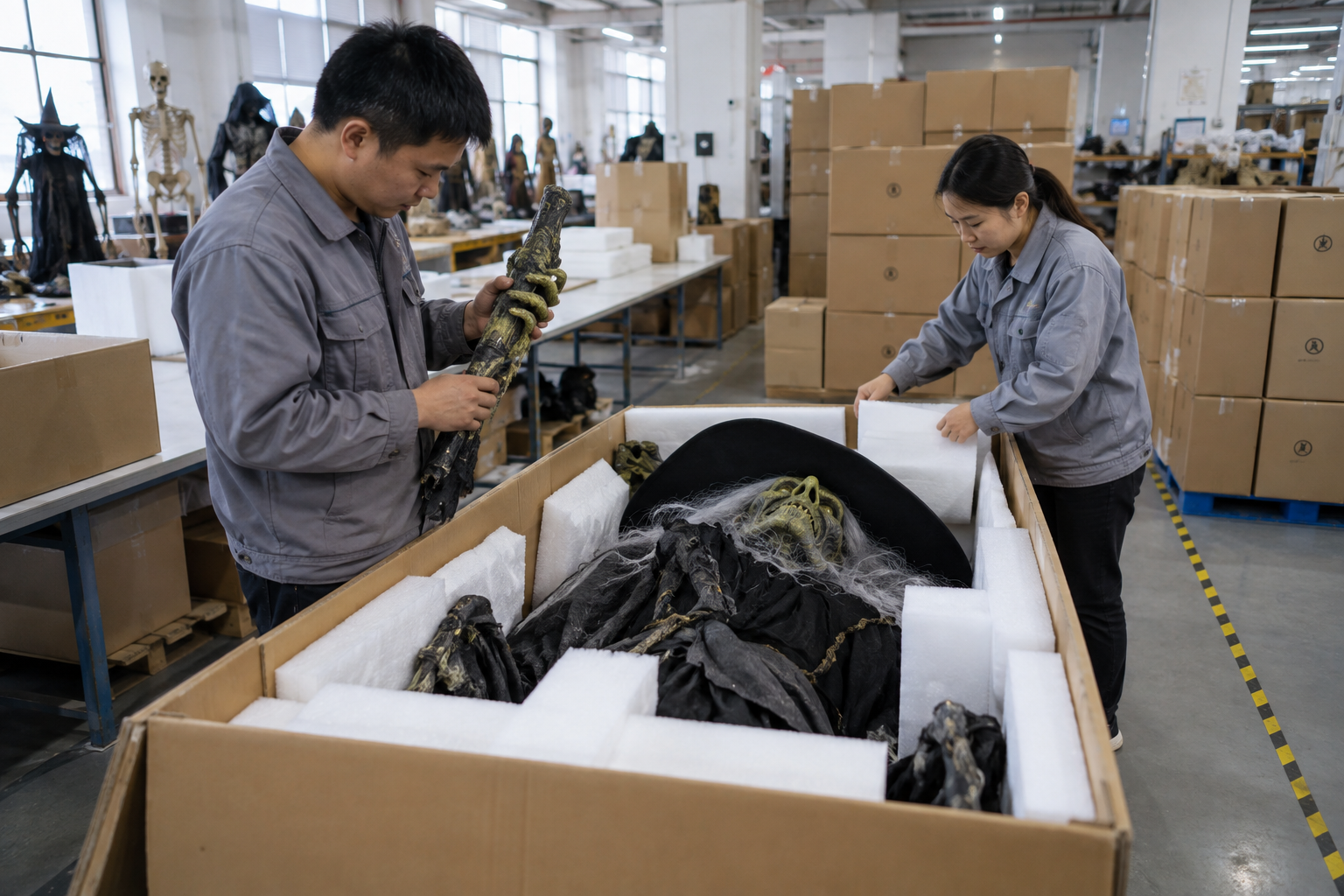
If damage occurs, describe where it appeared and how the package was arranged. A fractured protrusion can result from insufficient support, contact with another component or an inadequate separation. A crushed carton can affect the product differently depending on the insert. Document the actual condition before choosing a correction.
Inspect protective materials as well as the prop. Compression, tearing or movement marks can help the supplier understand what happened. Photographs should show the relationship between damaged product and packing, not merely a close-up of the broken surface. Keep removed materials until the review is complete.
Avoid treating every issue by simply adding more padding. More material can create new pressure points, increase handling work or prevent the product from sitting in its intended position. Compare alternative layouts with the supplier and provider, then retest the relevant configuration where needed.
Ask BooAri about a product and packing proposal with a clear route, quantity and condition criteria. Review the packing-volume guide if a protective revision changes carton dimensions, and agree the effect on freight before final approval.
Connect drop, vibration and compression questions
These terms describe different types of stresses, but the appropriate procedure, sequence and levels must be selected by the provider for the package and objective. A buyer should understand what each stage is intended to investigate rather than asking for impressive-looking footage.
A handling-impact question may focus on exposed ends or carton corners. A movement question may focus on rubbing and internal restraint. A stacking question may focus on the closed package and the support it provides. The relevant combination depends on the proposed distribution chain.
Record the order of checks and when the package is opened. Opening a package midway can change its state and affect later observations. Follow the agreed protocol and distinguish any supplementary inspection from the formal procedure. An informal video can support communication, but the written record should identify what actually occurred.
Decide when revisions require new evidence
Changes to product mass, shape, materials, accessories or packing can alter the result. Ask whether the earlier evidence still represents the revised unit. The ISTA retesting guidance highlights the need to consider product, package and process changes. Apply that principle to the actual revision rather than promising one test lasts indefinitely.
Keep a change log explaining what was altered and why. If protection improves but carton volume increases, link the test decision to the freight and receiving decision. If the product becomes larger, do not retain the old carton measurements simply because the commercial model name remains unchanged.
After approval, production should use the controlled packing sequence. Shipment inspection can check that the observed carton, inserts and component placement agree with the approved configuration. It cannot recreate every laboratory observation, but it can identify a visibly different package before dispatch.
Read a report in relation to the order
Check sample identity, product revision, package description, procedure, date, conditions and stated result. Review any exclusions or deviations with the provider. The document should make clear which configuration was tested and what the report establishes.
A report for a different item or an empty carton is not equivalent to a report for the current packed prop. A test provider's competence and the procedure's relevance are separate questions from whether the product in the report matches the order. Ask for enough information to connect them.
Avoid turning a narrowly scoped report into broad promotional language such as guaranteed damage-free transport. Real shipments include variations in handling and environment. The useful commercial claim is the documented test result for the identified sample, with the limits stated accurately.
Include receiving observations in the next packing review
After shipment, compare the actual arrival condition with the approved criteria and test assumptions. Record damaged cartons, affected components and handling circumstances that are known. Do not attribute the cause without evidence; describe the observable facts first.
Photograph intact examples as well as failures. A comparison can help identify whether an issue is local to one carton, associated with a particular item or related to an inconsistent packing arrangement. Preserve labels so the supplier can trace the affected unit and production scope.
Use the findings to refine the next order. A packaging test plan is a living purchasing record, not merely a pre-shipment obstacle. It can reveal protection needs, receiving instructions and inspection points that become more useful over repeated seasonal programs.
Buyer worksheet: choose the evidence before the test
Write the packaging test objective in one sentence: for example, assess whether the identified packaged prop remains acceptable after a distribution sequence representative of the intended route. Name the complete packaged-product revision, including product configuration, inserts, carton, closure and gross mass. Without that baseline, a pass or failure is hard to interpret and impossible to apply confidently to a later shipment. Decide who prepares samples and whether they come from production or a documented pilot run.
Then define what unacceptable damage means for this order. A scuffed shipping carton may be commercially tolerable while a cracked face, loose actuator mount or missing accessory is not. State which cosmetic variation is intentional and which interferes with the agreed visual finish. Include the functional checks to perform after unpacking, using the manufacturer's instructions and competent technicians where required. Do not decide acceptance solely by looking at the outer box or by powering an uncertain damaged unit immediately.
Ask a packaging specialist to choose the relevant procedure and intensity. ISTA's overview of procedures provides an official starting point but does not identify one universal test for all Halloween props. Record whether vibration, shock, compression or other hazards are within scope and why. A laboratory report should identify the test and sample; its title should not be represented as a blanket certification of every product and route.
After testing, connect the findings to a controlled revision. If a fragile hand needs a different insert, photograph the proposed solution and decide whether it changes carton dimensions or handling. Retest decisions should follow the nature of the change and the original evidence. During shipment inspection, verify that the approved protective method appears in the actual production cartons. A successful sample test has limited value if the factory later packs units differently.
Questions to close after a transit test
When a sample returns from testing, inspect the packed product against the acceptance criteria written before testing. Photograph any movement of inserts, contact marks and damage to accessories. Identify whether the observed issue concerns the product design, its protection or the way the sample was prepared. Changing only the outer carton may not resolve a loose internal component.
Record the report's exact scope. The tested unit, carton revision and procedure matter more than a broad claim that the product is certified for shipping. If production changes a finish, weight or geometry, ask the packaging specialist whether the old result remains applicable. A supplier should be able to explain why an unchanged test basis is still relevant, or what new evidence is needed.
At pre-shipment inspection, open selected production cartons using the approved method and compare the actual packing with the tested reference. Preserve the reclosure procedure so inspection does not leave goods less protected. Test evidence and production conformity answer two different questions and should both appear in the release record.
Frequently asked questions
Does a drop test prove a prop is safe to ship?
It provides evidence about a defined packed sample under a specific method. It does not cover every transit condition or establish that a different packing revision will behave the same way. Select the test around the distribution route and review product appearance and relevant functions after the agreed procedure.
Should the buyer specify an ISTA procedure by number?
The buyer can state a trading partner's requirement, but should discuss suitability with a competent provider. Package type, route and intended evidence affect selection. Obtain the current procedure and clear report scope. This guide is not a protocol and does not prescribe settings, sample counts or certification requirements.
What happens when the sample fails?
Document the product damage and packing condition before changing the arrangement. Identify the likely failure points with the supplier and provider, then propose a revision. Review the effect on dimensions and handling. Retest as appropriate, keeping the new product and packing identifiers connected to the result.
Can pre-shipment inspection replace transit testing?
They answer different questions. Inspection can compare produced goods and packing with the approved order; transit testing evaluates a selected package under defined stresses. Use the evidence needed for the purchasing risk. Neither automatically confirms final installation suitability or guarantees the condition of every future shipment.
Conclusion
A useful Halloween prop transit test plan starts with the route and ends with a traceable packing decision. Define the sample and acceptance criteria, choose the method with a provider, investigate failures and review changes. Keep the evidence connected to production and shipment inspection rather than treating a test video as a universal approval.
Send BooAri your item mix, route, carton proposal and condition priorities. Request a representative packed-sample review and discuss which inspection evidence is appropriate before dispatch. The enquiry form and factory overview provide a starting point for that order-specific conversation.
Further reading
Use these external resources alongside your local market, venue and professional safety requirements:
READY TO START A PROJECT?