

A suspended Halloween ghost can look light in a concept image while creating a serious installation question in a public venue. The factory can supply product mass, dimensions, intended attachment features and handling information. It cannot approve a ceiling point, select venue rigging or certify a site's load path from a remote photograph. A qualified rigger and the venue must own that design and approval.
This article is a procurement brief, not rigging instruction. It deliberately avoids specifying fastener sizes, working loads or attachment methods for an unknown building. The goal is to help a commercial buyer request the product information that a qualified professional needs before an overhead prop is ordered. ESTA's published entertainment-technology standards show the range of specialized rigging contexts; the applicable rules depend on the site and jurisdiction.
Decide whether suspension is necessary
Begin with the visitor experience. Does the prop need to float overhead, or would a floor-supported set create the same silhouette with simpler access? Suspended elements can preserve floor space and create a dramatic reveal, but they also introduce structural approval, height access, maintenance and emergency removal questions. The buyer should compare the complete installed scene, not only the cost of the decorative shell.
Map the public route and viewing position. A ghost high above an entrance may need a larger face or stronger contrast than one in a narrow corridor. A ceiling-hung spider can obscure signs, cameras or sprinklers if its envelope is not reviewed. The venue's qualified teams should assess any interference with building systems and required clearances. Do not infer acceptability from a rendering that omits these systems.
Consider movement. A static suspended object and a powered flying effect are different projects. If the scene calls for powered motion, identify that before product design begins and bring in the venue's specialist team. A decorative attachment feature on a static prop should not be assumed suitable for moving loads.
Draw the complete spatial envelope
Record maximum height, width, depth, any projecting costume or limbs, intended orientation and the zone the object occupies when installed. Distinguish product dimensions from the space needed for rigging hardware, safe access and maintenance. The qualified installer will determine final clearances. A supplier's product drawing should be detailed enough to support that assessment.
Provide accurate mass and product construction information
The factory should state the mass of the finished configured prop, including costume, lights, accessories and any internal equipment. If the product can absorb water, collect debris or carry other temporary items, the design team needs to discuss those conditions explicitly. Do not use a catalogue weight for a customized version with different materials. Weigh or calculate the actual approved configuration and state how the figure was obtained.
Document the product-side attachment features and their intended use. Are they engineered attachment points or merely handling loops used during assembly? Where are they located relative to the centre of mass? Which parts are removable? The factory should provide drawings and any relevant product-side evidence to the qualified rigger. The rigger then determines whether the product and venue solution are suitable; neither party should guess what the other assumes.
For a multi-part prop, identify the mass and connection of each section. A loose decorative hand, hat or fabric layer can become a separate overhead concern. Decide what is permanently attached, what is installed at height and what remains a serviceable component. A bill of materials and assembly instruction should match the approved sample.
Keep venue rigging and product manufacture separate
The supplier may design a prop with defined attachment interfaces. The venue or appointed specialist evaluates building structure, rigging hardware, lifting method, local rules and approval. Do not ask an overseas factory to declare that any ceiling will support the prop. Conversely, do not ask a venue rigger to compensate for an undocumented product-side attachment that was never designed for suspension.
Establish a responsibility matrix early. Product drawing and configured mass: supplier. Site survey and structural point approval: venue's qualified professional. Installation method and crew: appointed installer. Final operation and inspection: venue according to applicable rules. These roles may be contracted differently, but they should not be left implicit.
If a venue cannot approve the overhead approach, the buyer needs a fallback before production. A floor-standing version, wall-mounted scenic element or different location may preserve the creative intent. A custom suspended shell that cannot be installed is not a successful purchase, no matter how good the paint looks at the factory.
Plan power, light and service access
If the prop contains light or sound, describe the product-side power and control requirements. The site electrical team plans supply, protection and routing under local requirements. A cable draped visibly from the prop may ruin the scene, while one hidden without service access can create maintenance problems. The supplier should show where cables exit and which panels open, and the venue should approve the route.
Ask how the object will be cleaned, adjusted or removed. A decorative costume may gather dust; an LED may need replacement; a hanging angle may need correction after the first trial. Maintenance access should not require an improvised reach over a public route. The venue's operating team needs a documented method and schedule from its qualified installer.
At factory testing, the supplier can assemble the prop in an appropriate controlled setup and demonstrate lights or other quoted functions. That test does not approve the destination's support structure. At shipment inspection, check the product-side attachments, parts, labels and packing against the approved revision. Site installation and acceptance remain a distinct stage.
Protect the prop during export and load-in
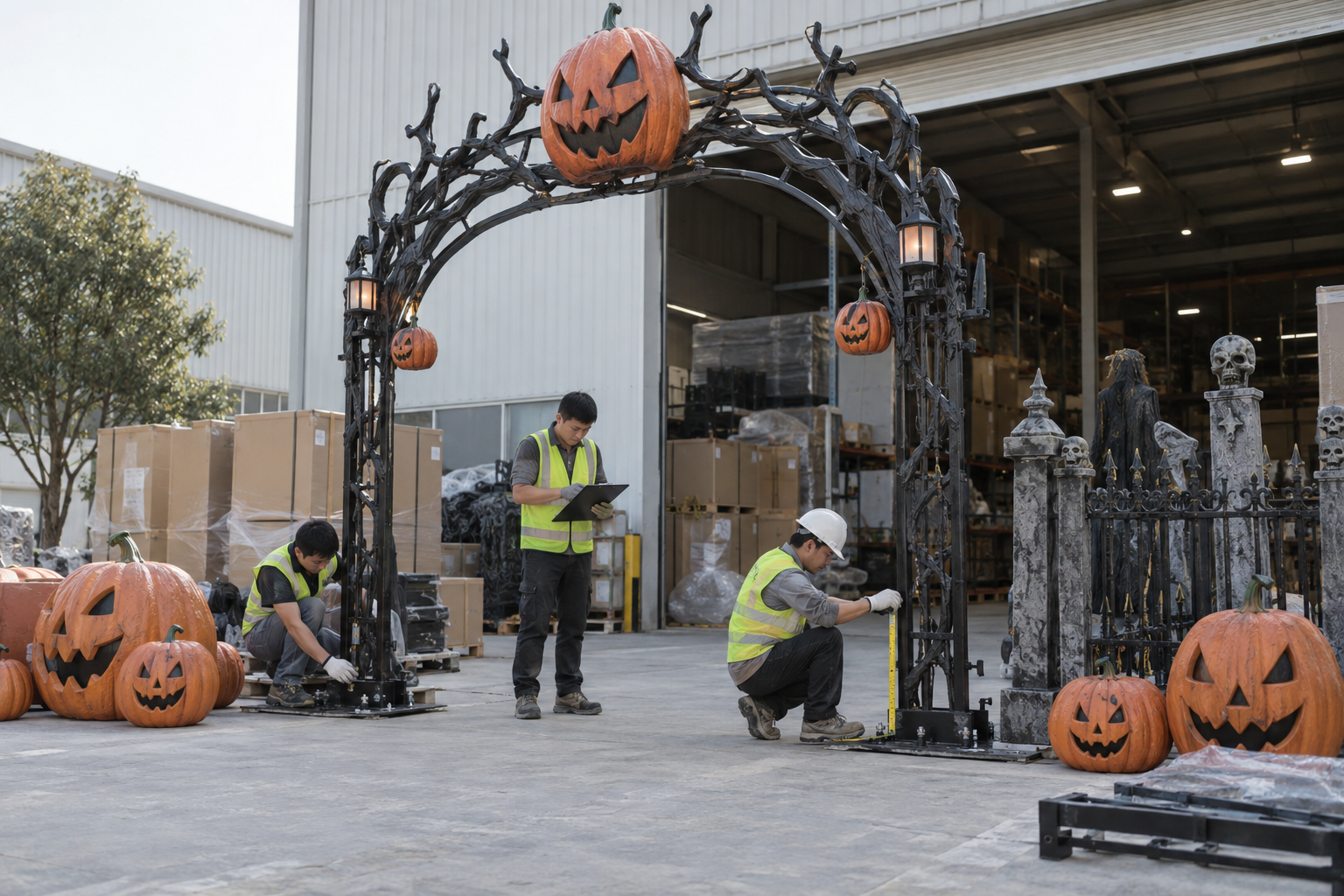
Irregular suspended pieces often include projecting limbs, fabric and fine finishes. Specify how these are protected and whether they ship detached. The packing list should identify the configured mass and each shipping unit's gross mass. Site staff need to know how to lift the item without using decorative fabric or unapproved attachment loops as handles.
Plan the load-in path. Does the prop pass through doors and lifts? Is there a clean area to unpack and assemble it before the rigging crew takes over? A large hanging figure may be easier to ship in modules, but every module adds a connection and identification task. Compare the packed state with the rigging plan before approving the order.
The installation preparation guide covers general site planning. This guide is narrower: the product-to-rigging interface. If the buyer expects a single vendor to coordinate both, the quotation must clearly include a qualified local rigging scope rather than letting the term 'installation included' hide responsibility.
Decision example: a mall atrium ghost
Imagine a fictional mall requesting a suspended ghost above a seasonal photo zone. The design mockup shows a three-metre figure hanging in the atrium. Before ordering, the buyer requests the prop's configured mass, maximum envelope, product-side attachment drawing and lighting connection. The mall appoints a qualified rigger to review the actual overhead points and the venue checks building-system clearances. This is a hypothetical workflow, not a BooAri project claim.
The rigger finds that the preferred position conflicts with an existing service requirement. The creative team moves the ghost to another location and adjusts its size. The supplier updates the product drawing and quote before fabrication. The final result may be less visually central than the original render but is a buildable, reviewable project.
If the buyer had approved the shell first and asked rigging questions after delivery, it might have faced redesign, storage cost and a missed opening. The lesson is to use site approval as an input to procurement, not as a final decoration task.
Buyer worksheet: hand a qualified team the right facts
Create a product data packet with installed dimensions, configured mass, centre-of-mass information where available, product-side attachment drawings, assembly sequence, removable components, power and control needs, intended orientation and maintenance access. Mark all information with the product revision. Add a clear statement of what the supplier has and has not tested.
Send the packet to the venue's qualified rigger and relevant site authorities before the order is frozen. Ask them to return installation constraints and any required design changes. Record who approves the venue point and who performs installation. A supplier should not be asked to supply a false 'universal hanging certificate' for unknown sites.
After a sample is made, compare it with the approved packet. If an accessory, costume or frame changes, reassess the mass and interface before bulk production. At final acceptance, the venue should record the installed configuration and the party responsible for periodic inspection and removal. The product and site records belong together but answer different questions.
Make a fallback part of the procurement decision
Overhead concepts have a greater chance of being changed by site review than floor scenery. Before approving a custom shell, define a second use if the intended hanging point is rejected: a wall-backed pose, floor base or alternative location. The fallback must be reviewed for appearance and product construction; it is not permission to drill a new hole into a finished prop. A supplier can quote two designed configurations or a controlled conversion option if the buyer provides site facts early enough.
Ask the venue what documentation it needs to review the proposal. Some teams may need mass and product-side interface drawings; others may request more detailed engineering evidence for the actual object. The factory should state what it can provide and which tests, if any, have been performed. Avoid using the word 'certified' without naming the standard, scope, issuing body and exact configuration. The qualified site professional remains responsible for the local support design.
At delivery, keep rigging-related product parts segregated and identifiable. Decorative costume elements can resemble straps or loops but may have no structural purpose. Label actual product attachment features and supply an assembly drawing that does not leave the installer to infer the load path from appearance. If an interface was revised after sample approval, send the update to the rigger before the crew starts work. A surprise at height is much harder to solve than a drawing question weeks earlier.
Finally, plan the removal. A seasonal prop must come down without damaging the venue or exposing staff to an improvised process. The venue's qualified team owns the method, but the product design can help by making components accessible and documenting the reverse assembly sequence. A purchase brief that includes installation but ignores removal is incomplete for a temporary Halloween event.
Questions for the qualified rigging handoff
Has the venue received the actual configured mass and dimensions, including accessories? Are product-side attachment features documented for the intended purpose? Has a qualified professional reviewed the specific site support and installation route? Is there an approved fallback if the preferred point is unavailable? The buyer should not authorize fabrication from a hanging render alone.
At arrival, check that all product-side parts match the reviewed drawing. A changed costume, added light or substituted frame can alter the basis of the rigging review. Stop and update the qualified team rather than asking installers to solve the discrepancy at height. Preserve the approved drawing with the venue's installation record.
Request evidence proportionate to the overhead risk
The product packet should identify what has actually been reviewed and tested. A visual sample is not proof of attachment capacity, and a product-side test is not approval of the venue structure. Ask the qualified rigger what product evidence is needed for the specific installation, then ask the supplier whether it can provide it. If it cannot, revise the design or site plan before placing the order. Do not fill a documentation gap with a generic certificate image.
Site teams should also plan access after installation. If a lamp or fabric element must be serviced, the prop should not require an unapproved shortcut at height. Record who may inspect it, how it is removed and which product components are replaceable. The buyer's purchase decision should include this operational cost.
Frequently asked questions
Can BooAri specify the ceiling hook for my venue?
Not from a generic product brief. The venue's qualified rigger or engineer must assess the actual structure and applicable rules. BooAri can provide the product-side information needed for that review.
Is a hanging loop the same as an engineered attachment point?
No assumption should be made. Ask for the manufacturer's documented purpose and evidence for the particular feature. A loop used to move a sample around a workshop may not be intended for public overhead suspension.
Can the same prop be suspended outdoors?
Outdoor use adds site-specific exposure and structural questions. A successful indoor installation does not approve an outdoor one. The relevant professionals must review the actual product, weather conditions, support and local rules.
Should electrical function be tested at the factory?
Yes, against the agreed product configuration, but a factory function test does not approve destination wiring or rigging. Qualified local teams should commission the installed system.
What if the venue rejects the proposed suspension point?
Pause product approval and review a different location, support concept or floor-standing alternative. Update dimensions, appearance and quotation before production instead of improvising on site.
Conclusion
A suspended Halloween prop is a product-plus-site project. The buyer should obtain accurate mass, geometry, attachment and service information from the supplier, then place the overhead installation under qualified venue control. That separation makes a dramatic effect possible without pretending a catalogue image can approve an unknown ceiling.
Send your venue plan and creative reference to BooAri's custom project team. We can discuss product dimensions, finish and product-side documentation for your appointed rigging professional to review.
Further reading
Use these external resources alongside your local market, venue and professional safety requirements:
READY TO START A PROJECT?