
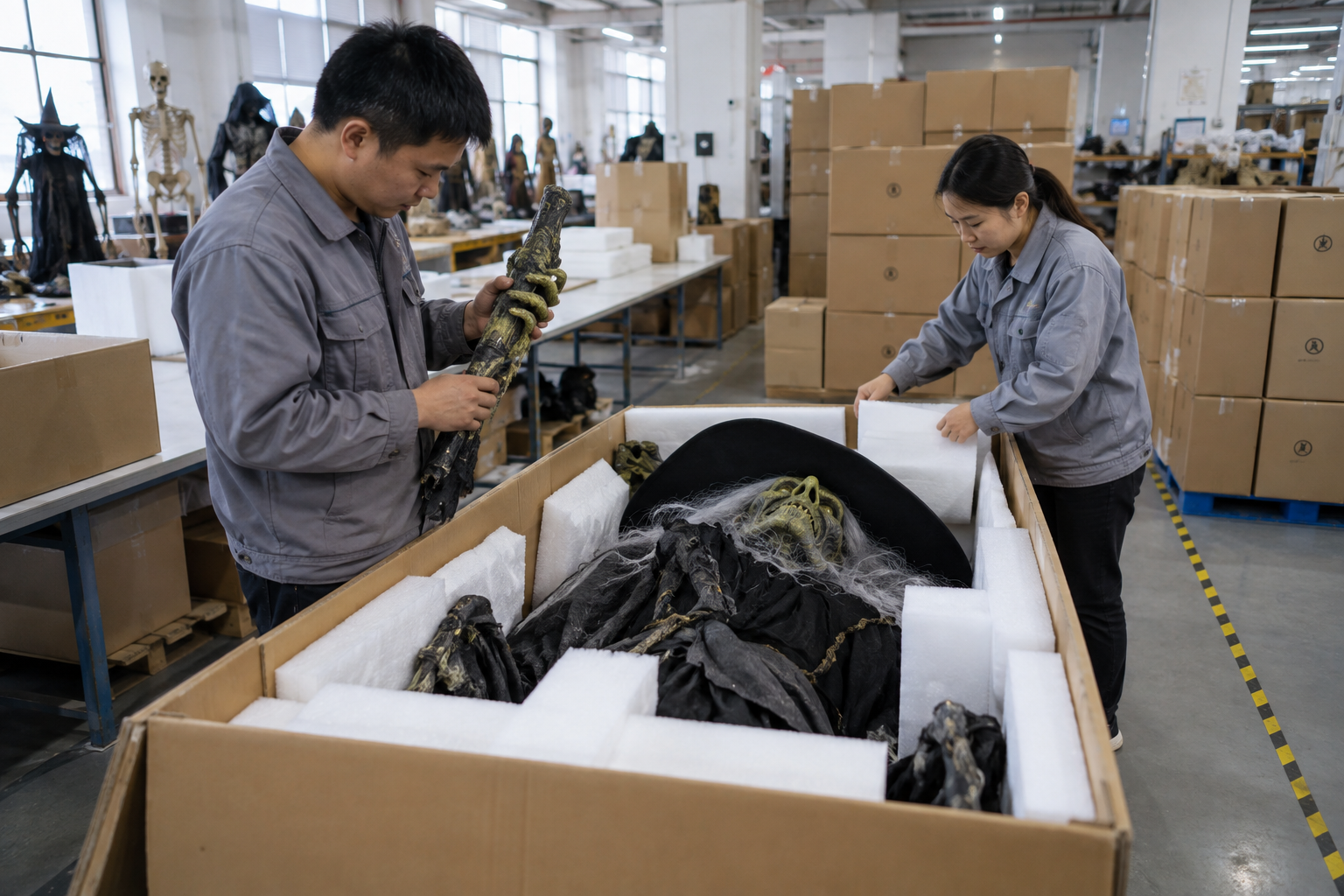
A touring Halloween display can be complete at the first venue and incomplete by the third without any single dramatic loss. Small adapters, bases, costume pieces and protective inserts move between cases; a repaired component returns under a new name; a site-specific cable gets packed with the wrong scene. A touring asset manifest makes each prop and its parts identifiable across load-in, operation, load-out and repair.
This guide is for event companies and attraction operators moving one display between multiple venues in a season. It is not a claim that a generic barcode system is required or that BooAri has operated a particular tour. The best tracking method depends on team size and venue workflow. GS1's logistics label guideline is a useful reference where partners use standardized logistics identification, but a well-controlled human-readable system can also work for a smaller tour.
Treat the display as an asset, not only a shipment
The original export packing list tells the importer what left the factory. A touring manifest must answer what the operator currently owns, where it is, what condition it is in and what is needed for the next venue. Create an asset identifier for each complete prop and component identifier for the pieces whose loss would prevent assembly or operation. Link them to their cases, spare parts and latest approved revision.
Decide the unit of tracking. A static pumpkin may be tracked as one object. A three-part entrance gate needs separate frame, scenic panel and hardware kit records, even if the public sees one gate. An animatronic may require controller, trigger, power and costume components tied to the main asset. Avoid tracking every disposable cable tie while overlooking a unique connector that cannot be replaced on the road.
Record which components are shared and which are matched. Two apparently identical controllers may carry different settings or revisions. If swapping them is unsupported, identify them individually. A spare can be shared only when compatibility is documented. This prevents an emergency repair from turning one failed prop into two.
Build a case map
Number every reusable case or carton. State what belongs in it, where each part sits and which asset it supports. A photograph of the open case can be helpful if it shows the final protected arrangement. Keep the packing sequence and case map accessible to the touring crew. The next load-out should return items to the same protected positions, not merely close the lid on everything that fits.
Establish a condition record at every handoff
At load-in, check case count, external damage, component count and obvious product condition before assembly. Record exceptions promptly. After installation, note any adjustment or site-specific substitute. At load-out, inspect surfaces, functions and case protection again. A problem recorded at one venue can be repaired before the next rather than discovered during the following opening rehearsal.
Use a simple condition scale with action attached: ready, service before next use, hold for assessment or withdrawn. Do not use a green mark when a prop is only cosmetically present but cannot complete its function. For an animatronic, record the full cycle and any unusual sound or return behaviour under the documented settings. For a static gate, check joints and visible finish after disassembly.
Photograph damage against asset and component identifiers. 'Broken witch arm' may describe several units; 'WITCH-03 right arm joint after Venue B load-out' is actionable. The record should not assign blame automatically. It describes condition and the work needed for safe next use.
Keep site-specific parts separate from core kit
Some venues require a different base, cable length, graphic panel or local fixing solution. Mark these as site-specific rather than mixing them into the core case. The supplier's product assembly instructions should state what the factory provides; the venue's qualified team documents its local installation. This distinction matters when the tour moves to a venue with different structural or electrical conditions.
For a multi-venue route, use a site sheet with floor plan, loading dock, access dimensions, power, operating schedule, approved installation and removal notes. Do not assume that a prop working at Venue A is automatically suitable for Venue B. A very large gate may fit one doorway but require module changes at another. Confirm those constraints before shipping the cases onward.
The reusable-connection guide explains why repeated assembly can affect joints and labels. The touring manifest adds a location and condition layer to that technical design. One without the other is incomplete.
Design for rapid but controlled load-out
Seasonal tours often have tight overnight moves. Speed should come from preparation: labelled parts, known tools, clear cases and assigned roles. Rushing an undocumented dismantling can damage finishes or leave small parts behind. Make a reverse-order checklist for the product's approved assembly sequence. Include photographs of the correct packed state.
Count at the point of release from each venue, not only at arrival to the next. If a component is missing, the previous site can still be searched. If the discrepancy is discovered several days later, the opportunity may be gone. A two-person sign-off or electronic scan can be useful for high-value assets, but should not become a ritual that no one verifies against physical contents.
Keep protective packaging in the case. If foam inserts are crushed or missing, the asset may need a different packing solution before the next transport. A case with a readable label but poor internal protection is not tour-ready. Ask the supplier whether replacement inserts or cases can be supplied by reference to the approved pack revision.

Manage repairs and revisions during the tour
When a component is repaired or replaced, update the asset record. Note who authorized the work, which part revision was installed and whether the relevant function or assembly check passed afterward. Do not put a repaired unit back into service based solely on a technician's verbal 'should be fine'. The tour manager needs a release state before booking it for the next venue.
If a new component is not identical to the original, review compatibility. A replacement controller may require different settings; a decorative panel may have a different attachment. Record the change and ensure the receiving crew gets updated instructions. A touring inventory that tracks quantity but not revision can still fail operationally.
Do not improvise structural or electrical repairs at a venue without qualified support and the manufacturer's procedure. A temporary cosmetic workaround may be acceptable for a distant scenic element if approved, but it should not hide an unresolved safety or function problem. Keep a clear hold status.
Decision example: a case that is full but incomplete
Imagine a fictional touring haunted gate with four cases. After the second venue, all four cases are present, but a bag of specialised joining hardware was placed in a technician's toolbox rather than its identified case. At the third venue, the gate cannot be assembled. The case count was correct, yet the asset manifest was incomplete. This is a hypothetical example, not a BooAri tour record.
A component-level checklist would have flagged the missing hardware during load-out. The crew could have recovered it before leaving or activated a documented spare. The example shows why physical shipping units and installable sets are different concepts. A good manifest must connect both.
Suppose the tour also discovers a scuffed scenic panel. The condition log records it, and the operator decides whether the mark needs supported touch-up before the next venue. The repair record stays with the panel identifier, not only with the overall gate. This prevents the same issue being rediscovered every week.
Buyer worksheet: the minimum viable manifest
List asset ID, product name, revision, complete-set contents, component IDs, case IDs, spare items, last known location and release state. For each venue, add dates for load-in, operation and load-out, plus the person who signed the condition check. Keep site-specific equipment on a separate tab or clearly marked column.
Photograph each packed case and fully installed asset at the start of the tour. Update the images after an approved revision. An image is useful only when linked to the correct asset and date. Store operating instructions, factory testing reference and supported repair contacts with the same record.
Before a case leaves a venue, perform a two-way reconciliation: every item on the manifest is physically present, and every physical item has a manifest place. Mark damaged or missing items as exceptions rather than silently adjusting the count. This gives the next venue a trustworthy starting point.
Connect condition records to the route calendar
A tour manifest becomes much more useful when it predicts the next decision. At each load-out, identify whether a prop is ready for the next booked site, needs service before dispatch or cannot travel. Put the service deadline next to the next load-in date. A repair that can be completed in two weeks is irrelevant if the next venue opens in three days. The tour manager can then choose a substitute, split the scene or change the transport plan while alternatives still exist.
Use a component criticality column. A missing decorative rat may reduce detail but not stop the scene. A missing controller or gate connection may make an entire asset unusable. This does not mean low-priority pieces can be forgotten; it allows the team to triage. Keep spare counts and compatibility visible. A spare labelled for revision A should not be assumed to fit revision B just because its shape appears similar.
Review case loading as part of each handoff. The original factory pack may not be followed once a tired crew repacks after midnight. Include a photograph or simple diagram inside the case and check that inserts, straps or dividers are intact. If the case cannot close without pressure on a fragile feature, stop and repack correctly. A touring system fails when the protective design exists only in the first shipment photograph.
After every venue, keep a short note about site-specific work: local base, cable route, access constraints and how long assembly actually took. Do not copy those instructions blindly to the next site. Instead, use them to refine the next venue's planning questions. The asset's core specification remains stable, while each site receives its own installation review. This avoids a false sense that the tour is 'the same setup everywhere'.
At the end of the route, compare manifest exceptions with the purchase brief. Did the original design need more spare connectors, clearer case labels or a different costume material? Ask the supplier to review specific evidence and quote a targeted revision. A tour creates valuable experience data, but only if the identifiers and condition notes can be traced back to the exact product revision.
Questions at the next venue release gate
Does every case contain the components listed for its asset? Which items were held for service after the prior load-out? Are replacement parts compatible with the current revision? Does the next site's layout, power and access still suit the prop? These questions should be answered before the truck departs, not in the next venue's loading bay.
Ask the crew to run the approved assembly and function checks on assets with recent repairs. Record the result against the asset ID. If one component is missing, decide whether a supported substitute exists or the scene must change. A manifest is useful because it makes that decision early and specific.
Keep touring records usable under time pressure
The manifest should work on a loading dock, not only in an office. Use short component names, clearly printed case identifiers and a way to record exceptions without internet access if necessary. The crew should be able to see which case contains the base, which parts are shared and which items are on hold. A detailed database that no one updates after midnight is less valuable than a concise accurate list.
Before departure, compare the physical cases with the manifest in both directions. Count assets, then investigate any unlisted item. This last check can catch a component borrowed from another scene or a site-specific cable packed by mistake.
Frequently asked questions
Do touring props need individual asset numbers?
For reusable multi-venue displays, individual numbers are usually helpful. At minimum, identify complete props and the components whose loss or mismatch would prevent installation. The level of detail should fit the operational risk.
Is a case count enough?
No. A full case may contain the wrong parts, and a complete set may be spread across several cases. Link case identity to the component list and perform a contents check at meaningful handoffs.
How do we track site-specific bases or cables?
Record them as site-specific and do not mix them with the core product kit. The next venue should receive only approved components and its own installation instructions.
What happens after a field repair?
Record the repair, part revision, authorized person and relevant recheck. Release the asset only after its condition is assessed for the next use. Keep unsupported repairs out of the operating set.
Can the original export carton be reused for touring?
Possibly, but check its condition and repeated-use suitability. The original pack may have been designed for one export journey. A reusable case or replacement insert may be more appropriate for several load-outs.
Conclusion
A touring Halloween display needs a manifest that tracks not just where cases are, but whether the correct components are present, protected and ready for the next venue. Identify parts, record condition at each handoff and make repairs traceable. The result is a faster setup built on evidence rather than optimistic case counting.
If you plan to move a display between sites, send the venue schedule, expected reuse and component requirements through BooAri's project form. Ask for product and packing information that can support a real touring manifest.
Further reading
Use these external resources alongside your local market, venue and professional safety requirements:
READY TO START A PROJECT?