
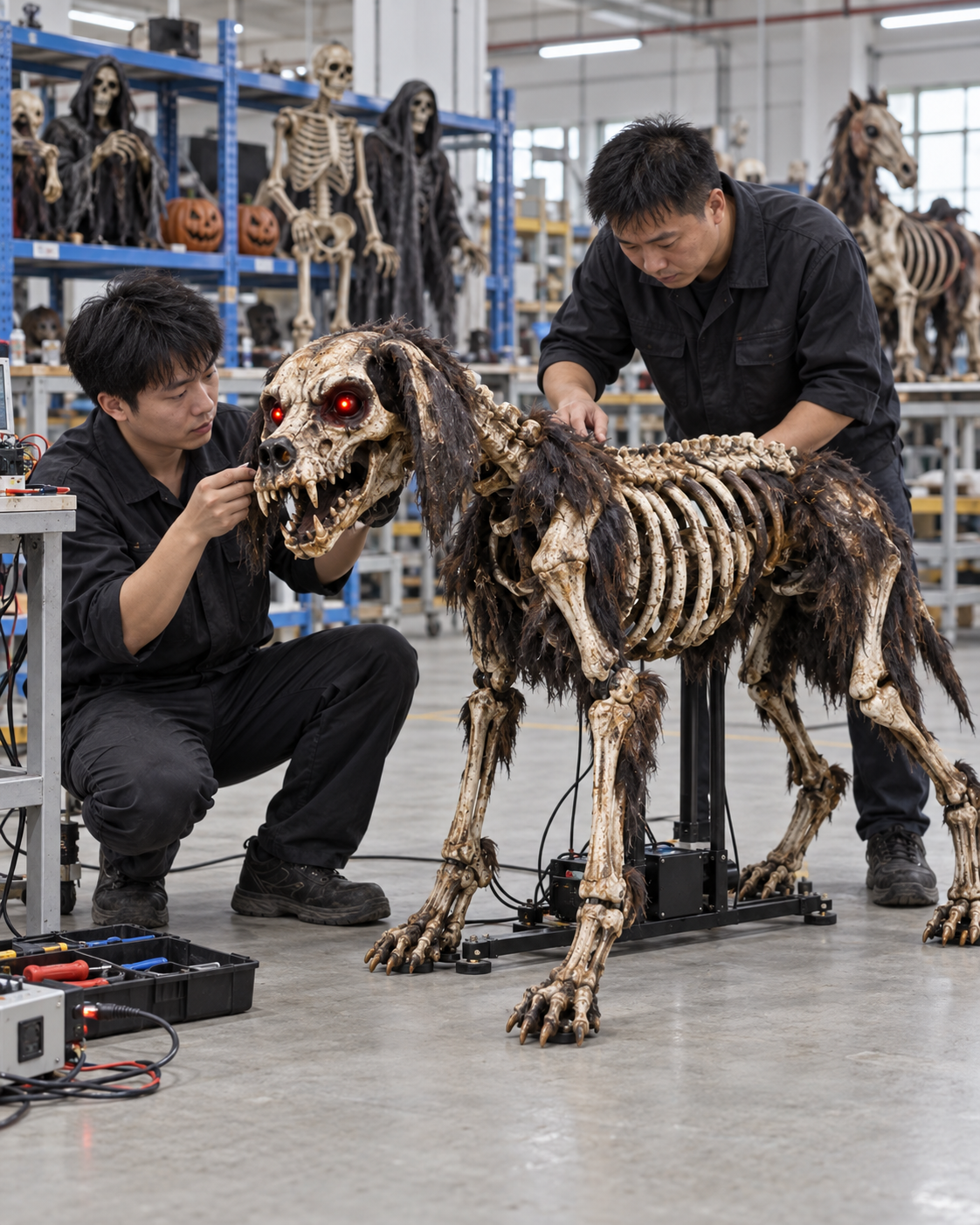
Commercial Halloween buyers sometimes select a battery-powered prop because it avoids a visible cable. That may be correct for a short, mobile activation, but it adds charging, battery inventory, downtime and transport questions. A mains-powered unit may suit a fixed venue with planned power, yet its cable, connector and local electrical installation must be reviewed. There is no universally safer or cheaper power route.
This guide helps specify the operating decision. It is not electrical design advice. Battery transport is a separate compliance issue; PHMSA's lithium battery shipper guide illustrates why chemistry, configuration and mode must be identified before freight is booked. Ask qualified local electrical staff to review actual connections and venue rules. For a broad overview of lighting, see the commercial Halloween lighting guide.
Describe the effect and operating schedule
List the functions that draw power: lights, motor, speaker, controller, wireless receiver or sensor. Define when each runs. A prop that flashes briefly on trigger has a different power profile from one that holds bright light all evening. Ask the supplier for a representative power test on the proposed configuration; do not calculate runtime from a catalogue claim without knowing the actual duty cycle and battery state.
Record the venue schedule: open hours, overnight shutdown, setup time, charging window and who performs daily checks. A portable battery unit may still need spare charged modules and a safe charging location. A mains unit may need a fixed outlet, protected route and an approved switching procedure. Choose based on the whole operation, not the absence of a visible cord in a photograph.
Define acceptable loss of effect
If a photo zone light fails midway through a shift, can staff replace a module within minutes? If a moving attraction prop stops, does the route remain safe and understandable? The criticality of the effect informs backup and monitoring. Write the acceptable response procedure before choosing a power source.
Compare installed footprint and public contact
Battery compartments require access, retention and protection from accidental operation. Mains adapters and cables require physical routes that visitors, carts and cleaners will not damage. Examine both during a site mock-up. A battery can make the visible display cleaner while adding a locked cabinet nearby; a mains supply can keep the product light but create a cable crossing that the venue will not accept.
Ask for the complete power chain, including adapter, charger, connector, extension arrangement and local plug interface. The quotation should say what is supplied and what the site provides. Do not assume a voltage marking means the entire installed system meets local requirements. The electrical safety article explains why the finished configuration and destination market matter.
Where the display is exposed to weather, neither battery nor mains makes it automatically suitable. Enclosure, seals, connectors, drain path, support and site wiring need product-specific and local review. Avoid using 'cordless' as a synonym for weatherproof or child-safe.
Measure battery runtime under a realistic trial
Agree a factory trial with the actual effect sequence, intended brightness or movement setting, charge state and a recorded start and stop point. Repeat if the first run is unrepresentative. Record temperature and any protective shutdown observed, but do not extrapolate a guaranteed lifetime from one demonstration. A buyer may set a required operating window with a margin agreed by the technical team.
Ask whether modules are removable and how they are identified. If the venue expects one replacement per day, plan where charged and depleted modules are kept. Record who may change them, how accidental activation is prevented and how defective modules are isolated. The supplier should provide product-specific instructions. Local fire and facility rules may limit charging areas or storage methods.
For mains units, request a representative continuous run and restart demonstration. The technical team should review startup current, controller behaviour after a power interruption and any need for a supervised reset. Again, a factory test supports product acceptance but does not certify the venue installation.
Price the support process rather than the battery alone
Compare the prop, power supply, chargers, spare modules, staff time, replacement access, freight classification and future battery sourcing. A mains system needs a site power and cable budget; a battery system needs a charging and inventory budget. The relevant numbers vary by the site and SKU, so request current quotations instead of using a universal cost-per-hour figure.
A hypothetical pop-up display open four hours per night might accept removable battery modules if a managed charging process exists. An eight-week static installation with permanent nearby power might favour a mains route. Neither is a BooAri performance promise. The buyer should build a scenario for its own operating hours and staff capacity.
Inspect what will actually ship
At shipment inspection, verify the power configuration, supplied adapter or battery type, charger, labels, spare count and accessories against the approved bill of materials. Demonstrate the visible function with the production controller setting. If batteries are included, have the responsible shipper and carrier review the actual battery configuration and documentation. Do not ship first and ask the forwarder later.

Build a decision sheet for the venue
Score each option against six questions: can it meet the operating window; can the site provide the required power or charging; can staff access the power components; can a failure be recovered within the venue's tolerance; can the package be shipped on the chosen route; and can the unit be maintained next season? If any answer is unknown, ask for a sample or local review before freezing the design.
Include an end-of-day checklist with shutdown, visible damage, charge state or disconnection, and the next shift's responsibility. A strong product application plan connects factory testing to daily use. The buyer can specify a battery version and mains version as separate variants only if both are evaluated and labeled distinctly.
Model the daily power routine before procurement
Write a sequence from venue opening to closing. Who verifies that a battery is charged or a mains supply is available? Who energizes the prop, checks its effect, records a fault, turns it off and leaves it safe overnight? Count actual staff interventions rather than assuming battery means 'set and forget'. If several mobile props share chargers, create an inventory of chargers, modules and charging locations. If the site cannot assign a responsible person, a power configuration that depends on daily swaps may be a poor fit.
For a battery option, ask the technical team to test representative operating cycles at the chosen visual settings. Record start charge, effect sequence, ambient condition and observed end point. Repeat on a production-like unit where possible. A catalogue's idealized runtime may not include sound, movement and bright LEDs together. Allowance for battery aging and operational contingency is a venue decision; the supplier can state what it tested, not promise indefinite operation.
For a mains option, walk the cable route from approved outlet to prop. Include connections, protection, adapter location, safe shutdown and who inspects damage. The installed supply may need local professional work beyond the product quote. Add its cost and schedule to the comparison. The battery option still needs destination-market and freight review. The whole-system assessment may reverse a quick conclusion based on unit price.
Compare an emergency substitution scenario
Ask what happens if the selected power source fails on a busy night. A removable battery module may be replaced by trained staff if the approved design permits it; an integrated pack may require the prop to be removed. A mains adapter may be easily swapped if it is accessible and correctly specified, but improvising a different adapter can damage the system. Identify authorized spare parts and the stop-use rule in the handover.
If a venue wants both battery and mains variants, define them as controlled configurations with separate sample tests, labels and packing. A single SKU with undocumented power options can confuse warehouse picking and support. Record which variant is shipped to each site and which accessories accompany it. This avoids a unit arriving with the wrong charger, adapter or operating instructions.
Decision review: make the evidence comparable
Before selecting a quotation, write a one-page decision record for choose power architecture. Start with the customer requirement, not a supplier feature. The same installed dimensions, destination, display period and approval date should appear on every option being compared. If two offers use different product scope, record the difference as a separate alternate. Otherwise a cheap option may simply omit work that the other bidder included.
For this guide, the useful sample is the exact lighting or motion sequence running on each complete power configuration. Ask for its revision and say what it can and cannot demonstrate. The critical inspection focus is run time, restart behaviour, accessible controls and supplied accessories. Set the viewing or operating condition in advance, then photograph or record the outcome. The person approving the sample should know whether a visual result, a technical function or a packing action is being accepted. One attractive image does not cover all three.
The packing question is battery inventory or adapter identity in the final carton. Measure or verify the proposed shipping unit rather than assuming an installed dimension will predict freight. At the site, the practical question is whether the venue can charge, isolate or connect the display within its daily routine. Ask the receiving and operations teams to answer it before the purchase is called complete. If they cannot answer from the supplier's proposed evidence, the project has an unresolved interface, not merely a documentation preference.
Keep a short decision log
Create columns for requirement, offered configuration, evidence, owner, approval status and unresolved risk. Mark evidence as a physical sample, drawing, supervised test, production record or professional site review. Those are not interchangeable. A factory test can validate a product function; it cannot approve unknown local conditions. Conversely, a site plan can show access but not prove the final batch matches the sample. Give each open item a person and date rather than leaving it in an email thread.
Challenge the proposal with a failure scenario
Imagine that a portable unit stops before closing because the charging handoff was never assigned. Ask what the operator would first observe, what should be stopped, which record identifies the affected unit and what corrective action can be checked. This is a stress test of the proposed purchase, not a claim that the failure has happened in a BooAri project. The answer may reveal a need for a revised sample, a clearer part ID, a different pack, or a local professional decision.
One viable route to examine is a managed spare module or a qualified mains route rather than a larger battery by default. It is an option to test, not a universal prescription. Estimate its effect on price, lead time, appearance, freight and maintenance. If the alternative changes the approved specification, issue a new revision and repeat the affected checks. Do not rely on verbal assurances that the change is minor. The buyer should be able to trace why the new option was accepted.
Close the record only when the buyer, supplier and destination owner agree what will be shipped and what remains a site responsibility. At shipment inspection, compare the production item and documents with that decision record. If the product arrives later with a changed component, the record tells the team which approval must be reopened. This discipline is more useful than a vague claim that a prop is 'commercial grade' because it ties the actual purchase to observable evidence.
Final power-choice release question
Before ordering, ask the venue to confirm who owns power readiness on the first day of installation and on every subsequent operating day. A battery prop may require a charging rota and secure spare storage; a mains prop may require a reviewed outlet and protected cable route. Put the chosen routine beside the product specification so marketing, operations and procurement approve the same real-world arrangement.
At shipment inspection, verify the exact variant and all power accessories. At arrival, the qualified local team should run the function under site conditions and record the result. A later site change, such as moving the prop to an exposed location, should trigger review. The original battery-versus-mains choice was made for an application, not for every possible location.
Frequently asked questions
Are battery Halloween props safer because they lack mains cables?
Not inherently. Battery design, charging, access and fire rules still matter, while mains cable risks depend on the site installation. Use qualified review.
How should runtime be specified?
Define the exact effect sequence, settings and required operating window, then test a representative finished unit under agreed conditions.
Can one prop support both options?
Possibly, if the manufacturer designs and validates each configuration. Do not assume an adapter can simply be swapped with a battery pack.
Does a battery change export packing?
It may. Chemistry and how cells are packed with or in equipment affect transport requirements; the shipper must check the applicable rules.
Conclusion
The right power source is the one the venue can operate, inspect and support. Compare site power and charging as complete systems, then approve the exact configuration. Send BooAri the effect sequence, operating hours, destination and venue power information through Send Your Requirements to discuss a testable option.
Further reading
Use these external resources alongside your local market, venue and professional safety requirements:
READY TO START A PROJECT?