

A Halloween prop discovered damaged on arrival creates two urgent tasks: preserve evidence and protect the opening schedule. These tasks should run in parallel. The warehouse must record the carton and product condition before packing is discarded, while the buyer decides whether the display can be repaired, replaced, substituted or operated without that element. Waiting until the attraction is being installed can make both the claim and the scene harder to recover.
This guide outlines a buyer-side arrival workflow for commercial props. It is not insurance, legal or carrier-claim advice; actual notice periods, exclusions and responsibilities depend on the contract, route and policy. The purpose is to capture reliable facts promptly and make a practical product decision. The examples below are hypothetical, not BooAri shipment incidents.
Prepare the receiving team before the truck arrives
Send the warehouse a shipment manifest with purchase-order line, SKU, set number, carton identifier and expected quantity. Identify which cartons contain fragile or opening-critical components. A receiving clerk should know whom to contact if a crate is crushed or a multi-carton set is incomplete. If the warehouse cannot identify the relevant buyer until days later, early evidence may be lost.
Agree an intake sequence: inspect outer units, count and photograph them, record visible exceptions on the carrier paperwork as the carrier and contract procedures require, and move suspect units to a controlled area. Do not ask staff to guess the cause from a dented carton. An outer bruise may not damage the prop; an apparently clean carton may conceal a broken delicate part. The receiving record should distinguish observed package condition from observed product condition.
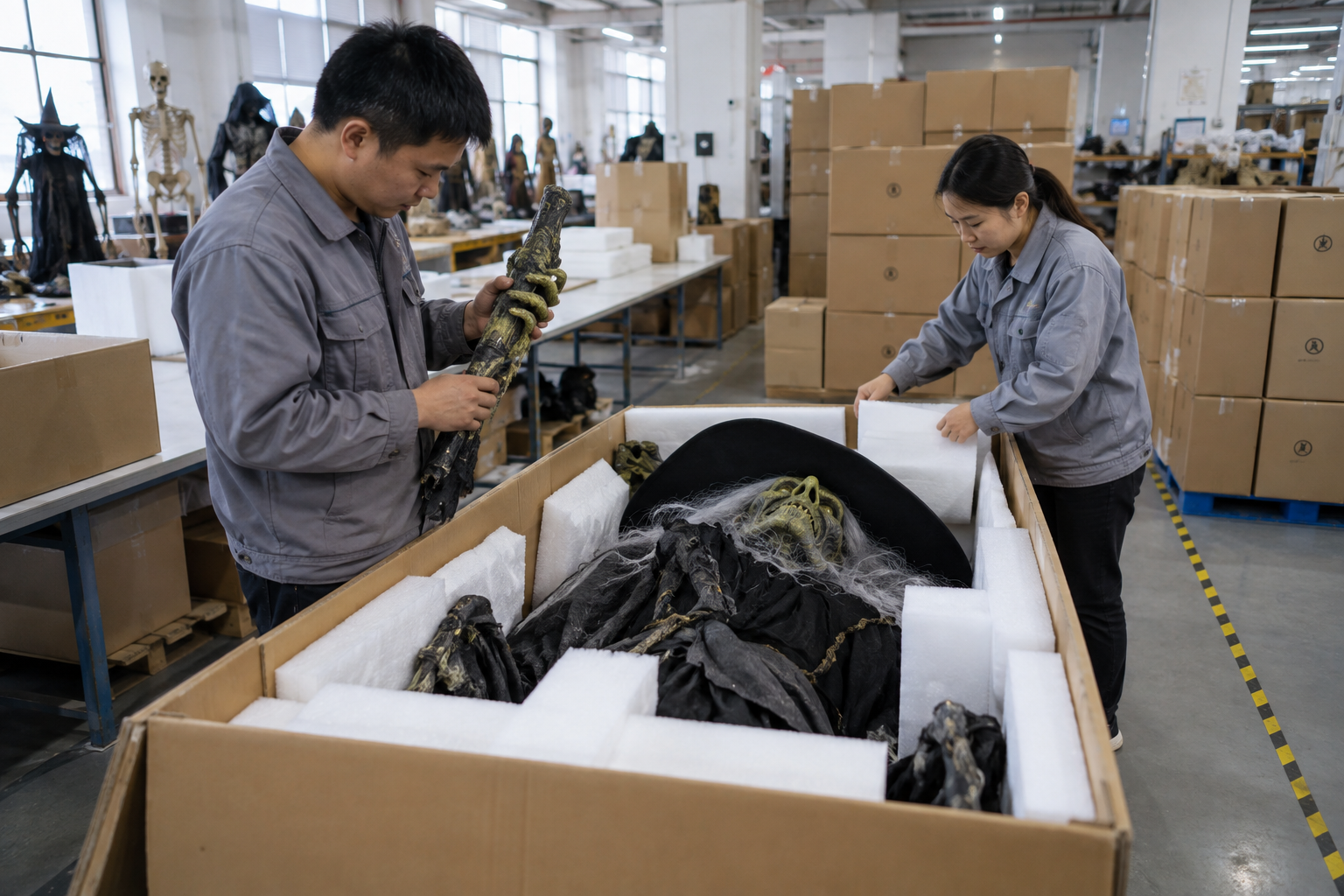
Keep protective materials until the issue is understood. A displaced insert, loose base or abrasion pattern can help the supplier and transport party assess how damage occurred. Discarding the carton and then photographing only the broken prop removes important context. Store materials safely and avoid blocking the venue's receiving route.
Record time and identifiers
The minimum record is the arrival date and time, vehicle or shipment reference, carton identifier, external condition, who opened it, internal packing position, affected product part and quantity. Photograph the full carton before opening, then the internal arrangement and the product from several angles. A close-up without a wide context can be difficult to connect to the shipment.
Separate missing, damaged and nonconforming goods
These are different exceptions. A missing carton is a quantity or routing issue. A prop with a broken arm after delivery is a damage issue. A fully intact witch painted in the wrong approved colour is a product-conformance issue. The immediate operational response may overlap, but the investigation and responsible records differ. Label the exception correctly instead of putting every problem under 'freight damage'.
Check whether a component was deliberately packed separately. Accessories, controllers, bases or detachable limbs may be in another numbered box. The carton matrix and packing list can prevent a false missing-part report. If the part is absent from all expected cartons, preserve the set identifiers and ask the supplier for a packing record.
When product damage is found, do not assume the carton caused it. Compare the item's location and protection with the approved packing revision. Factory finish photographs and shipment inspection evidence can help establish whether the mark was present before dispatch. The export packaging guide addresses prevention; this article focuses on the action after goods arrive.
Make the installation decision separately from the claim
The event team needs a decision about usability. First ask whether the damaged part affects safety, stability, electrical function or a required visual effect. If so, hold the item for qualified assessment. Do not improvise a structural or electrical repair under schedule pressure. If the issue is cosmetic and the manufacturer approves a specific repair method, a local touch-up may be possible, but record the work and obtain the buyer's visual acceptance.
Build alternatives into the project plan. A large prop may have a spare decorative panel, a static substitute, a revised scene layout or a later installation slot. A substitute should be checked against visitor flow and brand intent, not simply placed where the damaged unit would have stood. The choice is commercial and operational, not merely a claims calculation.
Escalate with a concise issue package: order and shipment references, item and carton identifiers, photographs, observed damage, required opening date, available local capability and requested decision. The supplier can respond more quickly to a precise record than to 'the Halloween decorations arrived broken'. State whether you need a replacement part, repair instructions, complete unit or revised installation advice.
Review packing without inventing a failure cause
Look at how the affected component was supported. Did a heavy base move into a sculpted surface? Did a finished limb contact the carton wall? Is the material scuffed in a pattern consistent with rubbing? These observations can guide a packing revision, but they do not establish legal responsibility by themselves. A carrier handling event, insufficient protection, incorrect packing or a pre-existing product issue may require different evidence.
If a route is repeated, ask whether the actual packed configuration was represented by prior transit testing. ISTA's procedure overview can help a packaging specialist choose a relevant packaged-product test. A test result is tied to the sample, pack and procedure used; it does not prove that every future shipment is immune to damage. If the production pack changed after testing, revisit the evidence.
Document corrective action before the next batch. A replacement insert, revised carton, protected accessory position or component design change should carry a new revision number. Test or review the changed configuration as appropriate. Without revision control, the next order may repeat the same problem while the team believes it was fixed.
Preserve claim and commercial records
The buyer, seller, freight forwarder, carrier and insurer may have different duties depending on the contract. Have the responsible logistics owner review notice deadlines and documentary requirements immediately. Do not wait for a final repair quote before giving required notice if the contract demands earlier action. Keep the exception record factual; avoid confident blame in the first message.
Retain the commercial invoice, packing list, delivery receipt, shipment and carton identifiers, dated photographs, survey report if obtained, relevant correspondence and repair or replacement estimate. Link every item to the same case number. If only part of a set is affected, state how many complete sets remain usable. This helps the operations team and the commercial claim team make decisions from the same facts.
Do not double count a replacement. If the supplier sends a new decorative panel, update the asset register and record whether the original damaged panel is retained, repaired or disposed of. Later shipment inspections and reorder discussions may otherwise inherit an unexplained quantity difference.
Decision example: a damaged entrance arch
Imagine a fictional event operator receiving a three-carton Halloween entrance arch. One carton has a crushed corner. The receiver photographs the label and damage before opening, then discovers that the protective insert is displaced and the visible arch panel has a fractured edge. The operator keeps the carton and insert, records the panel identifier and checks the other two cartons for a complete set. This is an example of evidence handling, not a BooAri customer case.
The venue must open in five days. Its installer says the structural frame appears sound, but the panel cannot be safely attached without a manufacturer's review. The buyer sends photographs and dimensions to the supplier, obtains a supported replacement or repair direction, and separately checks the route for a temporary visual substitute. The claim process continues with the logistics owner; the opening decision is not held hostage to it.
If the buyer simply discarded the packaging and mounted the panel with an improvised fastener, later assessment would be harder and the site might carry an unreviewed installation risk. Prompt factual documentation gives more options, even when it does not guarantee a quick reimbursement.
Buyer worksheet: first 24-hour response
Prepare the exception form before the season. Include fields for shipment, carrier, receiving location, carton, SKU, complete-set number, condition category, photos, item quantity, immediate hold status and owner. Provide instructions to preserve packaging and separate suspect units. Identify the person who checks carrier notice requirements and the person who decides installation options.
For every exception, answer four questions: What arrived? What condition was observed? What evidence exists from before dispatch? What is needed to keep the display schedule? Do not allow the most visible question, 'Who pays?', to obscure the immediate practical work. A replacement shipped too late for the event may have little operational value even if its cost is covered.
After closure, add a lesson to the next order brief. Was the carton mark readable? Did the receiving team know how to photograph internal packing? Was the spare-part route fast enough? Did the original product design permit safe panel replacement? A good arrival workflow informs future procurement and packaging decisions.
Choose recovery by component criticality
Not every damaged element has the same operational effect. A fractured decorative crow may be replaced with another accent, while a broken entrance gate base may prevent an entire scene from opening. Create a priority order before goods arrive: safety or structural hold, function-critical component, visually essential focal piece, and nonessential accent. This helps the supplier understand why one replacement is urgent and another can wait for the next consolidated shipment.
Ask whether replacement parts are genuinely interchangeable with the affected revision. A panel from last year's gate may look similar but use a different connector. Provide the product revision and photographs of the mating feature, and ask for supported compatibility confirmation. A rush-shipped part that cannot be installed wastes both time and freight. If a local repair is proposed, the manufacturer should specify the method and the venue's qualified team should assess any site implications.
Retain the affected goods until the commercial owner confirms whether they must be inspected or returned. The warehouse should not dispose of a large damaged prop merely to free floor space if evidence or salvage value matters. At the same time, do not let preserved material obstruct safe operations. Identify a controlled quarantine location and a review date. The decision may vary by contract and carrier, so record it rather than assuming.
After the urgent event decision, conduct a quiet technical review. Compare damage location with internal packing, loading photos and product design. Determine whether the issue calls for a stronger insert, a different accessory position, a revised component or no product change at all. A single arrival event does not automatically prove a systemic factory problem. Equally, a claim payment does not mean the packing is adequate for the next season. Use the evidence to make a specific correction and confirm it on a representative pack.
Questions during arrival triage
Does the receiver have the final shipped carton matrix? Are the damaged shipping unit and its internal protection still available for photographs? Is the affected prop safe to handle, or should a qualified person first assess it? What is the event's latest viable date for a replacement? These answers determine whether the team should seek a component, approved repair, substitute scene or delayed installation.
Give the supplier one concise issue package rather than many disconnected messages. Include identifier, revision, images, observed condition and requested decision. Route contractual notice to the logistics owner in parallel. A clear request can reduce avoidable email cycles even when the physical replacement still takes time.
Plan a replacement route before a claim exists
Ask which fragile components can be replaced separately and how they are identified. A buyer may be able to restore a display faster with one approved panel than with a complete unit, but only if the part fits the actual revision and its installation is supported. Keep the damaged component available for evidence until the relevant commercial parties decide otherwise. A repair or replacement plan should serve the event deadline without prejudging fault.
Frequently asked questions
Should the warehouse refuse a damaged carton?
That depends on the shipment terms, carrier process and local procedures. The receiver should document visible condition and follow the buyer's logistics instructions. A damaged carton can contain usable goods, and an undamaged carton can hide damage; accurate records matter either way.
Can a cosmetic mark be repaired on site?
Possibly, if the manufacturer approves the method and the repaired result meets the buyer's visual standard. Do not improvise repairs to structural, electrical or moving components. Record any work and recheck the product before public use.
What photographs are most useful?
Capture the unopened shipping unit with label, a wide view of the damage, internal protection as opened, the affected product part in context and a close detail. Include scale where useful and retain original timestamps or file metadata.
Does a transit test guarantee claim success?
No. A packaged-product test evaluates a defined sample and procedure. A claim depends on the actual contract, shipment facts and evidence. Test records can inform a technical investigation but do not replace receiving documentation.
How should a missing component be reported?
First check every carton assigned to that complete set. Then report the set number, expected component, relevant carton identifiers and the packing-list discrepancy. This lets the supplier search production and loading records efficiently.
Conclusion
Arrival damage is easier to handle when the receiving team can identify the unit, preserve its packing, document facts and separate the urgent installation decision from the commercial claim. Use the evidence to choose a safe recovery option and improve the next packing revision. A vague damage message sent days later helps nobody.
If your order involves fragile or multi-part displays, send the receiving constraints and destination details to BooAri's project team before production. Ask how the proposed pack, carton identity and replacement-part route will support your opening schedule.
Further reading
Use these external resources alongside your local market, venue and professional safety requirements:
READY TO START A PROJECT?