
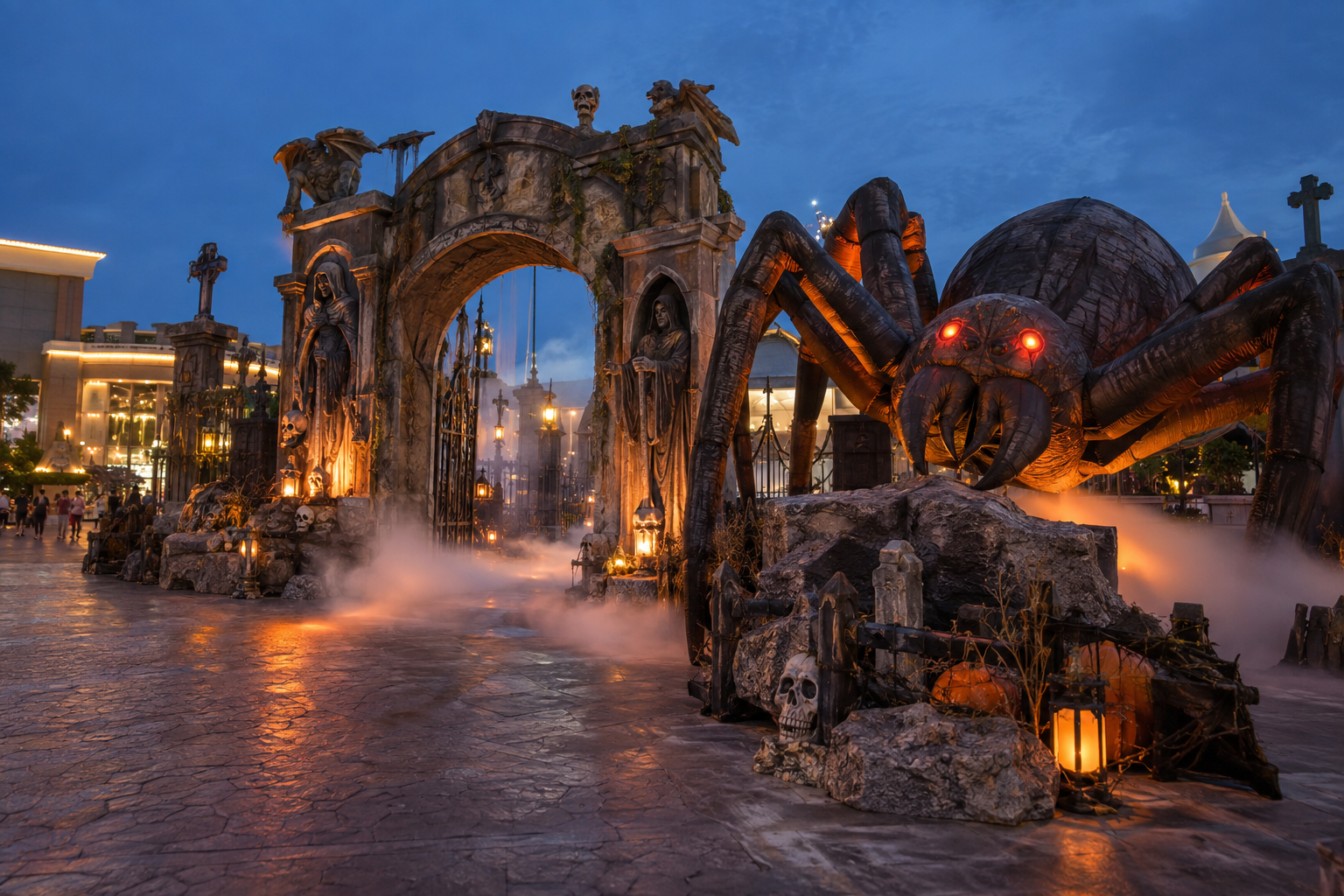
A Halloween trade-show booth prop has to do a different job from a prop inside a haunted attraction. It competes for attention from a busy aisle, must fit a contracted booth, may be assembled by a limited crew during a narrow load-in window, and often needs to survive repeated shows. The buying decision should start with the exhibition brief, not with the largest creature in a catalogue.
This guide is for brands, distributors and exhibitors commissioning themed scenery for trade shows. It does not claim that one design meets every organizer's rules. The exhibitor must obtain the actual booth manual, venue approval requirements and local contractor information. The supplier can then shape the product and packing around those facts. ISTA's packaged-product procedure overview is a reference for transport test planning, not a certificate that any exhibition prop will survive every route.
Decide what the booth must communicate
Write the commercial goal in one sentence. Is the booth introducing a new Halloween prop line, collecting distributor leads or demonstrating a moving character? A dramatic centerpiece can help draw traffic, but it should not hide the products buyers came to inspect or block conversations. The prop's role might be an aisle landmark, photo moment, product demonstration or brand backdrop. Each role implies different size and function.
Map visitor movement. Where will people first see the booth? Where do they stop, photograph, ask questions and exit? A giant spider suspended over a meeting table may be memorable but make discussions uncomfortable. A shorter entrance figure may frame the aisle and leave space for samples. Test the layout with floor tape or cardboard volumes before buying a finished sculpt.
Consider brand identity. Halloween visuals can be playful, scary or premium. A prop should support the exhibitor's customer segment rather than defaulting to the most extreme effect. If the booth sells family retail products, a gore-heavy centerpiece can send the wrong message. If it sells commercial haunt equipment, a timid prop may fail to demonstrate capability.
Keep product demonstration distinct from scenic atmosphere
If an animatronic is the product being sold, buyers need to see its actual function and specification. If an animatronic is only booth scenery, its movement should not repeatedly interrupt conversations or create maintenance work the crew cannot support. State which items are show samples and which are decorative props; label claims accurately.
Read the organizer manual before specifying dimensions
Booth height, sightline, hanging sign, rigging, power, sound, fire and material restrictions can differ by event. Obtain current organizer documents and have the exhibitor or appointed contractor interpret them. Do not assume a display accepted at one exhibition is automatically approved at the next. The supplier should receive maximum allowed size, entrance orientation, service access and any required documentation before sample design.
Check access routes as well as final footprint. A prop can fit the booth but not the dock, goods lift or service corridor. Record packed dimensions and gross mass. If modular construction is proposed, ask how long assembly takes, what tools are needed and whether decorative seams remain hidden under show lighting. A compact crate is valuable only if the on-site crew can turn it into the approved appearance within the allotted time.
Power and control should be planned early. A booth may have limited circuits or rules about cables and sound. The exhibitor's qualified local team should check electrical requirements. The factory can state product-side power needs and demonstrate functions under approved settings, but it cannot approve an unknown venue supply. If sound is used, ask the organizer about limits and neighbouring booths.
Design for repeated transport and fast assembly
An exhibition prop may be shipped to one show, stored briefly, then moved to another. Use part identifiers, reversible joints and a packing map where repeated use is intended. Avoid a design that requires destructive disassembly or fresh ad hoc adhesive after every show. A decorative panel with a replaceable brand graphic can adapt to different campaigns without replacing the whole structure.
Protect faces and protrusions. A trade-show crew may unload many cases in a short window. A good pack makes the correct handling points obvious and prevents small accessories from disappearing among promotional materials. Ask for a representative unpacking and repacking trial. If the buyer plans more than one show, inspect the prop after a second assembly as well as the first.
At shipment inspection, verify case count, parts, finish and function against the approved sample. A transport test plan may be worthwhile for fragile or high-value displays, but the procedure and sample must match the real pack. An attractive booth rendering does not show whether the object can survive repeated handling.
The knock-down prop guide compares packed volume and assembly work. This article adds the exhibition's narrow load-in window, organizer constraints and sales objective. Those factors can justify a different format from a permanent venue display.
Plan the handoff to booth staff
Prepare a concise assembly guide with numbered cases, component images, tools, approved pose, power connection information and a finished reference photograph. State which tasks require the event contractor or qualified personnel. A marketing team may be able to place lightweight static props but not perform rigging or electrical work. Do not let an ambiguous 'easy setup' promise hide that distinction.
Include an opening check. Does the main light work? Does the motion complete its cycle? Are accessible components secure? Does the logo face the aisle? If an effect fails, staff need an approved fallback that keeps the booth usable and does not invite unsafe improvisation. A static silhouette may remain valuable even if optional sound is disabled.
Photograph the installed configuration after the first show. Record parts that were hard to access, repair, clean or pack. Use that feedback before the next exhibition. The supplier can review a specific revision request; a generic complaint that 'setup took too long' is hard to solve without timing and sequence details.
Decision example: a booth centerpiece blocks its own products
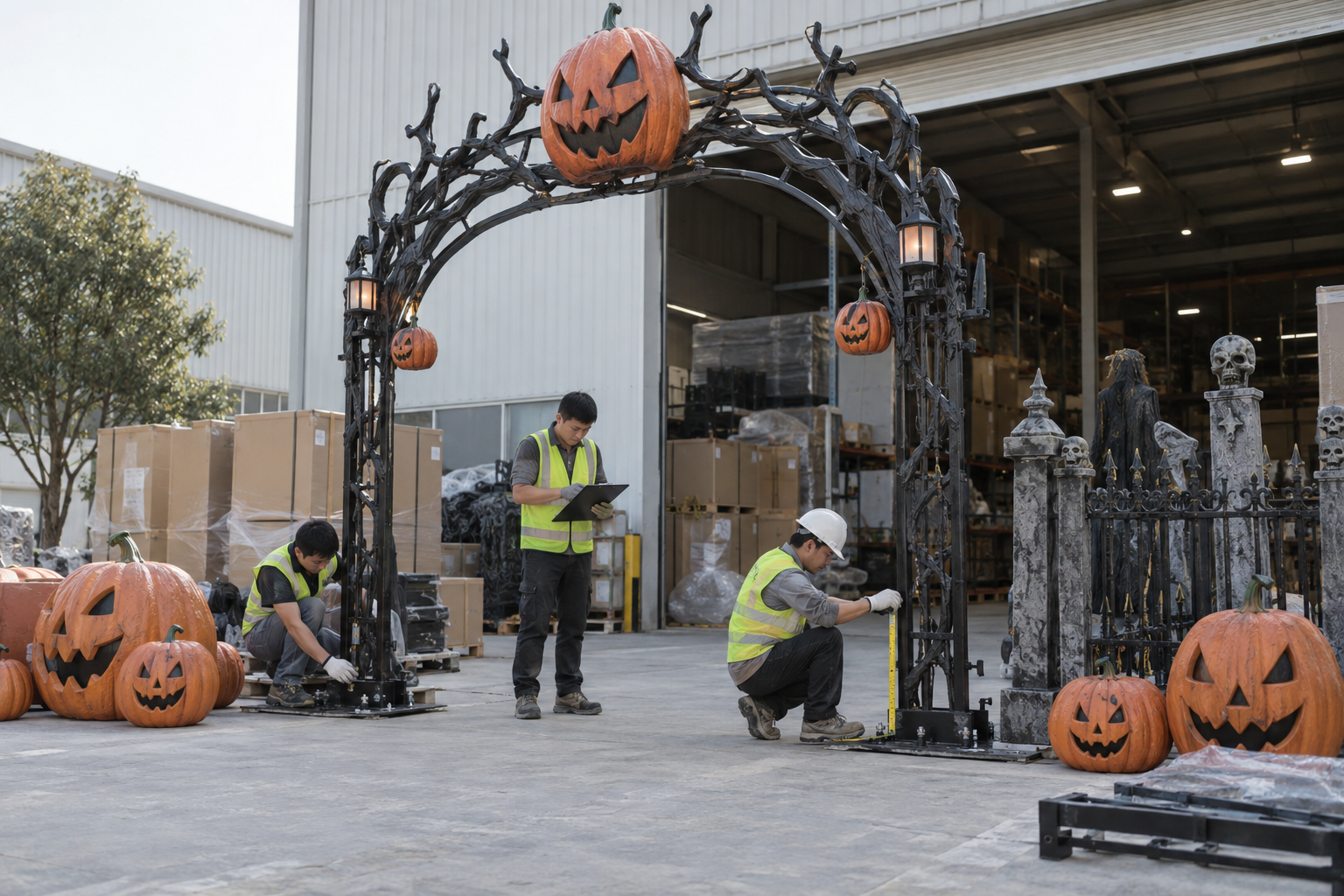
Imagine a fictional distributor ordering a five-metre haunted gate for a trade show. The gate fits the maximum booth height but occupies the whole front edge. Visitors photograph it and walk past; the actual product samples are hard to see. This is a hypothetical merchandising problem, not a BooAri client result.
The team revises the gate into two narrower modules flanking an open entrance. The modules still create an aisle landmark but leave a sightline to the demonstration area. The supplier updates packed dimensions and assembly instructions. The exhibitor checks the revised design against the organizer manual and load-in route before approving production.
The case illustrates why booth dimensions alone are not enough. A prop can comply with a size limit and still fail the sales objective. A physical layout mockup and visitor approach test should precede final fabrication.
Buyer worksheet: trade-show prop RFQ
Provide event name and dates, booth plan, organizer rules, delivery and load-in windows, dock and lift limits, product role, target visitor, brand direction, power availability and expected number of shows. State whether the prop is a sellable demonstration unit or scenic support. Include any requirement for replaceable graphics and approved photography.
Ask the supplier for installed and packed dimensions, gross mass, case count, assembly sequence, expected crew and tools, functions, maintenance access and a sample approval plan. Have the appointed show contractor review the answer before placing the order. The best time to discover a height or access conflict is before manufacturing.
At sample review, test aisle visibility and product access using a floor mockup. At factory testing, demonstrate functions under recorded conditions. At shipment inspection, check parts and pack. After show installation, record actual setup time and problems for the next order. This creates a closed loop between creative impact and operational reality.
Test the booth in three states
Evaluate the proposed display before visitors arrive, during active selling and after closing. In the empty-booth state, staff need room to assemble and service it. During selling, visitors need a clear approach, product view and conversation area. After closing, the prop may need to be powered down, secured and cleaned without dismantling everything. A concept that works in only one state can become an operational burden. Record all three on the booth plan.
Ask the sales team where it will stand during conversations. A loud animated effect near the meeting area can make demonstrations memorable but interrupt pricing discussions. A booth prop should support the exhibitor's objective. If the product being sold is the animatronic, schedule a controlled demonstration and provide specification sheets. If it is scenic support, consider whether a quieter static pose delivers the same landmark value with fewer interruptions.
Model the installed object and the case footprint. Exhibition venues often allow cases to be stored only in specific areas, and a giant crate may not remain behind the booth. The buyer should plan whether packaging is removed by the contractor, stored on site or transported away and returned at load-out. This decision affects case construction and handling cost. Do not discover on the first show day that there is nowhere to put the protective shell.
Check the visual hierarchy across brand, product and scene. The Halloween centerpiece may be the most photographed object, but a buyer should still be able to identify the exhibitor and locate the products for purchase. Use a quick aisle test with someone unfamiliar with the brand: what do they notice first, what do they think is being sold, and where would they enter? If the answers are wrong, revise placement or graphic balance before enlarging the prop.
Treat post-show feedback as product information. Record actual setup time, case damage, worn connectors and the quality of visitor interaction. A reusable display can be improved between shows with a clearer assembly label or replaceable panel. The change should be controlled and checked against the next organizer's rules. A large first-show success does not prove the asset will remain easy to deploy repeatedly.
Questions before the booth sample is signed off
Can staff install the display inside the organizer's load-in window with the actual tools and crew? Can buyers still see the products and hold a conversation? Where will protective cases go during the show, and how will the prop be packed afterward? A trade-show sample should be reviewed as a repeatable working asset, not just an attractive object.
Check the props and graphics from the aisle under realistic hall lighting. Verify that the exhibitor's brand is clear and the Halloween scene does not confuse what is being sold. If an effect runs continuously, observe whether sound or movement interferes with neighboring booths. Change the operation plan before multiplying the display.
Compare ownership cost across more than one show
The exhibitor should estimate storage, cases, freight, setup labour, service and graphic changes using its own contracts. A low-priced one-piece prop may cost more to move repeatedly than a modular option, while a complex modular design may create extra installation labour. Ask the supplier for both installed and packed configurations and ask the appointed show contractor to review the actual labour steps. Do not use a generic return-on-investment percentage; compare the events the buyer has booked.
If a booth design will change between shows, identify which elements are fixed and which are replaceable. A seasonal logo panel, product pedestal or backdrop may need different artwork at the next exhibition. Make those parts accessible and protect them in transit. A well-designed reusable asset should not require destructive alterations every time a campaign changes. Record the approved configuration for each event.
Frequently asked questions
Can one Halloween booth prop work at every exhibition?
Possibly, but each organizer and venue may have different limits. Design modularity and check the current booth manual, access route and local contractor requirements before each use.
Is a large prop always best for attracting buyers?
No. It must support the sales objective and leave room for product viewing and conversation. Test the approach from the aisle and inside the booth, not only the rendered hero angle.
Should the prop be packed in a reusable case?
If it will travel repeatedly, a reusable protective system may be valuable. Compare its mass, volume and handling demands with alternatives, and trial unpacking and repacking before approving it.
Who approves overhead or electrical installation?
The venue and appointed qualified professionals under applicable rules. The supplier should provide accurate product-side mass, dimensions and power information, not claim universal site approval.
What should staff do if an effect fails at opening?
Use the approved fallback, such as a safe static presentation, and contact the designated technical lead. Do not improvise an electrical or structural repair during the show.
Conclusion
Halloween trade-show props should be bought as repeatable exhibition assets. Define the booth's sales role, read organizer constraints, test visitor sightlines, approve a practical pack and hand staff a realistic setup guide. A memorable prop is valuable only when it can arrive, be installed and support the conversation the exhibitor came to have.
Send your booth plan, organizer limits and show schedule to BooAri's custom project team. Ask for a prop direction and packing proposal built around those real constraints.
Further reading
Use these external resources alongside your local market, venue and professional safety requirements:
READY TO START A PROJECT?