
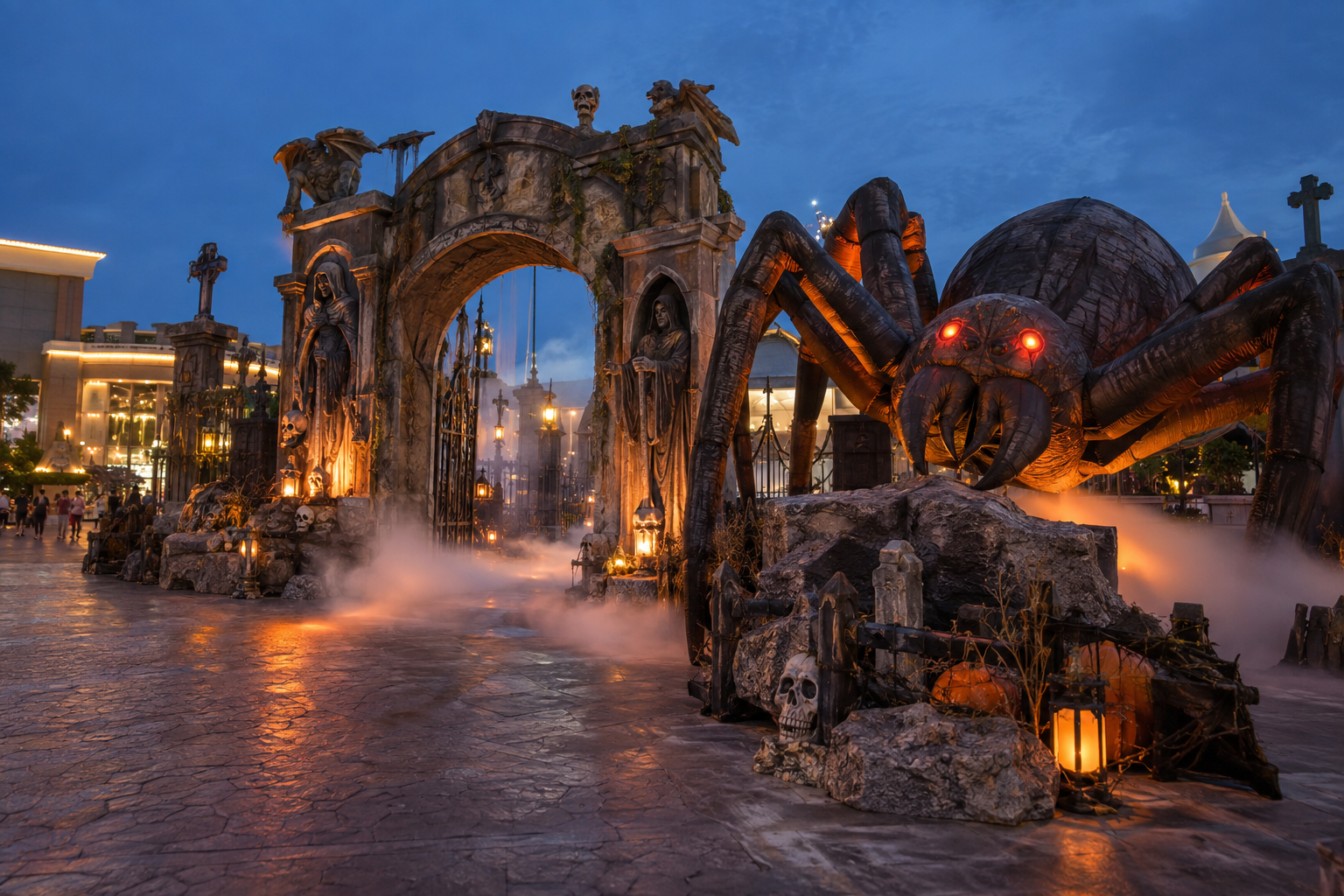
A Halloween sign shaped like a tombstone may fit the scene perfectly and still fail its practical job if visitors cannot read it before reaching a junction. Wayfinding props are not ordinary decorative pieces with words added late. They need to communicate a route, remain legible under the venue's lighting and coexist with accessible circulation, staff instructions and emergency information.
This guide is for attraction operators, event planners and retail property teams buying Halloween-themed directional displays. It does not replace a venue's code-required signage, emergency plans or accessibility assessment. The U.S. Access Board's accessible-route guidance is one primary reference for U.S. contexts; the destination venue should apply its own relevant requirements with qualified advisers.
Begin with the decision visitors must make
On the site plan, mark every location where a visitor must choose a route: entry versus ticketing, queue versus exit, family route versus intense attraction, photo zone versus retail, and accessible route alternatives. For each point, write the one decision the sign needs to support. A sign that says 'Enter the darkness' may be atmospheric but not tell visitors which door to use.
Observe how people approach the junction. The message must be seen before a visitor passes the decision point. Note sightline, likely crowding, direction of travel and whether visitors are standing or moving. A sign visible in a clean venue photograph may disappear behind a queue or tall display after opening. The prop's height and viewing angle should be chosen from actual approach positions.
Keep the number of messages manageable. A themed sign that contains five destinations, a long story paragraph and sponsor logos may ask too much of a moving visitor. Use one clear primary destination and secondary details where necessary. The creative treatment should support recognition, not obscure it.
Distinguish show signage from required safety information
Themed wayfinding can guide guests around an event, but it should not replace mandated exit, fire, accessibility or other required signs. The venue's responsible team must ensure the installation does not block or confuse them. A supplier should receive the placement constraints and prohibited zones before fabricating a large overhead or freestanding piece.
Test wording and visual hierarchy at real distance
Use a simple mockup at intended size. Print the main words on paper, place them where the prop would stand and walk the route under ordinary and show lighting. Can a first-time visitor make the correct choice without stopping to decode the theme? If not, revise copy, size, contrast or location before commissioning a textured sculpture.
Check contrast under the actual lighting conditions. Orange lettering on a weathered brown plank may look good in a rendering but vanish under warm scene light. A ghostly white-on-black panel can work in a dim corridor if the lighting supports it; it may glare in daylight. Evaluate the physical material, finish and text together. Do not infer night performance from a bright desktop proof.
Consider language and symbols. The buyer's venue team should confirm which languages, arrows or internationally understood pictograms are needed. The factory can produce approved artwork but should not invent a translation. For branded or changing event routes, decide whether text panels need to be replaceable. A permanent carved direction to 'Zone A' is awkward if the site layout changes annually.
Specify the prop as a physical object
Provide maximum height, width, base footprint, viewing side, material direction, lighting need and installation method as a buyer brief. A freestanding sign in a queue requires a stability and contact review; a wall-mounted sign depends on the venue surface; an overhead sign needs a qualified rigging assessment. The factory can describe product-side construction, but the venue approves actual fixing and circulation.
Ask how the sign ships. Tall decorative posts and projecting arrows may need modular packing. A detachable arrow should be keyed or labelled so the receiving team cannot install it pointing the wrong way. Provide an assembly instruction and a final installed reference. The packing list should connect each base, post, arrow and graphic panel to the correct sign.
For illuminated signs, state power and control needs. If the sign must remain visible when a show effect is off, include that operating condition in the brief. Avoid a design that relies on a timed flash to communicate a constant route instruction. The venue's electrical team should review local installation and cable management.
Coordinate wayfinding with the visitor experience
Halloween scenery can deliberately disorient visitors as part of a story, but operations still need an intelligible route. Decide where mystery is acceptable and where a clear instruction is essential. Ticket scanning, accessible entry, emergency exit, staff-only doors and high-capacity queue merges deserve more clarity than a decorative transition between scenes.
Ask staff which questions they answer repeatedly. A sign can sometimes reduce a real friction point: 'Where is the family entrance?' or 'Which way back to the market?' The best prop responds to that observed need. A beautiful sign with a message no one asks about may add visual clutter without solving a visitor problem.
The queue-line scenery guide discusses waiting areas. This article focuses on directional communication. A queue prop might frame the line, while a wayfinding prop must make the route unambiguous. They can be designed as one visual family without becoming the same object.
Review at factory and again on site
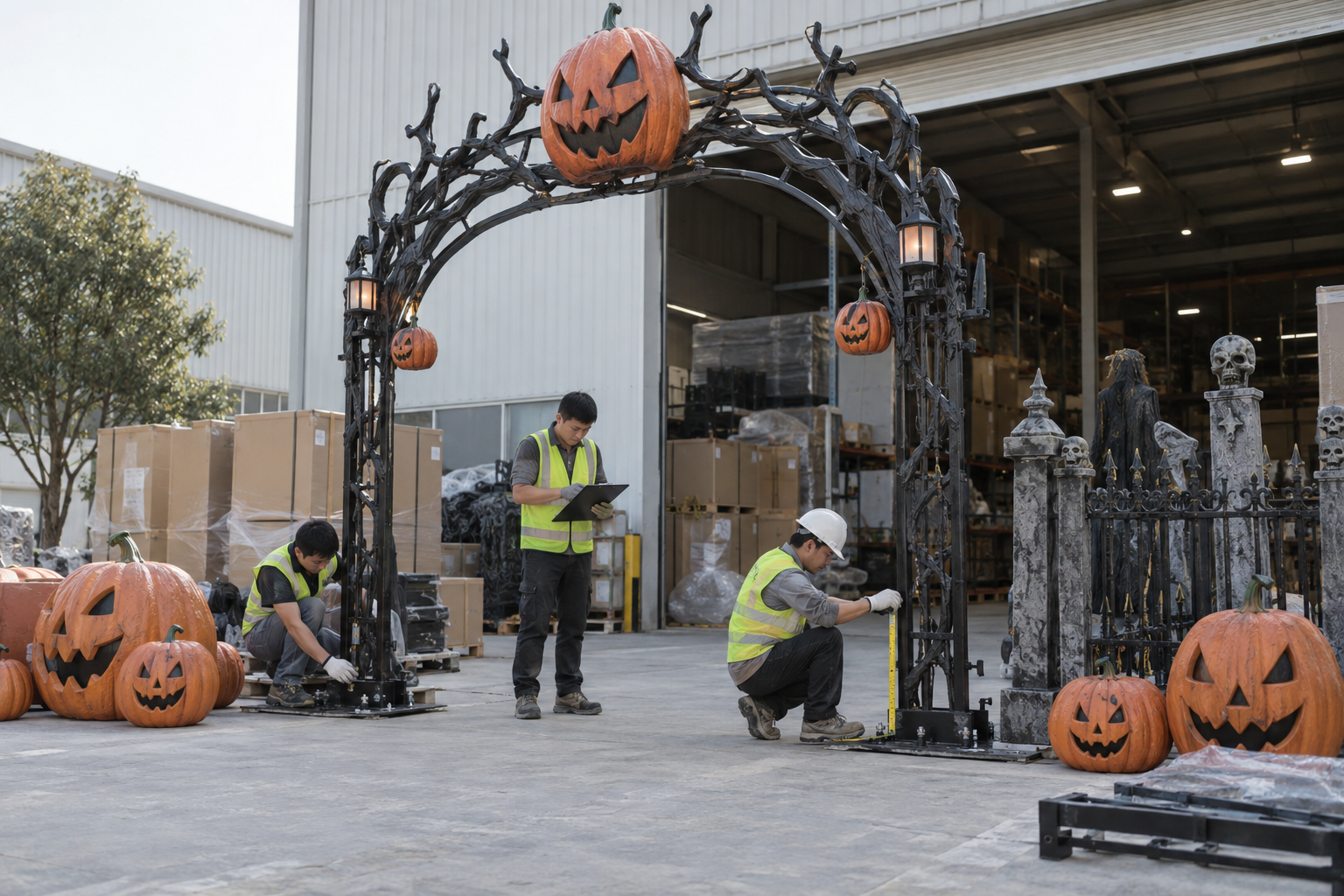
Factory approval can verify dimensions, finish, artwork, assembly and light function. Use a photographed full-size mockup and check the text against the approved file. At shipment inspection, count signs by destination or scene, inspect directional arrows and protect printed faces. None of this proves that the prop works in a crowded venue.
Site commissioning should walk the actual route from first-time visitor positions. Test in the lighting and crowd arrangement expected during operation. Invite operations staff and, where possible, users unfamiliar with the layout. Record where a sign is missed or misunderstood. A small relocation or changed arrow panel may solve a problem better than ordering another large scenic piece.
If the route changes, manage revisions. Update the map, panel content and staff script together. A sign left in place after the route changes can be worse than no sign. Store old graphic panels separately and mark them obsolete so they do not reappear during next season's installation.
Decision example: a fork after ticketing
Imagine a fictional event with a family pumpkin path and a more intense haunt path. A carved wooden sign is placed at the fork with two poetic names but no clear indication of which route suits children. Staff spend the first evening redirecting families. The buyer tests a revised panel using plain-language route labels beneath the themed names, with arrows visible before the junction. This is a hypothetical example, not a BooAri venue case.
The revised panel is not necessarily bigger. It simply prioritizes the decision visitors came to make. The team also checks whether the sign blocks an accessible route or required notice. When the Halloween event ends, the removable text panel is stored with its route version so next year's crew can confirm that it still matches the layout.
The procurement insight is that wording, viewing point and panel replaceability belong in the product specification. They should not be delegated to the installer after the decorative shell is finished.
Buyer worksheet: one route decision per row
Create a wayfinding schedule with location, decision to communicate, approach direction, expected viewing distance, lighting, required wording, languages, mounting context and owner. Attach photographs from the visitor approach, not only a plan view. Identify prohibited installation zones and any required clearance for the venue's qualified review.
For each sign, request a full-size text proof and physical product drawing. Check arrow direction from the actual installed orientation. Ask whether graphics are replaceable and how spare panels would be ordered. Approve a complete mockup before production if the sign is central to crowd movement.
After installation, conduct a first-time visitor walk and record changes. If staff still need to give the same directions repeatedly, revisit copy or placement. The measure of success is whether visitors can make the intended choice, not whether the sign photographs well for the catalogue.
Write a route-change procedure before printing permanent arrows
Seasonal events often change after the first site plan: a queue grows, a family entrance moves or a photo zone closes for maintenance. The sign set should support controlled updates. Identify which message panels are replaceable, how they are stored and who authorizes a new direction. A reversible arrow is not enough if the product title, map and staff script still point to the old route. Keep all route information under one version.
Test the signage from a visitor's first glance, not a designer's close reading. Recruit someone who has not studied the plan. Show them the mockup at the intended approach distance for a short interval, then ask where they would walk. If the answer differs from the intended route, improve the message or placement. Do not explain the sign before the test; real visitors will not receive that briefing. Repeat after show lighting and surrounding scenery are installed.
Coordinate the signs with staff operations. A sign may direct visitors to a closed attraction while staff are temporarily sending them elsewhere. Assign a person to cover or change affected panels when operations change. If the sign contains a QR code or event schedule, confirm who maintains the destination and what the offline fallback is. A decorative prop should not become a single point of failure for a critical visitor instruction.
At the factory, use a sign schedule to verify copy, arrow orientation and finish for each unique identifier. At packing, group panels by route or destination and make the first-needed items accessible. At the venue, check the actual installed direction and obstruction. A correctly printed arrow can still point the wrong way if the post is rotated. Photograph the final orientation and add it to the venue handover.
Review after opening. Count recurring staff questions at each junction and note where guests hesitate or turn back. These observations do not require a sophisticated tracking system; a simple daily note can reveal one unclear decision point. Adjust the smallest element that solves the problem. A wayfinding prop is successful when it quietly helps visitors move, not when its decorative detail requires staff to explain it.
Questions for the first route rehearsal
Show a new visitor the sign at the approach position. Can they choose the correct route without staff explanation? Does the message remain legible when the queue is full and show lighting is active? Is the arrow correct from the installed orientation, and are required safety signs still visible? Record the answers before opening.
If guests hesitate, change the smallest effective element: wording, contrast, angle or position. Do not assume a larger sculpt fixes an unclear message. Keep revised panels and the route map under the same version. Staff should know who may change a sign when a route closes temporarily.
Measure legibility after decoration is added
A plain full-size sign proof may work, then fail once artificial web, foliage, animated figures and theatrical lighting surround it. Re-run the approach test after the complete scene is installed. Observe whether people stop in the circulation route to read or ask staff for clarification. If a sign is blocked by a seasonal crowd, move it upstream rather than increasing text density. For multi-language venues, confirm that each required language is genuinely readable at the decision point and not reduced to tiny secondary copy.
When routes change during operation, make temporary updates obvious and controlled. Cover obsolete arrows, update staff maps and keep old panels out of the active kit. A thematic sign that is beautifully made but points to a closed door damages visitor trust. Give operations authority to request a correction without waiting for the next design cycle.
Frequently asked questions
Can themed signs replace required exit signs?
Do not assume so. Required life-safety and accessibility signage is governed by the venue and applicable rules. Themed props should complement, not obscure or replace, those systems.
Should arrows be permanently printed?
That depends on whether the route is stable. Replaceable panels can be useful for temporary events or annual layout changes. If the direction is fixed, permanent graphics may be simpler, but the installed orientation still needs checking.
What should be tested before ordering?
Use a full-size copy mockup at the intended location and walk the route under realistic light. Confirm legibility, decision timing and obstruction. Then approve the physical prop construction and packing.
Can a sign be both decorative and accessible?
It can be designed to support both goals, but the venue must check applicable accessibility requirements. Use clear messaging, appropriate placement and a route review rather than relying solely on a themed visual effect.
How do I specify a multi-sign set?
Create a schedule with one row per sign, unique identifier, approved copy, arrow direction, destination and carton identity. Check completeness before shipment and again during venue setup.
Conclusion
Halloween wayfinding props are successful when people can follow them. Start with route decisions, test copy at real distance, coordinate physical construction with the venue and verify the result on site. Strong themed design supports clarity; it does not excuse ambiguity.
Send your route map, decision points and visual references to BooAri's custom project team. Request a sign schedule and proof process that your venue operations team can test before production.
Further reading
Use these external resources alongside your local market, venue and professional safety requirements:
READY TO START A PROJECT?