

A Halloween prop behind a barrier and one that visitors are invited to touch are different products in practice. A photo-zone pumpkin may be leaned on, cleaned repeatedly and reset by staff; a haunted character behind scenery may never be contacted. The buying brief should describe expected interaction, not assume that a visually attractive prop is ready for public handling.
This guide helps venue and retail buyers specify high-contact Halloween displays. It does not certify a design as safe for every public setting. Local rules, user ages, accessibility, cleaning products and venue risk assessments remain important. CPSC's safer-product handbook discusses product-safety process in broad terms; the actual product and destination determine applicable requirements.
Map the contact zones
Observe how visitors will approach the display. A prop marketed as a backdrop may become a seat, handrail or climbing invitation if its shape suggests one. Identify surfaces that are likely to be touched, leaned on, gripped or bumped. Mark them on the drawing and decide whether contact is intended, tolerated under supervision or actively discouraged. Signage alone may not change a prop's obvious invitation to interact.
Consider different users. A family photo area may include children reaching for a pumpkin stem, adults steadying themselves on a gate and staff moving the prop for cleaning. A horror attraction may have hurried visitors brushing past a figure even if they are told not to touch. The product should be reviewed against realistic behaviour, not only the ideal route shown in a rendering.
Separate visitor-facing contact from staff service contact. An access panel may be handled daily by trained operators but should not be in a public grip zone. A detachable arm may be fine for packing but vulnerable if visitors pull it. The factory can propose a different joint, guard or placement when the brief reveals that contact is expected.
Define how the venue will supervise use
State whether staff will be present, whether visitors can queue around all sides and whether the prop remains accessible outside opening hours. A supervised photo moment and an unattended mall corridor need different operating assumptions. The venue owns its supervision plan; the supplier needs to know it because it affects material, base, finish and replaceable-part choices.
Review construction and stability as a system
Ask how the prop stands, how its base is attached and which decorative elements project into the visitor space. A heavy-looking shell is not necessarily stable; weight distribution and the installed configuration matter. Conversely, adding mass without a handling plan can make receiving and repositioning difficult. The venue's qualified team should review the final fixing and public-route conditions.
Inspect edges, seams and hardware in reachable zones. A deliberately jagged horror texture can be visually convincing without having sharp or easily detached contact points. Ask for a representative sample to be handled by the buyer's operations team. The acceptance criteria should include the physical interaction, not just a camera view from the front.
If a component is replaceable, document its securement and replacement procedure. A pumpkin hand or character hat that is frequently touched may be designed as a service item; that is better than discovering after the first weekend that a permanent glue joint fails in routine use. Replacement parts should match the approved revision and be clearly identified.
Specify finish and cleanability together
High-contact use changes the finish question. A delicately airbrushed latex-like surface can look excellent but may be difficult to clean repeatedly. A hard shell may tolerate a different care method, but the actual coating still needs manufacturer guidance. Ask which cleaning products, contact time and wiping method are suitable for the specified material. Trial the method on a representative sample before bulk approval.
Document what happens after cleaning: colour transfer, gloss change, softening, residue or loosened costume details. A finish that survives one quick wipe may behave differently after a season of use. Do not invent a universal chemical-resistance claim. The buyer and supplier should agree a practical test reflecting the venue's cleaning policy, and the venue should avoid unapproved chemicals on the installed prop.
Design service access so staff can clean the expected touch zone without removing major scenery or reaching near energized parts. If lighting is inside the prop, local operating procedures should define when it is isolated for maintenance. This is a site and product coordination issue, not merely a janitorial afterthought.
Plan contact-aware factory checks
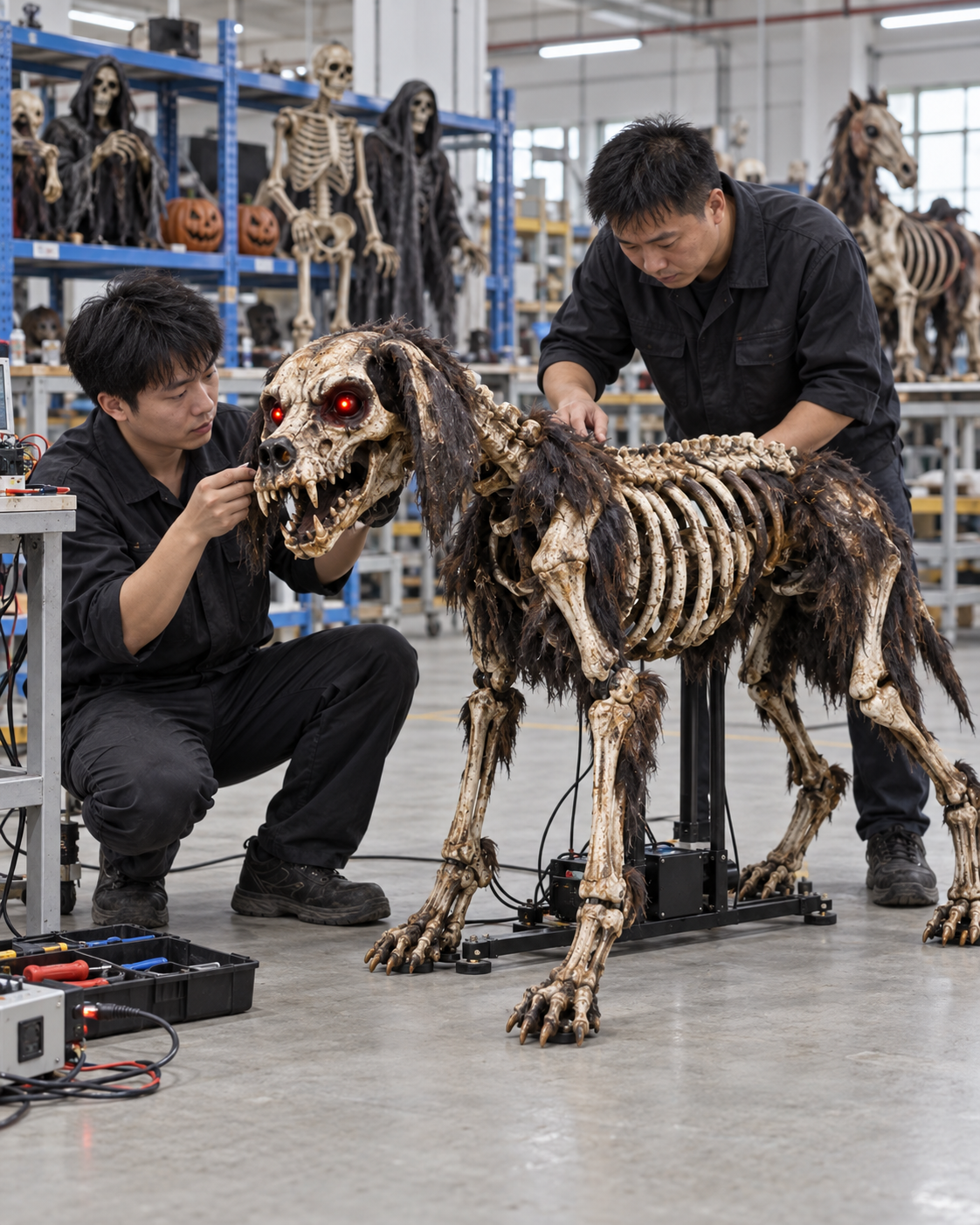
At sample review, perform a supervised handling walkthrough. Have the buyer's staff use the prop as the visitor is likely to: pose beside it, place a hand where the shape invites it, and pass close at normal walking speed. Observe loose trim, snag points, rocking or unplanned movement. The test should be controlled and should not encourage unsafe experiments. Record what was learned and revise the brief if visitor behaviour differs from the original assumption.
At factory testing, confirm quoted functions and the integrity of accessible components. For a light-up prop, check how the cable and switch are protected from public interaction in the intended installation. For a static photo object, inspect finish and mounting features. Shipment inspection can compare selected production units with the approved contact-zone sample and accessory list, but destination commissioning must assess the actual floor and route.
The factory page can guide a conversation about assembly and checks. The family-friendly photo-zone guide explores framing and audience fit. This article is narrower: what changes when visitors can physically interact with the display.
Design an operating and damage-response loop
The venue should know what 'normal' looks like. Provide a brief pre-opening check for visible looseness, new damage, missing components and cleaning status. If a prop is damaged, remove it from public interaction until an authorized person assesses it. Staff should not improvise a fix to an unfamiliar electrical or structural component.
Capture recurring contact patterns. If every visitor grips the same projecting hand, that is design feedback, not merely a series of isolated accidents. Consider a stronger component, a different pose, a barrier or a staff instruction. A replaceable part may be commercially better than repeatedly repairing the same permanent feature.
For a multi-site rollout, share the operating feedback with the supplier before the next batch. The venue can describe where people touched, what cleaning was used and what changed. The supplier can then evaluate a controlled revision. Keep revised and original units distinct so spare parts and instructions remain compatible.
Decision example: a pumpkin people sit on
Imagine a fictional shopping mall orders a large friendly pumpkin for photographs. The creative brief says visitors will stand beside it. During a mock installation, families naturally ask children to sit on its wide top. The product was never specified or reviewed as seating. This is a hypothetical planning example, not a BooAri case.
The venue should not quietly allow a new use because the prop 'feels solid'. It can change the scene layout to discourage sitting, select a different purpose-designed element, or ask qualified parties to review a revised product brief. The supplier would need to understand the intended loads and product application before proposing anything. A decorative shell should not be promoted as a seat by implication.
The buyer also notices that children grasp the stem while climbing into the photo area. A repositioned camera mark or lower visual prop may solve the behaviour without changing the whole concept. This shows why real mock-up behaviour can be more informative than a polished concept image.
Buyer worksheet: specify expected contact
Draw the visitor route and mark intended touch, foreseeable incidental contact and no-contact areas. Note likely ages, staffing, opening hours, cleaning method and whether the prop is moved daily. Add product-side questions about edge finish, removable parts, base interface, service access and replaceable components. Have the venue's qualified team review site fixing and circulation.
Create sample acceptance steps: visual review, careful handling in expected zones, cleaning trial, assembly check and function demonstration where applicable. Record failures and approved changes. Do not describe a sample as 'public-safe' solely because it survived one informal touch. Any required market testing or professional assessment remains separate.
Before shipment, confirm that production matches the approved contact-zone construction and that instructions tell staff what not to do. At installation, the venue checks the actual floor, fixing, visitor flow and daily operating plan. The supplier's product evidence and the venue's site acceptance should meet at a documented handoff.
Agree what the product is not intended to do
High-contact briefs are clearer when they state excluded uses. If a pumpkin is for standing photographs, write that it is not intended as a seat or climbing surface and design the scene to support that boundary. If a figure's outstretched arm is decorative, do not locate it where it becomes the most obvious handhold. Excluded use is not a substitute for a foreseeable-use assessment, but it gives the designer and venue an explicit problem to solve. The right response may be a layout change rather than an ever-stronger shell.
Run a staff walkthrough before production approval. Ask the people who will supervise the scene where they expect guests to stand, where they will intervene and how they will clean between busy periods. Their answers may differ from the marketing rendering. Mark those contact and service positions on the product drawing. A supplier can then review whether a removable costume, exposed cable or fragile finish falls in a high-traffic zone. The buyer should record which assumptions are tested and which remain site questions.
Plan the receiving and installation sequence. High-contact props are often heavy or large because they need a substantial base or protective structure. Check dock, doorway, lift and final route. A product that can withstand visitors but cannot be moved into the venue without lifting it by decorative parts is not a good design. Give handlers a clear place to grip or a supported method specified by the manufacturer; do not invent it during unloading.
At opening, assign an owner to the daily visual check. Staff should know what change triggers a hold: a new wobble, detached trim, accessible wire, damaged edge or unsupported function. A short photo reference of the approved condition can help. When an issue occurs, record it against the asset revision and correct it through a supported method. Repeated observations should feed into the next product brief rather than being normalized as routine damage.
Finally, distinguish product-level and site-level evidence. A factory sample may pass a controlled cleaning trial and physical review. The venue still decides circulation, supervision and fixing in its own space. That division allows both teams to contribute the information they actually control and avoids a misleading promise that one test makes a prop universally suitable for public contact.
Questions at the public-contact sample review
Where are visitors most likely to put their hands, even if signs tell them not to? Which components could be pulled, leaned on or climbed? How will staff clean those surfaces without reaching a powered part? Walk the mock scene with the operating team and record actual behaviour. Adjust the layout if the object invites a use it was never designed to support.
Ask whether service components can be replaced without dismantling the display. A high-contact prop may need a spare exterior panel or trim piece more urgently than a distant scenic item. Keep the replacement tied to the approved revision and the venue's repair procedure.
Check the distinction between use and misuse in the scene
The buyer should not use a disclaimer to ignore foreseeable behavior. If children repeatedly try to sit on a decorative pumpkin, the venue needs to change the design, layout or supervision. If a staff-only access hatch is reachable from the public side, review placement and protection. The factory needs these observations to propose product changes, while the venue retains responsibility for the installed route and staff procedure. Record both sides of the decision so the prop is not treated as universally suitable simply because one sample looked sturdy.
Frequently asked questions
Can a decorative Halloween prop be used as seating?
Not unless it is specifically designed, assessed and approved for that use. A wide shape can invite sitting, but appearance is not proof of structural suitability. Change the visitor plan or commission an appropriately reviewed product.
What should a factory know about visitor contact?
Tell it where people will touch, lean, pass close or interact, along with age group, supervision and cleaning expectations. This information can affect material, finish, joints, base and service design.
Is a cleaning trial necessary?
It is useful for high-contact finishes. Use the venue's intended method on a representative sample and review colour, texture, residue and component security. Follow the material supplier's instructions and local policy.
Does a passed factory test approve the venue installation?
No. Factory testing checks the product under defined conditions. The venue must review site fixing, visitor route, local rules and operation after installation.
How should a damaged public-contact prop be handled?
Restrict interaction and obtain an authorized assessment. Document the condition and use the manufacturer's supported repair or replacement route. Do not improvise on structural, electrical or moving parts.
Conclusion
High-contact Halloween displays need a brief that describes real visitor behaviour, reachable surfaces, cleaning and daily operations. Factory sample checks can inform product design, while the venue must still approve the installed site. Buying for contact from the start is more reliable than treating a fragile decorative prop as an interactive attraction after delivery.
Send your visitor route, intended interaction and cleaning requirements to BooAri's custom project team. Ask for a product direction that can be reviewed against the actual public-contact brief.
Further reading
Use these external resources alongside your local market, venue and professional safety requirements:
READY TO START A PROJECT?