

A latex Halloween prop cleaning trial asks a specific question: can the proposed care method remove the expected soil without unacceptable change to this finished product? It is not enough to know that a cleaner works on another rubber object or that a costume fabric looks washable.
Commercial buyers should consider cleaning before the order, particularly for props used near visitors, handled during installation or repeatedly packed for rental. The finished surface may combine paint, adhesives, foam, fabric and electronic equipment. Each can impose different restrictions.
This guide describes how to scope a careful material-compatibility trial and document operating care. It does not recommend a universal chemical, claim disinfection efficacy or replace manufacturer instructions. Cleaning, sanitation and electrical safety need product-specific and venue-specific decisions.
Identify what is actually being cleaned
Request a material and finish description appropriate to the product. Latex skin, coated foam, rigid scenic surfaces and costume fabric should not be treated as interchangeable. A painted or sealed surface may respond differently from the underlying material.
Identify attachments and concealed components. A face may include a flexible coating, attached hair, adhesive details and an internal mechanism. A wipe method applied carelessly can reach areas that were not intended to be wet. The product's care instructions should define the permitted scope.
For Halloween costume fabric cleaning, ask whether the costume or individual pieces are removable. Record fabric identification where supplied, trims and any decorative treatments. Do not assume a removable garment is machine washable or that a care label for plain fabric applies to the embellished assembly.
Keep material documents tied to the actual product revision. Smooth-On's technical bulletins and safety data library illustrates the importance of product-specific material information. It does not establish which material BooAri uses, nor does guidance for uncured materials automatically apply to a finished prop.
Define the soil and the operating need
Describe the expected problem: warehouse dust, handling marks, costume lint or another identifiable soil. Different problems may require different approaches. Asking for easy cleaning without describing use makes it difficult to evaluate suitability.
Record frequency and access. A display behind a barrier may need occasional dust removal, while a rental item might need a documented check between deployments. A product intended for visitor contact requires a separate assessment of contact suitability and the venue's hygiene procedures.
Distinguish cleaning from disinfection. Removing visible soil does not demonstrate that a surface has been disinfected. If the venue requires a disinfectant process, competent personnel should determine suitable products and procedures, then verify compatibility with the manufacturer.
Do not turn a small surface trial into a health or sanitation claim. Its result supports a defined care method under stated conditions. It does not establish effectiveness against microorganisms or suitability for every type of public contact.
Ask for manufacturer guidance first
Before testing a cleaner, obtain the supplier's care instructions and restrictions. Ask about wetting, solvent exposure, abrasion, drying, costume removal and protection of controls. If no guidance exists, request clarification rather than choosing an aggressive method to discover the limit.
Clarify the difference between routine operator care and technical maintenance. Staff may be allowed to clean an accessible outer surface but not open a housing or remove a mechanism. A maintenance manual should not be interpreted as permission for untrained operators to perform every task it describes.
Check any available information for the proposed cleaning product, including use instructions and safety requirements. Follow relevant workplace and venue procedures. Do not mix chemicals or increase concentrations because the first trial appears slow.
If the supplier cannot confirm compatibility, agree how a representative sample will be tested and what remains uncertain. A transparent provisional answer is more trustworthy than an unsupported claim that every common cleaner is safe.
Design a small, controlled compatibility trial
A haunt prop cleaner compatibility trial should begin on a representative sample or an inconspicuous area specifically approved for the purpose. Define the material, finish revision, cleaning product, application method and observation sequence. Avoid risking the only approved display during an informal experiment.
Use the proposed operating method, not a vaguely similar substitute. Document whether application uses a cloth, brush or another permitted tool and how much wetting is intended. Follow the cleaner's instructions and the manufacturer's product restrictions.
Compare with an untreated reference where practical. Observe colour, sheen, tackiness, texture, transfer onto the cloth, adhesive edges and any visible deformation. The relevant acceptance criteria depend on the product; there is no universal tolerance for every Halloween surface.
Evaluate after the agreed drying and observation period, not only while the surface is wet. A finish can look temporarily darker or glossy during application. Record whether the condition returns to the reference appearance and whether any delayed change is observed.
Keep a trial record operators can understand
State the approved method in plain language with the actual product identifiers. Include what not to clean, when to stop and how to report an unexpected result. Avoid a technical record that leaves operators guessing whether water immersion or a different detergent is acceptable.
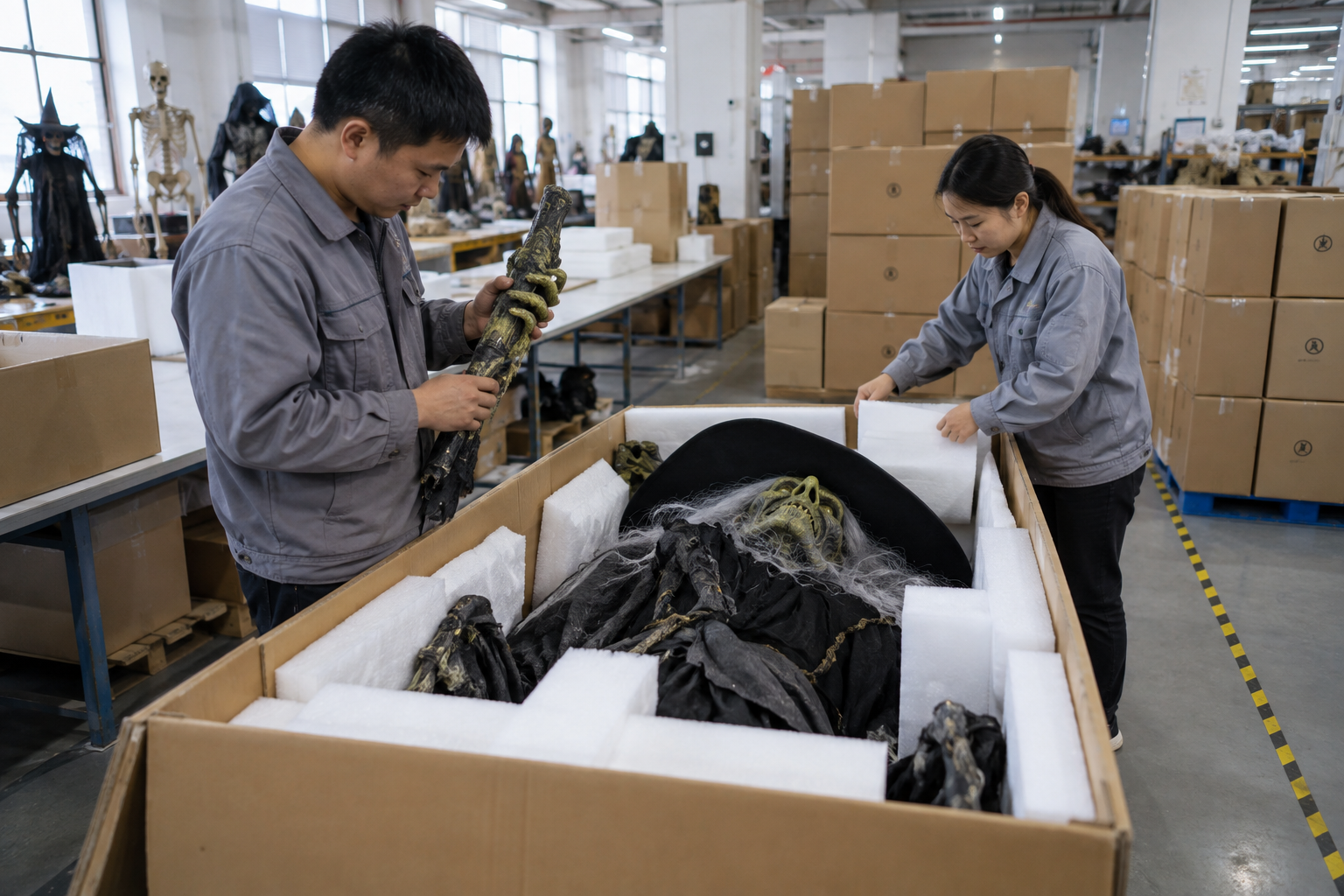
Treat costume removal as a separate operation
If a costume is removable, demonstrate the approved sequence. Check attachment locations, alignment references and any parts that could be misplaced. Cleaning access is only useful if the costume can be refitted correctly without damaging the surface or interfering with movement.
Consider whether trims, hair or accessories are removed with the garment or cleaned separately. Photograph the assembled reference before removal. Record small components in a labelled kit so the process does not create a new completeness problem.
After refitting, check clearance and the agreed motion sequence where applicable. Fabric positioning can affect how a character moves or what a visitor sees. A freshly cleaned costume does not make the complete prop ready for operation until relevant assembly checks are complete.
Ask whether replacement costumes are available and how they are identified. For repeated deployment, a supported spare costume may simplify turnaround, but only if it matches the product and intended appearance. Include this option in the spares compatibility plan.
Plan drying before storage or opening
A Halloween decoration drying procedure should be specific to the permitted care method and the product. Confirm where the item can dry, whether parts need separation and how equipment remains protected. Do not prescribe heat, direct sunlight or forced-air treatment without product-specific approval.
Record the condition required before repacking. Damp fabric or an incompletely dried surface should not be assumed suitable for immediate sealed storage. The supplier's care guidance and the venue's procedures should determine the release condition rather than a universal number of hours.
Include space and staffing in the procurement decision. A prop that takes substantial supervised handling to clean and dry may be difficult to turn around between rental bookings. The correct comparison is the complete care workflow, not just the price of a bottle of cleaner.
Storage protection should avoid undoing the cleaning work. Clean inserts, separated accessories and appropriate packing can reduce new contamination or surface contact. Review reusable scenery reassembly when the prop will be packed repeatedly.
Inspect function without exposing equipment to water
Before care, follow the manufacturer's instructions for making the product safe and protecting equipment. Do not clean energized mechanisms or improvise access to electrical areas. The venue's authorized technical team should handle any uncertain equipment condition.
After care, perform the approved visual and functional checks before returning the product to service. Confirm that attachments are secure, surfaces meet the agreed appearance and costumes do not obstruct motion. Electrical or pneumatic checks should remain within the applicable technical procedure.
If accidental wetting reaches a restricted area, stop and seek qualified advice. A product turning on is not proof that it is suitable for public operation. Record the incident and follow the supplier's support process instead of concealing it as a routine cleaning result.
For factory testing, ask for the approved care method to be demonstrated on the defined sample. Shipment inspection can verify that the instructions and necessary removable-part identification accompany the order. It should not claim an unperformed sanitation test.
Example: dusty face and decorated cloak
Imagine a hypothetical rental character with a flexible painted face and a decorated fabric cloak. The buyer expects dust after storage and occasional handling marks after installation. No particular material formulation or cleaning chemical is assumed here.
The supplier confirms that routine care of the accessible face is limited to a defined gentle method and provides separate instructions for the cloak. The buyer requests representative samples because the cloak includes applied trim and the face has a selective gloss treatment.
A small trial checks visible soil removal and appearance against an untreated reference. The proposed face method leaves no unacceptable observed change under the agreed review, but one alternative cleaner changes the gloss. The alternative is not approved, even though it removes the mark more quickly.
The cloak trial reveals that removal and refitting take longer than the purchasing team expected. The rental schedule is updated to allow handling and drying, and the buyer asks for a supported spare cloak. This turns cleaning feasibility into a practical commercial decision rather than a vague quality claim.
The final care record separates face cleaning, cloak care, equipment protection and release checks. It clearly states that the trial does not establish disinfection. Operators now have a controlled method and a route for exceptions instead of an instruction to clean as needed.
Add care requirements to the quotation
For Halloween prop cleaning procurement, request material guidance, a trial sample where justified, removable-part instructions and replacement options. State the intended use and the expected care frequency. Compare whether suppliers can support these requirements for the actual ordered product.
Ask who approves the final method. The supplier addresses product compatibility; the venue addresses operating and hygiene policy. Neither should silently assume the other's responsibilities. For an importer reselling the product, decide what approved care information accompanies each unit.
If cleaning is a critical selection factor, resolve it before large-volume production. A late discovery that a costume cannot be cared for as expected may be expensive to correct. Treat the trial as a sample-approval milestone with a defined scope and decision date.
Use BooAri's enquiry process to describe product use, likely soil and turnaround requirements. Ask for a product-specific care proposal. Do not request a universal easy-clean guarantee covering unknown chemicals, contact patterns and storage environments.
Buyer worksheet: scope a representative care trial
Identify the exact finished surface to be cleaned and the soil likely in the venue. For a character with a flexible face, painted accessories and a fabric cloak, one trial on bare rubber would be insufficient. Ask the supplier which of these surfaces staff may clean, which pieces can be removed and what areas must be protected. Keep the material and finish revision in the trial record; a later substitution may change compatibility.
Write the proposed routine method before testing. State the cleaner, application tool, contact pattern and drying or release check using manufacturer guidance. Do not improvise concentrations or mix products. Use a representative sample or approved hidden area and preserve an untreated reference. Observe colour, sheen, tackiness, transfer, texture and attachments immediately and after the agreed observation period. The goal is to decide whether the method is acceptable for this product, not to make a general hygiene claim.
Include the handling sequence. If the cloak must be detached, count the small parts, photograph correct refitting and verify that it does not obstruct movement afterwards. Record how staff know when the item is ready to repack or reopen. A cleaning method that leaves the prop wet during the available rental turnaround may be commercially unsuitable even if the finish survives the wipe. The buyer should consider staff time and storage space as part of the product choice.
Separate outcome statements carefully. The trial may support that a specified visible mark can be removed without observed unacceptable finish change under documented conditions. It does not prove disinfection, compatibility with other chemicals or suitability for visitor contact. Give operators a short approved instruction and a stop-and-report route for unexpected change. Request a new review when the surface, care product or operating use changes.
Questions to close before approving routine care
Ask what the venue expects staff to remove from the surface and how often. Dust, handling marks and public-contact hygiene requirements are different issues. Obtain instructions for the actual finish, costume and attached details rather than applying a general fabric or rubber guide to the full prop.
Trial the proposed method on approved representative material. Record the cleaner, tool, observation period and reference condition. Watch for changed sheen, colour transfer, tackiness and adhesive edges. If the trial fails, document that result and ask the supplier for a supported alternative; faster removal does not justify damaging the finish.
Translate the approved outcome into a short staff instruction with drying and release checks. Mark technical areas that routine cleaning must not enter. If the venue needs disinfection, request qualified advice and product-specific compatibility evidence. A visual cleaning trial alone cannot substantiate that claim.
Frequently asked questions
Can we use the same cleaner on every Halloween prop?
Do not assume so. Materials, coatings, adhesives and costumes can differ, even within one display. Obtain product-specific guidance and verify the proposed method on an approved representative sample where needed.
Does a successful cleaning trial prove disinfection?
No. A compatibility and visible-soil trial does not establish disinfectant efficacy. If disinfection is required, the venue's competent personnel should define the relevant process and confirm its compatibility with the product manufacturer.
Are removable costumes automatically washable?
No. Removability describes access, not a permitted cleaning method. Decorative finishes, trims and attachments may impose restrictions. Request care instructions for the complete garment and demonstrate refitting before relying on routine removal.
What should we check before repacking?
Follow the product-specific release condition, including adequate drying, appearance, completeness and relevant functional checks. Preserve approved instructions and separate restricted equipment areas from routine care. Do not use one generic drying time for every material.
Conclusion
A cleaning trial helps buyers evaluate suitability when it is narrow, representative and documented. Identify the finished materials, follow manufacturer guidance and plan removal, drying and release checks. Keep care compatibility separate from unsupported hygiene or durability claims.
Send BooAri your product use, expected cleaning need and turnaround schedule through the enquiry form. Request material-specific care guidance and a scoped sample trial before committing to the production order.
Further reading
Use these external resources alongside your local market, venue and professional safety requirements:
READY TO START A PROJECT?