

The most useful Halloween prop brief for next season is often written just after this season closes. Staff still remember where visitors stood, which carton was hard to open, which component failed and which scene attracted attention. If those observations remain in chat messages and photographs without product identifiers, the next buyer will repeat the same assumptions. A post-season review converts field evidence into an actionable reorder or redesign decision.
This guide is for importers, distributors and venue operators planning a second order. It does not claim that BooAri has observed particular customer outcomes or calculate a universal return on investment. Use your own sales, operations and condition records. A supplier can then respond to a clear revision brief instead of guessing from a request to 'make next year's props better.'
Collect evidence while the installation is still known
Within the final operating period, ask marketing, operations, maintenance, warehouse and buying teams for short observations. What did visitors notice? Where did they queue or touch the display? Which effect required repeated reset? Did a prop photograph well but disappear under real lighting? Did receiving or assembly take longer than planned? These are different viewpoints and should not be collapsed into one satisfaction score.
Connect every observation to a SKU, revision, location and date. A report that 'the skeleton broke' is difficult to act on when several skeleton versions were purchased. Include photographs of the installed context and the affected detail. State whether the issue was observed once, repeatedly or only under a particular condition. Avoid turning one anecdote into a claimed defect rate without a denominator.
Collect commercial data with context. A retailer's sell-through may reflect placement, price, promotion and delivery date as well as product appeal. A venue's photo count may reflect visitor traffic and camera placement. The review can identify questions to investigate without inventing causal certainty. Keep actual measures and interpretations in separate columns.
Preserve the approved reference
Retrieve the purchase specification, approved sample, artwork, factory testing record, shipment inspection report and packing list. Compare field notes with what was ordered and what arrived. A problem may be a product deviation, a site integration issue, an incomplete buyer brief or a maintenance gap. The improvement depends on identifying the right category.
Classify feedback into decisions
Use four outcomes: repeat unchanged, revise, replace with a different product direction or discontinue. A visually successful static prop that arrived and installed cleanly may need no design change. A beloved animatronic with hard-to-access service parts may merit a targeted revision. A scene that conflicted with the venue's route may need relocation rather than a new prop. A product that never matched the audience may be retired.
Do not make every field comment a design request. Changes can create new tooling, sample and packing costs. Ask whether the proposed revision addresses a repeatable problem and whether the value justifies the work. The buyer should rank issues by effect on safety, function, installation, customer experience and commercial outcome. A minor paint preference may not merit changing a proven production process.
Where an issue concerns safety or applicable compliance, seek qualified review and stop using affected units as needed. This is not an ordinary cosmetic revision to queue for next season. CPSC manufacturing best practices emphasize product-safety process broadly; the actual market and product determine the required action.
Turn observations into a specification change
Write each proposed change with current condition, observed problem, intended new condition, affected component and evidence needed for approval. 'Make the gate easier to assemble' is weak. 'Reduce the number of unlabelled identical connectors and provide a numbered sequence that a new installer can follow' is testable. Define how the team will know the revision worked: a closed-carton assembly trial, a visual comparison under site lighting or a supported full movement cycle.
Check knock-on effects. A stronger base may increase carton mass; a larger face may alter viewing distance and transport size; a replaceable panel may create a visible seam. The supplier should quote the complete revised product and packing, not only the changed part. The buyer then decides whether the trade-off is acceptable.
Maintain old and new revision identities. If both remain in stock, warehouses and venue crews need to know which parts fit which version. A '2027 improvement' nickname is insufficient when a controller or bracket changed. Use a revision register and updated component list.
Review the entire delivery chain
Product performance is one part of the season. Ask whether samples were approved in time, whether factory testing answered the buyer's real questions, whether shipment inspection found actionable issues, whether cartons arrived identifiable and whether the venue had correct instructions. A finished prop can be excellent while the overall buying process wastes time because information arrived too late.
Look at the first failure point. If installers could not locate hardware, a new carton label might solve more than redesigning the gate. If a prop looked wrong at the venue, determine whether the approved factory sample was viewed under inappropriate light. If a late freight booking caused a rushed installation, revise the calendar and approval milestones before blaming the product.
The warehouse-to-opening guide describes the final deployment gate. The post-season review asks what that gate learned and how to change the next order. A closed loop between operations and purchasing is more valuable than a generic trend forecast.
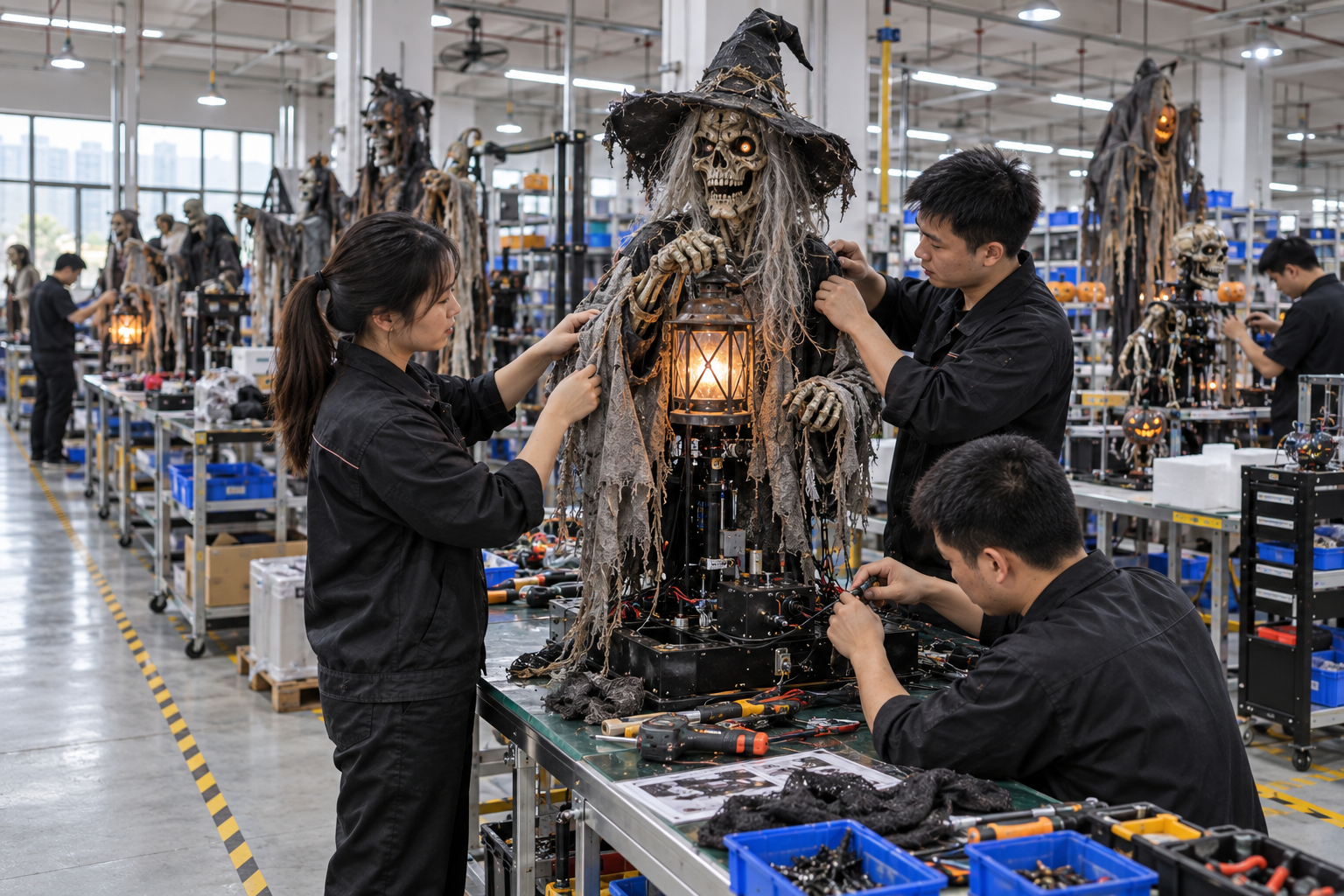
Involve the supplier with a structured evidence pack
Send the supplier a concise set of issue cards rather than a long unsorted photo folder. Each card should show product revision, field observation, frequency or count if measured, venue condition, desired outcome and requested response. The supplier can then classify whether the change is a design revision, process correction, packing change, instruction update or site-use question.
Ask for feasibility, sample needs, cost and timing for each proposed change. Do not assume a correction is free or immediate, and do not accept a vague promise that it will be 'improved'. Agree the new acceptance evidence before production. For example, a revised costume fastening can be demonstrated on a sample and checked in selected production units.
If the original item was custom or licensed, verify that the proposed change is allowed under the customer's design and rights approvals. A new face or logo may need another review. Preserve the old approved reference and mark when it is superseded. The supplier should not have to infer which file from last season is authoritative.
Decision example: a successful prop with a difficult setup
Imagine a fictional attraction with a popular giant spider. Visitor feedback is positive, but the installation team reports that four similar legs are easy to swap, causing hours of trial and error. The spider's appearance and function are good; its assembly information is weak. This is a hypothetical example, not a BooAri customer result.
The buyer requests keyed or clearly labelled leg positions, a revised illustrated instruction and a closed-carton assembly trial by someone unfamiliar with the prototype. The supplier prices and samples this limited change. There is no need to redesign the spider's face or market it as a wholly new product. The next season's success criterion is installation clarity, not a subjective improvement in scariness.
Now imagine another venue reports that the spider's legs obstruct a walkway. That may be a site placement issue rather than the same assembly issue. The buyer separates these observations, checks the venue layout and decides whether a different footprint variant is needed. Grouping every complaint under 'spider redesign' would obscure the actual decisions.
Buyer worksheet: one-page next-season brief
For each SKU, list the prior revision, order quantity, sites, key observations, product condition, sales or visitor evidence, receiving and installation issues, and proposed outcome: repeat, revise, replace or retire. Give each proposed revision an owner, priority, sample gate and target decision date. Attach only the photographs that support the stated issue.
Add a section for what should not change. A prop may have a recognizable silhouette that customers liked. Protecting that successful feature can be as important as fixing a weak joint. State the approved design elements and where variation is allowed. This avoids an overzealous improvement that erases the product's appeal.
Before sending the new RFQ, reconcile remaining stock and spare parts. If the buyer has usable older units, decide whether revised parts are compatible and how mixed versions will be identified. Estimate the commercial value of the change with the buyer's own data. The supplier can then quote a realistic revision scope rather than guessing about inventory and rollout.
Prioritize revisions as a portfolio, not isolated complaints
A buyer may end the season with twenty issue cards and budget for only three changes. Rank them against the actual business outcome: safety or compliance first, then failures that prevented opening, then repeated installation or service cost, then visual refinements. Give each proposed change a confidence level based on evidence. A single staff comment and a repeated documented failure should not receive identical weight. This makes the next order discussion focused without discarding useful smaller observations.
Ask whether one change solves several problems. A revised component label might reduce installation time, prevent wrong-part damage and improve packing reconciliation. By contrast, a new paint colour may solve only a preference and could create sample, artwork and inventory complexity. The supplier can help assess manufacturability, but the buyer must state the desired outcome and commercial priority. Avoid asking for a blanket 'improved version' without trade-offs.
Set approval ownership by discipline. Creative staff approve appearance, operations approve setup practicality, technical staff approve supported functions and purchasing approves cost and timeline. An approval meeting should show the old reference, observed field evidence, proposed revision and test plan. If the proposed change affects a licensed design or local compliance, include the responsible rights or regulatory adviser. A supplier's sample should not be treated as fully approved because one team liked its photograph.
Keep a decision log for changes not made. 'Deferred because the venue route caused the issue' or 'not enough evidence to justify tooling' is useful next year. Otherwise the same request can return as though it were new. Review deferred issues after the next installation; some will disappear when the site changes, while others will become clearer.
At the end, issue a concise next-season specification with one revision number and references to the accepted sample, artwork, pack and test. The post-season review is complete only when the new order can be quoted and checked against it. A thick report with no orderable decisions is less useful than a short controlled brief that the factory and receiving team can follow.
Questions before sending a revision RFQ
Does each proposed change cite an actual field observation and affected SKU? Is the old approved sample available? Have operations and creative teams agreed what must stay the same? What test will show the change worked? If the answer is only 'it should look better', the request is not yet ready for production pricing.
Ask the supplier to identify effects on tooling, material, packing, delivery date and spare compatibility. Record the buyer's decision on changes that are deferred. A next-season brief should be short enough to quote but detailed enough to prevent the same misunderstandings.
Bring the next buyer into the review
The person placing the next order may not have visited the installation. Give them a short evidence packet: approved prior revision, actual field observations, photos, remaining stock, proposed changes and decisions not to change. Invite the site operator to explain the few high-impact issues directly. This transfer prevents a new buyer from treating the supplier's catalogue page as the complete history of the asset.
Frequently asked questions
When should a post-season review happen?
Collect observations before staff disperse and installation details are forgotten, then consolidate them after sales and return data are available. Do not wait until the next purchasing deadline to reconstruct the season from memory.
Should every customer comment become a design change?
No. Check whether the observation is repeated, whether it concerns the product or site, and what change would measurably help. Some issues are solved by instructions, route planning or staff training rather than redesign.
What should be sent to the manufacturer?
Send product revision, concise issue description, photos, operating context, desired outcome and requested evidence. Identify priority and timing. Avoid an unsorted folder of comments without clear decisions.
Can an unchanged SKU be reordered without checks?
Still confirm the approved revision, current components, artwork, packing and destination requirements. A repeat order is easiest when the prior reference is controlled, not when everyone assumes nothing changed.
How do we know a revision worked?
Define an approval test that corresponds to the problem: assembly trial, function cycle, finish comparison or packing review. Verify it on the sample and in production as appropriate. Avoid a vague sign-off that the prop 'looks better.'
Conclusion
A post-season Halloween prop review turns field experience into a clearer next order. Preserve evidence, classify the decision, specify the change and agree how it will be tested. The goal is not to redesign everything; it is to repeat what worked and correct the few decisions that constrained the season.
Send your SKU revision, field notes and next-season quantity through BooAri's project enquiry. Ask for a feasibility and sample plan for the specific changes you want to make, with successful features explicitly retained.
Further reading
Use these external resources alongside your local market, venue and professional safety requirements:
READY TO START A PROJECT?