

A modular Halloween arch or giant figure may have an invisible frame that determines whether the display can be transported, assembled and maintained. Buyers sometimes ask whether steel or aluminum is 'better'. That question is incomplete without span, geometry, connection details, site loads, lifting limits and the venue's approval process. The material choice belongs to a qualified structural design, not a universal blog rule.
This article helps procurement teams prepare a useful brief for that design. The ESTA Technical Standards Program is one place to identify relevant entertainment-industry standards and technical stakeholders; it does not turn a supplier quote into a certified installation. For hanging loads, use a qualified rigger and the separate overhead-prop procurement brief. Here we focus on floor-supported modular frames and the information a buyer can responsibly request.
State the installed geometry and operating environment
Give the designer a plan and elevation with maximum dimensions, intended silhouette, public clearance and position of the base. Include the expected viewing directions and whether visitors can touch or lean on the structure. A frame for a sheltered photo backdrop is not necessarily the same as one for an outdoor entrance. Site exposure, ground conditions and local approval can dominate the material debate.
Specify transport as a design input. What is the narrowest doorway, vehicle opening and lift? What maximum section mass can the receiving team handle with approved equipment? How many installation hours are available? The frame should be divided into sections around both structural and handling needs. Do not ask the fabricator to cut a finished frame merely because a carton proved too large.
Separate frame and finish responsibilities
The steel or aluminum structure may support a foam shell, printed panel, lighting and decorative accessories. Ask who designs the interface and who verifies the combined assembled mass. The finish can hide bolts and prevent inspection if access was not planned. Include inspection hatches and removal sequence in the brief before sculpting or coating begins.
Compare material through the whole connection system
Steel and aluminum differ in density, fabrication methods, corrosion behaviour and suitable joining approaches, but an actual frame is governed by selected alloy or grade, member section, weld or fastener design and workmanship. Request drawings and a construction description, not a one-word assurance. A lower-mass frame is useful only if the completed assembly and joints are appropriate for the site.
Examine detachable connections. Ask for a section map, numbered members, orientation marks, fastener specification and access space for tools. A modular frame repeatedly assembled by event staff needs clear physical indexing; otherwise similar-looking pieces may be swapped. The reusable-scenery connection guide addresses repeated assembly wear. If joints are covered by decorative skins, provide a reversible cover or access method.
Where a metal frame meets other materials, review movement and finish. A rigid attachment to a brittle scenic shell can create local cracks during transport. A flexible costume hanging from a frame may need rounded contact and a secure fastening method. These are design questions for the supplier and qualified reviewer; avoid substituting a generic 'heavy duty' label for drawings and trial assembly.
Discuss corrosion and finish in context
An outdoor frame may encounter rain, wet storage, cleaning products or salt air, but no metal is automatically maintenance-free. Ask what grade, coating or surface treatment is proposed and how exposed cut edges, welds and fastener interfaces are handled. A decorative paint finish may conceal early corrosion if the frame is not inspectable. Obtain care instructions matched to the actual finish and exposure.
For indoor repeated use, damage from transport may matter more than rain. Look at protective sleeves, case supports and contact points. A frame that is repeatedly dragged out of a crate can lose coating at exactly the places staff use for lifting. Designated handles or lift points may protect both the structure and the scenic surface.
If the buyer requests a corrosion or environmental test, agree the relevant method, sample configuration and acceptance with a competent specialist. A photograph of painted metal is not evidence of a particular environmental rating. The finished assembly, including fasteners, should be checked against the approved specification.
Trial assembly is part of supplier selection
Request a prototype of the most complex joint or a full mock assembly when the order justifies it. Use the intended tools and a realistic crew. Record how sections are laid out, joined, aligned, checked and removed. Observe whether connectors bind, holes align and decorative coverings still fit after tightening. A successful weld inspection does not prove that the modular structure can be installed in the available window.
For a large freestanding prop, the qualified reviewer may need actual mass, centre-of-gravity information, base interface and calculated loads. The manufacturer should provide accurate product data; the local engineer must evaluate the site and anchoring. Do not use this article as a stand-in for design calculations. If the venue cannot approve a proposed base footprint, change the concept before production.
Keep the acceptance record practical
The buyer can ask for drawings with revision numbers, critical dimensions, complete parts list, photographs of joints, a trial-assembly record and a packing map. Store them with the approved sample. At shipment inspection, count frame sections and hardware, check visible condition, and confirm identification marks remain readable after finishing. If a frame is nested in a crate, photograph each layer before closure.
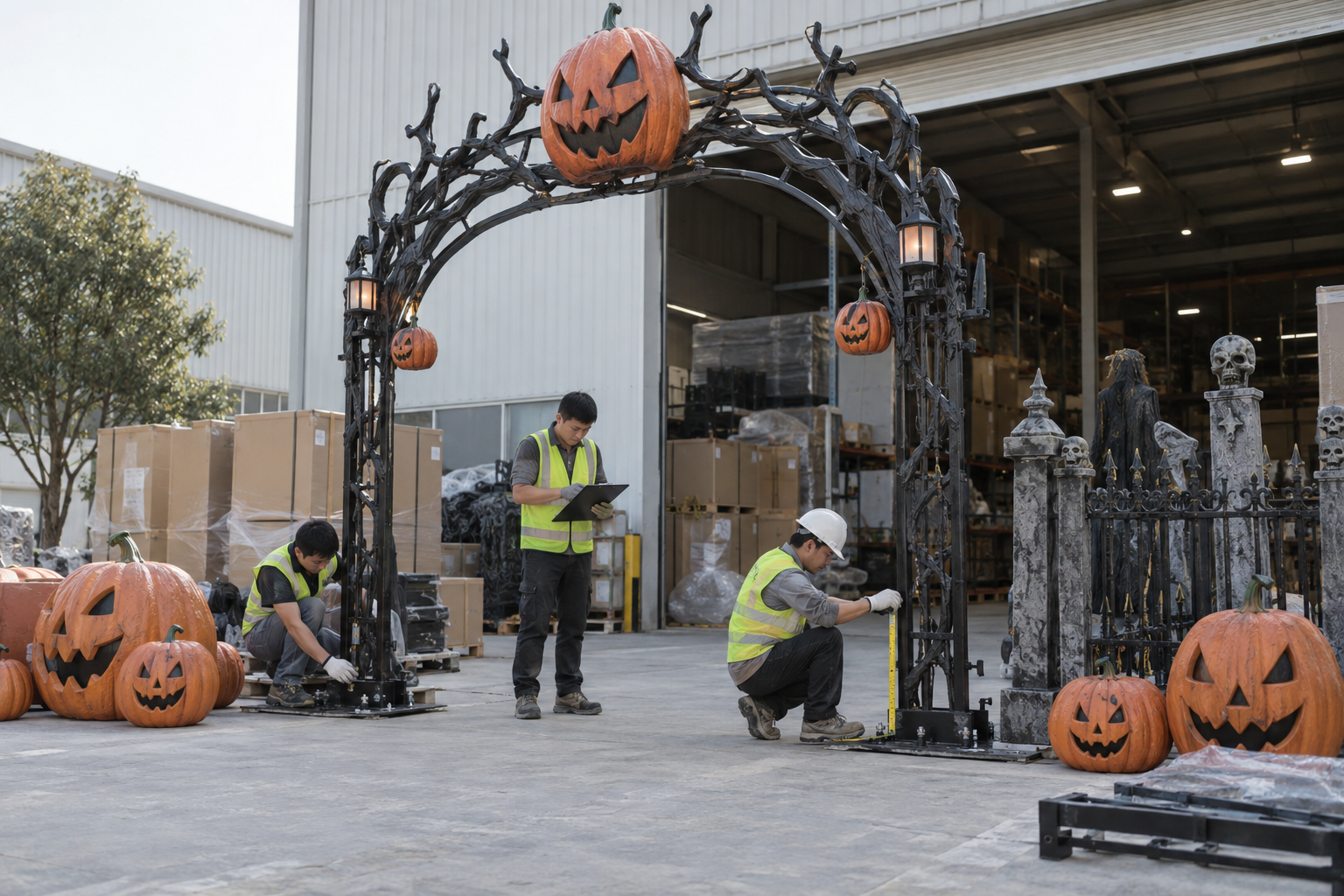
Compare installed cost, not metal price
Add fabrication, finishing, packaging, transport, handling equipment, installation labour, maintenance and storage to the comparison. A light material may save labour but require a different joint or surface treatment; a lower material cost may produce heavier freight or longer site assembly. Get current figures from the actual bidders and installer instead of adopting a made-up cost multiplier.
A hypothetical touring attraction might prefer a higher initial fabrication cost for repeatable labeled joints. A one-time sheltered exhibition may prioritize different factors. Neither scenario says what BooAri has built or promises that a material is suitable. The decision should be made against the agreed geometry, route and approval conditions.
Ask for an alternate quote only after holding the same design brief constant. If the alternate changes member dimensions, section count or base, note those as scope changes. A buyer who compares an aluminum concept with a differently sized steel concept is not measuring the material choice alone.
Detailed frame quotation comparison
Ask bidders to return a frame drawing with a component schedule, not just a total price. It should identify metal grade or alloy, member sizes, joint types, surface finish, major attachments and the proposed section split. The buyer need not calculate structural capacity, but can check whether two bids describe the same geometry and installed scope. Have the qualified reviewer assess the actual design assumptions and advise what information is missing. If a quote omits the base, scenic shell or installation hardware, mark that omission before comparing it with a more complete offer.
Request measured or justified estimated mass by section and the assembled unit. Mass distribution can be as relevant to handling as total mass. A tall frame with a heavy upper scenic element may create a site question that a simple weight figure hides. The local team should review floor loading, anchoring and visitor interaction for its venue. Include transport and handling costs for each section; a lower fabrication price can become expensive if the resulting piece needs specialist unloading.
Ask how the frame will be protected during shipment. Coating scratches at exposed corners may become maintenance points, particularly if the structure is reused. Include an identified repair method for finish damage and a pack design that supports members without bending or abrading decorative skins. The crate and pallet guide can help clarify unloading equipment and site access.
Inspection points hidden by scenic finishing
Before foam or fiberglass covers the frame, request a planned production check on major joints, interfaces and identification marks. The exact method belongs to the qualified manufacturer and inspector, but the buyer should know which parts will become inaccessible. If an inspection concern is discovered after the shell is finished, remediation can be costly and may damage the approved appearance. A staged record can therefore be more useful than a single end-of-line photograph.
After scenic assembly, inspect bolt access and whether finish panels can be removed without damage. Assemble from packed sections, then remove one service panel as a maintenance trial. A frame that looks excellent only before it is covered is not an installable product. Keep the drawings and site-approved as-built record with the prop. If the venue changes the base or attachment later, recheck the technical approval instead of assuming the original factory review still applies.
Decision review: make the evidence comparable
Before selecting a quotation, write a one-page decision record for specify a structural frame brief. Start with the customer requirement, not a supplier feature. The same installed dimensions, destination, display period and approval date should appear on every option being compared. If two offers use different product scope, record the difference as a separate alternate. Otherwise a cheap option may simply omit work that the other bidder included.
For this guide, the useful sample is the most complex metal joint assembled with the intended crew and tools. Ask for its revision and say what it can and cannot demonstrate. The critical inspection focus is alignment, fastener access, finish damage and identification marks. Set the viewing or operating condition in advance, then photograph or record the outcome. The person approving the sample should know whether a visual result, a technical function or a packing action is being accepted. One attractive image does not cover all three.
The packing question is member length, section mass and protection around attachment points. Measure or verify the proposed shipping unit rather than assuming an installed dimension will predict freight. At the site, the practical question is whether the floor and base interface can obtain qualified local approval. Ask the receiving and operations teams to answer it before the purchase is called complete. If they cannot answer from the supplier's proposed evidence, the project has an unresolved interface, not merely a documentation preference.
Keep a short decision log
Create columns for requirement, offered configuration, evidence, owner, approval status and unresolved risk. Mark evidence as a physical sample, drawing, supervised test, production record or professional site review. Those are not interchangeable. A factory test can validate a product function; it cannot approve unknown local conditions. Conversely, a site plan can show access but not prove the final batch matches the sample. Give each open item a person and date rather than leaving it in an email thread.
Challenge the proposal with a failure scenario
Imagine that the lightweight option still needs a larger base than the venue permits. Ask what the operator would first observe, what should be stopped, which record identifies the affected unit and what corrective action can be checked. This is a stress test of the proposed purchase, not a claim that the failure has happened in a BooAri project. The answer may reveal a need for a revised sample, a clearer part ID, a different pack, or a local professional decision.
One viable route to examine is redesigning geometry or placement rather than substituting metal by name alone. It is an option to test, not a universal prescription. Estimate its effect on price, lead time, appearance, freight and maintenance. If the alternative changes the approved specification, issue a new revision and repeat the affected checks. Do not rely on verbal assurances that the change is minor. The buyer should be able to trace why the new option was accepted.
Close the record only when the buyer, supplier and destination owner agree what will be shipped and what remains a site responsibility. At shipment inspection, compare the production item and documents with that decision record. If the product arrives later with a changed component, the record tells the team which approval must be reopened. This discipline is more useful than a vague claim that a prop is 'commercial grade' because it ties the actual purchase to observable evidence.
Final frame release question
Before releasing fabrication, ask whether the exact approved frame can be recognized after the scenic surface is added. Label section IDs and retain a simple as-built drawing. When the first finished structure is assembled, compare its base interface and actual mass with the values given to the site reviewer. If there is a material or geometry change, the responsible professional should revisit the decision; a revised quote is not the same as revised structural approval.
For a seasonal asset, choose a storage position that does not force members to carry unintended loads. After the first dismantling, photograph joint wear and any corrosion or finish damage. That evidence can guide the next year's maintenance. It also helps procurement decide whether the apparent saving from a lighter or cheaper frame survived actual handling.
Frequently asked questions
Is aluminum always the lighter finished frame?
Not automatically. Member sizes, bracing, connections and base construction determine finished mass. Compare designed assemblies, not density alone.
Can the factory certify an outdoor frame from a catalogue picture?
No responsible approval follows from a picture. Site loads and anchoring require project-specific information and qualified local review.
What should be shown in a frame sample?
The most critical connection, realistic assembly sequence, access to fasteners, protective interface with the scenic skin and packing method.
Who owns the base and floor interface?
The purchase contract should say. The venue or qualified installer must approve local floor conditions and attachment; the manufacturer provides accurate product interfaces.
Conclusion
Choose frame construction through a documented design and installation process. The best quote is the one that makes geometry, joints, inspection and site responsibilities visible. Send BooAri your venue drawing, section-size limits, exposure, reuse plan and target quantity through Send Your Requirements so the right technical questions can be raised before fabrication.
Further reading
Use these external resources alongside your local market, venue and professional safety requirements:
READY TO START A PROJECT?