
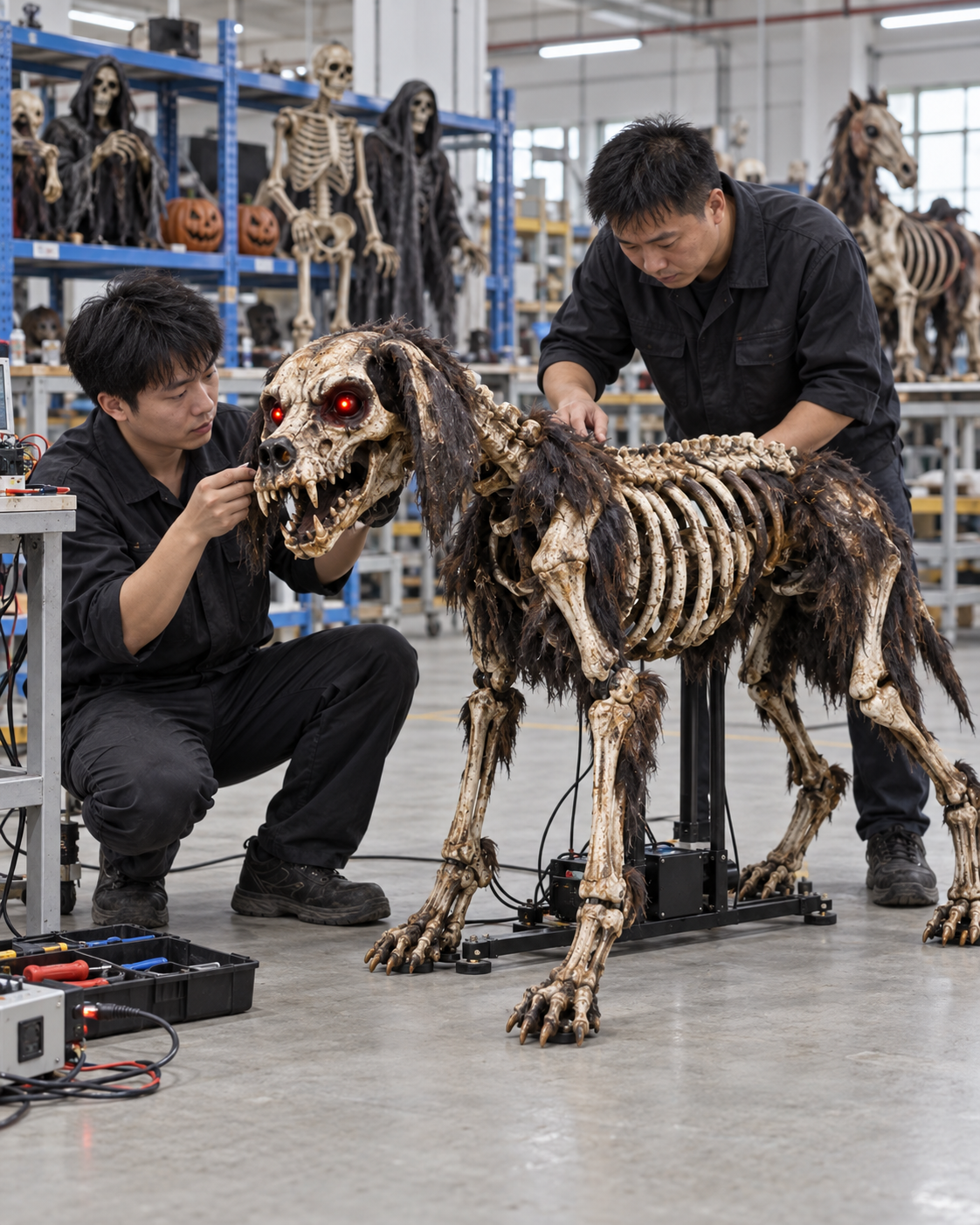
Animatronic throughput planning compares visitor arrivals with the time an effect needs to perform, return and become ready again. A prop can deliver a strong individual reveal yet miss later groups if its full recovery period is longer than the route allows. Specify complete cycle behaviour before committing to the display.
The relevant times are not always obvious in a product video. A short clip may show only the dramatic movement and omit the return, ready delay or controller lockout. Buyers should request an uninterrupted demonstration that includes both the visible performance and the recovery sequence.
This guide uses hypothetical timings to illustrate the purchasing method. They are not BooAri product performance data or a recommendation for visitor capacity. The actual manufacturer's operating limits and the venue's route plan determine what the system can support.
Define performance, return and readiness
Separate three stages: the visible effect, the physical return to its starting condition and the controller's readiness to accept another event. These stages may overlap or occur sequentially depending on the design. Ask the supplier to describe the actual behaviour rather than applying a generic model to every animatronic.
Record when the effect begins relative to the trigger. A programmed start delay is different from a slow response caused by an issue. If the creative team wants a brief pause before the reveal, include it in the accepted sequence. The controller and operator need the same understanding of what normal behaviour looks like.
Ask whether the prop indicates readiness and how staff can recognize an incomplete return. A visible home position may help, but it is not necessarily an electrical or control confirmation. Use the manufacturer's instructions to define the check relevant to the product.
Request an uninterrupted demonstration
An acceptance video should show the initial ready state, one activation, the complete performance and the next accepted activation. Identify the settings and product revision. A montage of separate movements can explain appearance, but it cannot establish the interval between complete cycles.
Compare the full cycle with group arrivals
Suppose, for calculation only, the visible effect takes eight seconds, return takes four and the controller then holds a six-second readiness delay. If these stages are sequential, the total ready-to-ready interval is eighteen seconds. Groups arriving every twelve seconds cannot all receive one new complete cycle under that assumption.
This does not establish that the route is unsafe or commercially unsuccessful. It identifies a planning mismatch. The venue might accept an effect for alternate groups, change the scene placement or choose another configuration. The creative and operating teams should decide which outcome fits the visitor experience.
Calculate with actual measured behaviour and documented controller logic. If return and delay overlap, simply adding values may overstate the interval. If the controller queues a trigger, the observed start can occur after visitors have moved away. Ask how the product handles those conditions before using a spreadsheet as a capacity promise.
Define what should happen to a second trigger
A trigger received during a cycle can be ignored, queued or affect the existing sequence, depending on the controller. Each behaviour changes the visitor experience. Ignoring may miss a later group; queueing may start an effect for an empty scene; restarting may interrupt the original reveal.
Write the intended response in plain language. For example, the venue may want one complete scene for the first visitor crossing a threshold, then no retrigger until the prop returns. That is a requested behaviour, not a statement that every BooAri controller supports it.
If the product has adjustable logic, record the accepted setting and who owns later changes. Uncontrolled adjustments can alter the scene's timing without changing the visible prop. Staff need to know whether a difference is intentional or indicates a fault.
Consider dwell time and sightlines
An effect can recover quickly yet remain poorly matched to the route if visitors cannot see it when it runs. Compare the activation point with the visitor's viewing position. A group may cross a sensor before rounding a corner, or move beyond the character before a delayed movement starts.
Use a walkthrough with the proposed scenery. Observe the first and last person in a representative group. The desired moment may work for the leader but not for those following. A second viewing angle or a different trigger position can improve the presentation without changing mechanical speed.
Queue-line effects introduce another pattern: people may remain in view for several cycles. Decide whether repeated performances enrich the waiting experience or become distracting. Throughput is not always the dominant measure; dwell quality and audio repetition can matter more.
Compare single visitors and groups
A nominal arrivals-per-hour figure does not describe group spacing. Visitors arriving in clusters create different activation demands from evenly spaced individuals. Record group size, pause behaviour and route uncertainty in the trial so the timing model reflects the experience being bought.
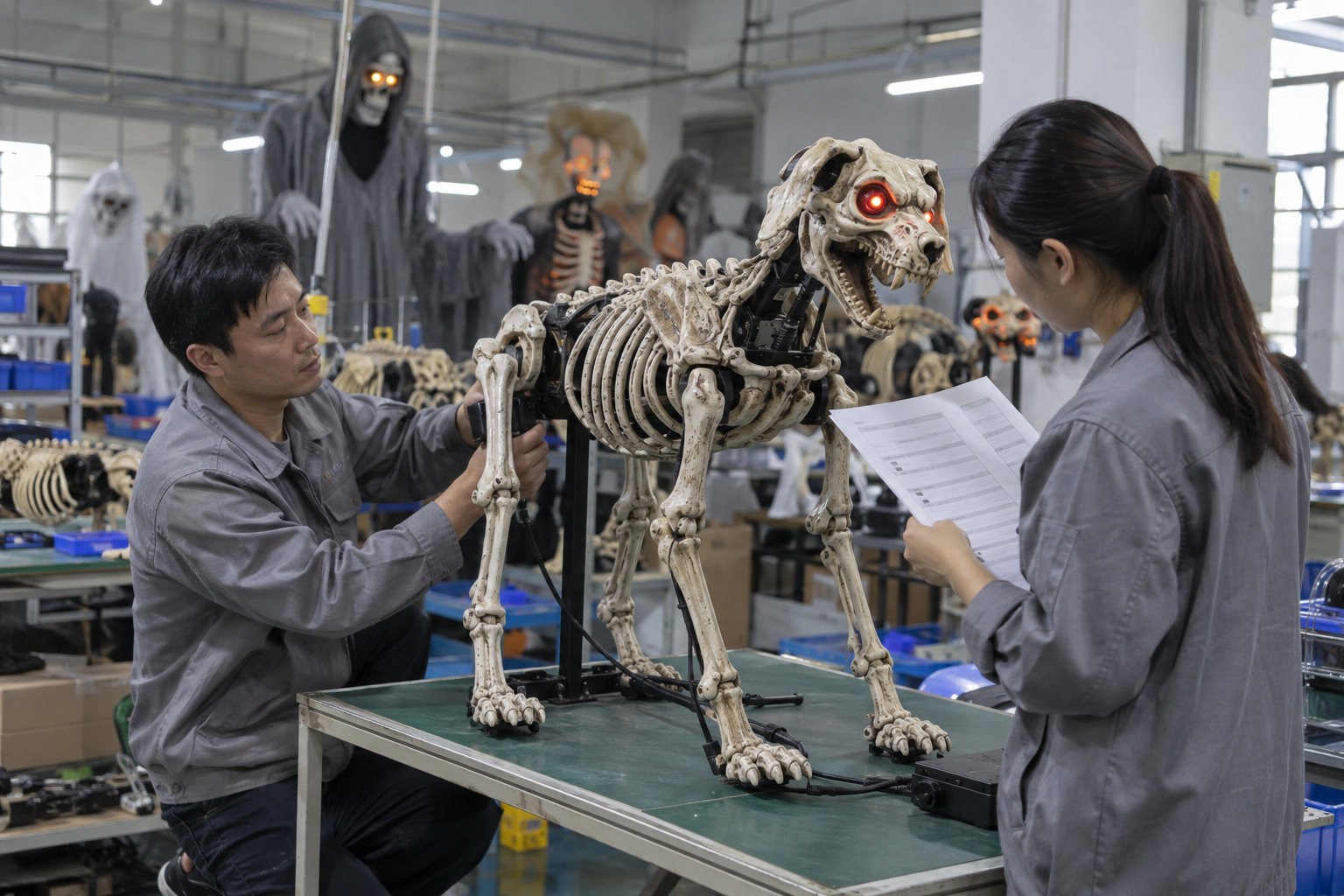
Ask about duty-cycle and operating limits
Readiness for another trigger does not necessarily mean continuous operation is within the manufacturer's recommended use. Ask for the applicable operating limits and care instructions for the exact configuration. Mechanical design, control settings and component selection can affect the answer.
Do not extrapolate a brief successful demonstration into a lifetime or an all-night continuous-use claim. If the venue needs a demanding schedule, describe it to the supplier and request the evidence appropriate to the order. A factory trial should be scoped around the declared requirement and documented limitations.
Record how the product should be handled after an interruption or incomplete return. Staff should not manually force moving components into position based on appearance. Follow the manufacturer's procedure and agree who can diagnose or service the system.
Review trigger selection alongside timing. Send BooAri the expected group spacing and scene sketch through the custom-project page so the proposed animatronic direction can be evaluated in the intended route.
Build a timing trial with measurable observations
Prepare an observation sheet with trigger event, effect start, performance end, return completion and next accepted activation. Use a consistent timing reference. Record the controller settings and environment so another reviewer can interpret the result.
Run the trial with both the intended spacing and a plausible interruption pattern. A group stopping near the sensor or a staff member crossing the route may create repeated input. Observe the system's response without changing several variables at once. The trial should reveal logic and recovery, not simply count successful movements.
Define an acceptable visitor result. The buyer might require that the complete reveal remains visible for the intended group, or that later visitors do not interrupt it. State these criteria before testing so a fast cycle is not approved even though it weakens the creative effect.
Include reset visibility in scene design
Physical return can be visible, audible or both. In some scenes it becomes part of the character's performance; in others it exposes the mechanism and weakens the illusion. Ask the creative team how the return should be treated at the actual viewing position.
Scenery can hide selected parts of the return, but should preserve required access and clearance. Do not enclose moving components without the supplier's guidance. A faster route may need a more compact effect rather than heavier visual concealment that makes maintenance difficult.
Consider sound during recovery. An otherwise compelling character may repeat an audio segment or mechanical noise that guests hear while waiting. Review the audio-zone guide if sound contributes to the timing problem.
Compare alternatives without reducing everything to speed
An effect with a longer cycle may still be the better choice when visitors dwell in the scene and expect a deliberate performance. A short burst can suit a faster route, but may deliver less narrative detail. Compare the complete experience, technical support and operating demands.
Ask whether the effect sequence can be adjusted within the manufacturer's supported range. A setting change may alter return or readiness without requiring another product. However, an unsupported speed change can affect loads and behaviour; the buyer should not request it as a casual modification.
Sometimes the best alternative is static scenery with a separate controllable light or audio moment. That choice changes the buying scope and may suit the venue's staffing. It should be described honestly rather than sold as mechanically equivalent to the original animatronic.
Document the accepted scene for shipment and installation
Keep the product revision, supported trigger, timing settings and demonstration with the approved reference. Shipment inspection can verify the identified configuration and agreed visible sequence. Site commissioning then checks visitor position and the installed environment.
Include an operating handoff for venue staff. Explain normal ready state, expected response, limitations and the contact route for an abnormal condition. The local team should define opening and interruption procedures based on the actual manufacturer documentation.
After opening, record observed group behaviour and timing exceptions. A scene may operate differently from a rehearsed trial because visitors pause, return or approach unpredictably. Use those observations for controlled adjustments or the next order rather than making unsupported performance claims from a single evening.
Buyer worksheet: model a full visitor sequence
Build a timeline with visitor arrival, detection, effect start, visible action, return, lockout and readiness for the next activation. Request each interval for the proposed configuration and ask how it was measured. A headline cycle time may exclude reset or intentionally ignore triggers during operation. Those omissions matter when groups arrive frequently. Do not substitute a video duration for a defined timing sheet unless the footage shows the whole uninterrupted sequence.
Use a hypothetical arrival pattern to examine capacity. Suppose a group reaches the scene while the effect is halfway through its action. Decide whether the next group can still see the meaningful moment, waits for a reset or walks past an inactive character. The answer can lead to a different scene layout, a shorter cue or an operator-controlled sequence. No universal visitors-per-hour figure follows from the mechanism alone because group size, walking speed and staffing vary by venue.
Ask the manufacturer what repeated operation has been demonstrated for the product revision and under what conditions. Duty-cycle language must be tied to a specified mechanism and use. If the operating schedule requires frequent activation, include that schedule in the enquiry and scope any relevant validation. Do not infer endurance from a single factory run. Conversely, a slow theatrical action may be entirely suitable if the visitor route provides a planned pause.
During a sample review, time several complete cycles and note variation, return position and response to a second trigger. Record the settings used. Include sound and lighting in the same timeline if they are synchronized. The final venue walkthrough should repeat the check with actual approach distances and visitor movement. Hand operators the approved timing and response rule so an intentional retrigger delay is not mistaken for a fault.
Questions to close with the operations team
Ask how groups actually arrive at the scene, not only how the designer expects them to arrive. Use observed or planned route patterns to check whether a prop can present its main action before visitors move on. A long hold at the start of a cue may work in a staged show but fail in an open retail aisle.
Record the complete timing sequence, including sound, lighting and the period when another trigger is accepted. FrightProps' trigger-option comparison illustrates why the controller and input choice belong in the timing discussion; confirm the actual product's behaviour. If an operator can alter timing, identify the approved control and the version of the settings used in the factory test. Improvised speed changes can affect visual presentation and technical suitability; use the supplier's supported options.
Consider the consequence of a stalled or incomplete return. The venue should have a clear way to pause the scene and request technical support. Staff should not force the mechanism into its rest position without the manufacturer's procedure. Include these operating responsibilities in the handoff, not only the purchase quote.
Decision example: one prop, two arrival patterns
Imagine a fictional corridor where visitors arrive either as a guided group or as an unsupervised trickle. The same animatronic runs a visible action and then needs a return interval. Under guided operation, the host can pause the group until the cue is ready. Under free flow, a second visitor may pass while the character is returning. The hardware has not changed, but the suitability of its timing has.
The buyer should ask whether the route will use an operator-controlled trigger, a waiting mark or a different scene placement. Record the proposed solution in the operational brief and demonstrate its real sequence. Do not respond to a throughput concern solely by asking the supplier to speed the mechanism; that may be outside the supported configuration. A scene can be effective at a slower pace when the audience is deliberately held for it.
This example also clarifies the evidence needed. Factory footage should show the full action and reset under the quoted controller settings. The venue walkthrough should test the actual arrival pattern and staff role. If the free-flow route cannot show the intended moment consistently, the team can change the route or choose another effect before purchasing volume units.
Frequently asked questions
Is cycle time just the length of the movement?
No. Buying decisions should consider the full ready-to-ready behaviour, including any start delay, physical return and controller readiness interval. The stages can overlap depending on the design. Request an uninterrupted identified demonstration and calculate using the actual sequence rather than adding generic timings from a sales description.
Can a prop serve every visitor group?
Only if the arrival pattern, viewing time and supported operating behaviour align with that goal. Group spacing is variable, and some scenes intentionally perform less frequently. The venue should define the desired experience, then test it with the proposed trigger and effect. Avoid a capacity promise without those conditions.
What if a second trigger arrives during the effect?
The controller's logic determines the response. It may ignore, queue or otherwise handle the event. Ask the supplier to demonstrate the proposed behaviour and document settings. The desired response should be part of scene approval so later adjustments do not unintentionally change the visitor experience.
Does a successful timing trial prove long-term reliability?
No. It confirms observed behaviour under stated conditions. Operating limits, durability evidence and maintenance requirements are separate questions for the manufacturer. Describe the planned schedule and request appropriate evidence. Preserve the test record without presenting it as a lifetime or continuous-operation guarantee.
Conclusion
Animatronic throughput depends on recovery and visitor position as well as movement. Measure the complete sequence, confirm retrigger logic and rehearse the actual route. A documented timing decision lets procurement, creative staff and operations evaluate the same product against the same intended experience.
Send BooAri your group-spacing assumptions, desired reveal and opening schedule. Ask for supported timing behaviour and an uninterrupted factory demonstration. Use the enquiry form to include the effect's role in the visitor journey, not just the character image.
Further reading
Use these external resources alongside your local market, venue and professional safety requirements:
READY TO START A PROJECT?