
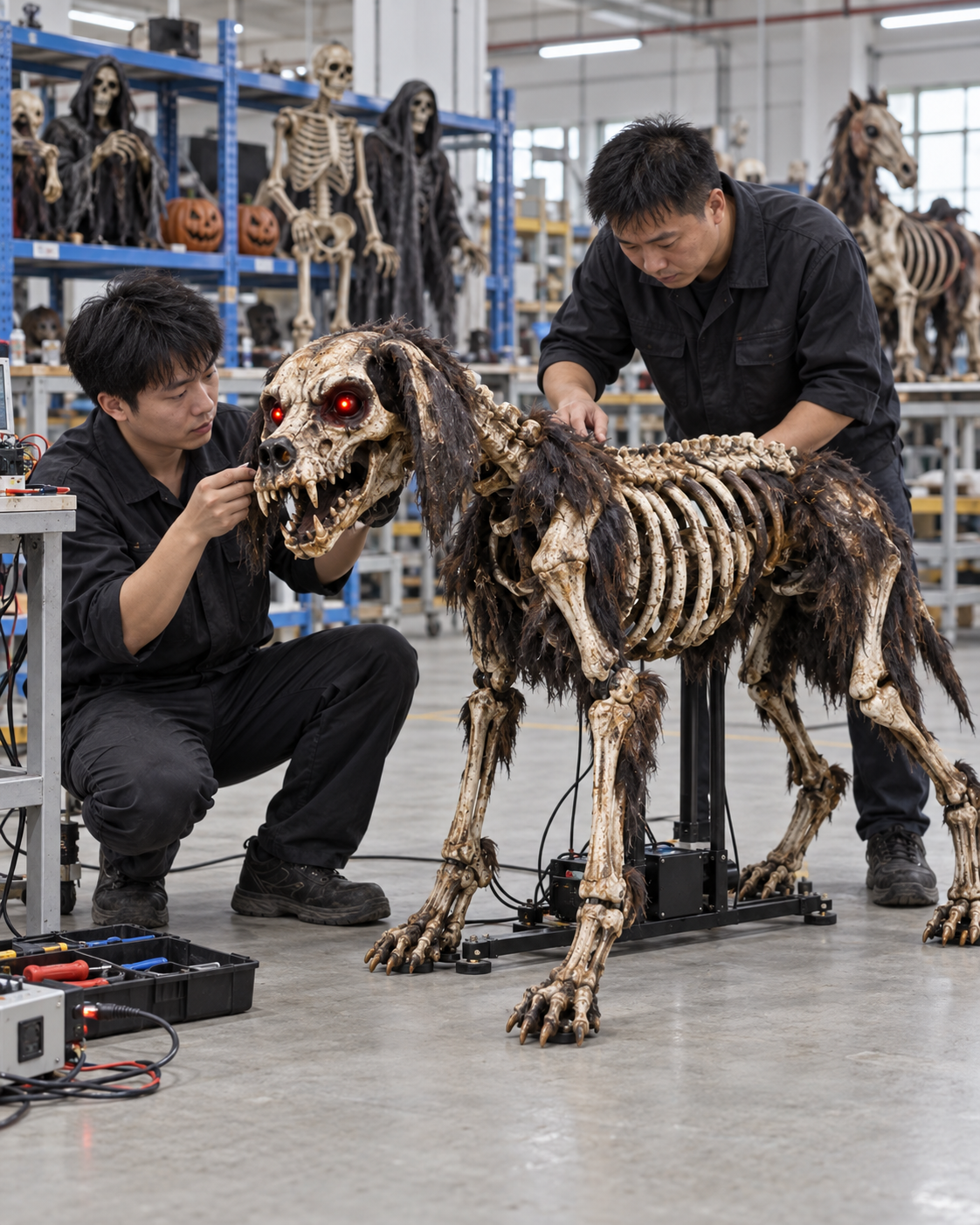
A Halloween animatronic that fails during opening hours creates an operational decision, not only a warranty question. The venue needs to know when to stop the effect, who may isolate it, how the visitor route remains safe, what evidence to capture and whether a reset is permitted. These decisions should be briefed before the order, because access panels, controls and spare parts are easier to design while the product is still being developed.
This article is a buyer framework, not a maintenance or lockout procedure for a specific machine. OSHA's control-of-hazardous-energy overview underscores why servicing energized or moving equipment requires a qualified, site-specific process. The site safety team must write its actual procedure. For routine care, see the animatronic maintenance and spare-parts guide.
Define normal, degraded and stopped states
The buyer should ask the manufacturer to describe what normal operation looks like: trigger, movement, light, sound, cycle time and reset. Then list plausible abnormal states: no response, partial movement, repeated retriggering, jam, unusual sound, loose costume or exposed cable. Each state needs an observable sign and an operating response. Staff should not improvise by repeatedly restarting a device that may be damaged.
Decide the safe customer-facing state. If an animated figure stops, can it remain as a static display without blocking the route, or must the area be closed? A prop positioned over a path may require a different response from a figure behind a barrier. These are venue decisions informed by product geometry and local assessment, not something a generic supplier warranty can decide.
Set reset authority
Distinguish a routine operator reset from technical service. An attendant might be allowed to use a defined front-panel command after a harmless communication interruption. A jammed actuator, damaged cord or loose frame needs qualified isolation and inspection. The handover should identify who may do what, under the site's rules. Do not give all staff a vague instruction to 'turn it off and on'.
Make fault information visible without exposing hazards
Ask whether the controller shows useful status, such as power, trigger received, output disabled or a fault code. The buyer needs enough information to report a problem accurately. However, diagnostic access should not encourage untrained staff to open energized compartments. Place routine indicators and service panels according to the design and local safety review.
Create a short fault log: unit ID, date and time, symptom, state before failure, visible damage, operator action and photo or video if safe. Record environmental context, such as rain exposure or a recently changed show file, without assuming causation. The log helps the supplier and site technician distinguish a product fault from a site input problem.
In the show-file handoff guide, version identity prevents a repaired unit from returning with a different cue. Link the fault record to controller and firmware version when relevant. Never upload confidential keys or visitor data into a public service ticket.
Agree the factory fault scenarios
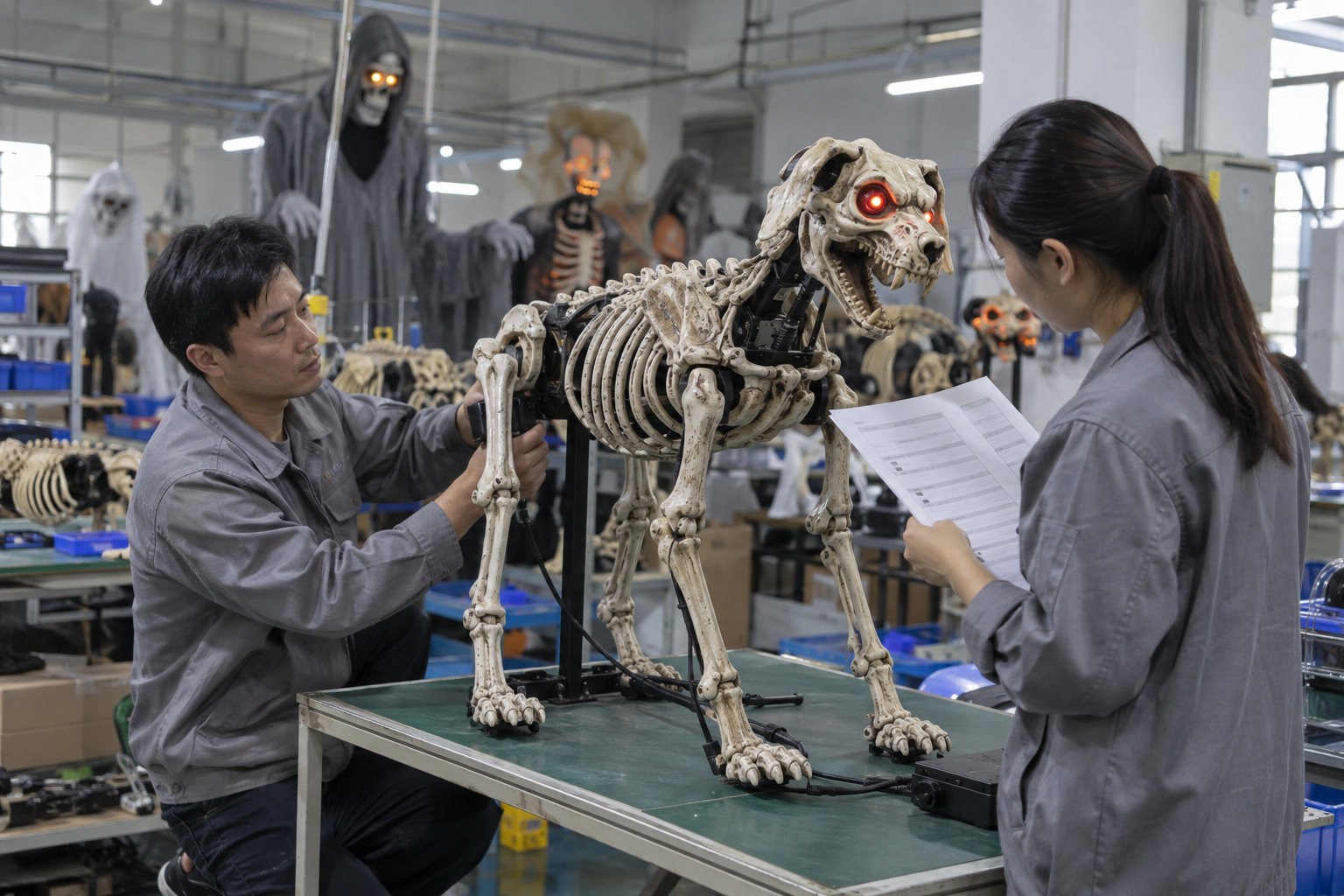
Factory acceptance should include normal cycling and carefully planned recovery demonstrations that do not create unsafe conditions. For example, a supervised power-interruption and restart test may show whether the prop unexpectedly moves on restoration. A sensor-disconnect scenario may be relevant for another design. The qualified product team must choose safe test methods and pass criteria. Do not induce a mechanical jam solely to make a dramatic video.
Ask for a video of the complete approved operating cycle, reset and stop. Record unit identity and controller settings. Then show where the operator control and service isolation points are, within what the manufacturer is authorized to demonstrate. A factory result does not substitute for commissioning after installation; site power and integration can change behaviour.
If the device has pneumatic components, discuss pressure isolation and residual energy separately with the competent technical team. If it has motorized parts, inspect reachable pinch areas and guards. If it has a battery, include charging and isolation rules. 'Animatronic' is not a single hazard category, so the buyer brief should identify actual energy sources and interactions.
Design access and spare strategy around downtime
Clarify which modules can be replaced at the venue and which must return to the manufacturer. A quick-swap controller can be valuable only if a trained person has the compatible spare, approved configuration and safe access. A spare actuator without a matching connection or mounting instruction does not reduce downtime. Request part numbers and version compatibility in the maintenance pack.
The scene layout should allow service without dismantling unstable scenery or blocking a critical exit. Identify the minimum access space and whether a barrier can isolate the prop from visitors. If the access panel is hidden behind a decorative wall, include removal steps and the tools needed. The replacement-part identification guide helps keep spares aligned with the production revision.
Set a realistic escalation chain: attendant observes and isolates according to site rules; technical lead assesses; supplier receives the fault evidence; management decides whether the effect remains closed. The exact names and response times belong to the venue contract, not this article. Avoid promising that every fault can be repaired overnight.
Use failure scenarios in the purchase decision
Compare two product offers by the normal effect and the recovery process. A more dramatic motion may need more service access, spare stock and staff capability. If the venue cannot support those needs, a simpler effect may be the more reliable purchase. This is a commercial judgement about total operating effort, not a claim that simpler technology never fails.
A hypothetical haunt has one animated character in a narrow transition room. If that character stops in a pose that obstructs the path, the venue needs a shutdown and route plan before opening. A wider scene with a static backup may tolerate a stopped effect until the next service window. These are planning examples, not BooAri operational records.
Handover and daily checklist
Provide unit ID, startup and shutdown steps, expected sequence, stop-use signs, permitted operator reset, technical contact, part identifiers and fault-log template. Train the appropriate staff on the actual installed device. At daily opening, run a controlled cycle, check barriers and clearances, inspect obvious damage and confirm that the effect returns to its expected state. Document exceptions rather than hiding them for the sake of keeping the show running.
Write a stop-use rule for the exact scene
The venue should define observable conditions that require immediate isolation: exposed wiring, unexpected motion, loose support, repeated breaker trip, uncontrolled restart or visitor access to a moving mechanism. The list should be tailored by qualified staff to the actual prop. Attach photographs of normal positions and controls so attendants can distinguish an intended horror effect from a fault. The rule should specify whom to notify and how visitors are kept clear, without asking attendants to diagnose a hidden mechanism.
Create a simple decision card for the shift supervisor. It can distinguish 'effect inactive but structurally secure', 'abnormal motion or noise' and 'visible physical damage'. For each, identify whether the scene remains open as a static display, is bypassed, or is closed pending qualified review. A planned static fallback may preserve visitor experience while avoiding unsafe improvisation. The card is not a technical isolation procedure; the site's competent team must provide that separately.
During factory approval, observe the stopped pose as well as the animated pose. If a failure could leave a large arm projecting into the route, the product or scene may need redesign. Recovery planning therefore belongs before final installation, not solely in an after-sales manual.
Make support evidence actionable
When a fault occurs, record the unit ID, timestamp, sequence step, trigger condition, configuration version and visible symptom. If safe, capture a short video from outside any restricted zone. Identify the last change to power, controller, sensor or scenery. This helps the technical lead reproduce the issue without asking venue staff to bypass guards or cycle a damaged unit repeatedly.
Agree how the supplier responds to a clear evidence package. A remote troubleshooting call may resolve a configuration issue, while a mechanical failure may need parts or onsite service. State what is within warranty, what is a site integration issue and what remains unknown until diagnosis. Avoid promising a fixed resolution time for every failure. The buyer can instead require an escalation contact, parts policy and a way to approve corrective action before reopening the effect.
Decision review: make the evidence comparable
Before selecting a quotation, write a one-page decision record for plan operational recovery. Start with the customer requirement, not a supplier feature. The same installed dimensions, destination, display period and approval date should appear on every option being compared. If two offers use different product scope, record the difference as a separate alternate. Otherwise a cheap option may simply omit work that the other bidder included.
For this guide, the useful sample is normal operation and a safe, supervised recovery scenario on the final unit. Ask for its revision and say what it can and cannot demonstrate. The critical inspection focus is fault indicators, stop-use signs, access and restart authority. Set the viewing or operating condition in advance, then photograph or record the outcome. The person approving the sample should know whether a visual result, a technical function or a packing action is being accepted. One attractive image does not cover all three.
The packing question is identified spare modules and the correct service documentation. Measure or verify the proposed shipping unit rather than assuming an installed dimension will predict freight. At the site, the practical question is whether the route remains safe with the effect disabled. Ask the receiving and operations teams to answer it before the purchase is called complete. If they cannot answer from the supplier's proposed evidence, the project has an unresolved interface, not merely a documentation preference.
Keep a short decision log
Create columns for requirement, offered configuration, evidence, owner, approval status and unresolved risk. Mark evidence as a physical sample, drawing, supervised test, production record or professional site review. Those are not interchangeable. A factory test can validate a product function; it cannot approve unknown local conditions. Conversely, a site plan can show access but not prove the final batch matches the sample. Give each open item a person and date rather than leaving it in an email thread.
Challenge the proposal with a failure scenario
Imagine that a prop repeatedly restarts into a partial-motion fault during opening hours. Ask what the operator would first observe, what should be stopped, which record identifies the affected unit and what corrective action can be checked. This is a stress test of the proposed purchase, not a claim that the failure has happened in a BooAri project. The answer may reveal a need for a revised sample, a clearer part ID, a different pack, or a local professional decision.
One viable route to examine is isolating the effect and using a static scene fallback while qualified staff assess it. It is an option to test, not a universal prescription. Estimate its effect on price, lead time, appearance, freight and maintenance. If the alternative changes the approved specification, issue a new revision and repeat the affected checks. Do not rely on verbal assurances that the change is minor. The buyer should be able to trace why the new option was accepted.
Close the record only when the buyer, supplier and destination owner agree what will be shipped and what remains a site responsibility. At shipment inspection, compare the production item and documents with that decision record. If the product arrives later with a changed component, the record tells the team which approval must be reopened. This discipline is more useful than a vague claim that a prop is 'commercial grade' because it ties the actual purchase to observable evidence.
Final operations release question
Before opening, ask the shift supervisor to explain the prop's stop-use signs without consulting the builder. If the person responsible for visitors cannot distinguish a normal reset pause from a fault, the handover needs work. Demonstrate the authorized operator actions while qualified staff are present, and give technical contacts a route to the versioned product record.
After a real fault, review whether the planned response worked. Was the scene isolated quickly? Was the record sufficient for diagnosis? Did staff attempt an unapproved restart because the control was easy to reach? Use those observations to update training, barriers or access. The first failure should not be treated solely as a warranty ticket; it is also evidence about the venue's operating design.
Frequently asked questions
Should an attendant restart a jammed animatronic?
Not without the site-approved procedure and qualified assessment. Repeated restart may worsen damage or create a hazard.
Is factory testing enough for fault recovery?
No. Factory tests verify the product configuration. The site must commission the installed system and train staff under local rules.
What should be in a fault report?
Unit identity, symptom, time, operating context, visible damage, actions taken and safe visual evidence. Include configuration version when relevant.
Is a spare module sufficient to prevent downtime?
Only if it is compatible, accessible, configured and installable by authorized staff within the venue's service window.
Conclusion
Procure the recovery path with the effect. Defined fault states, access and responsibilities make a prop manageable after the first successful demonstration. Send BooAri your scene layout, operating hours, effect sequence and technical-support model via Send Your Requirements to discuss an appropriate acceptance and handover plan.
Further reading
Use these external resources alongside your local market, venue and professional safety requirements:
READY TO START A PROJECT?