
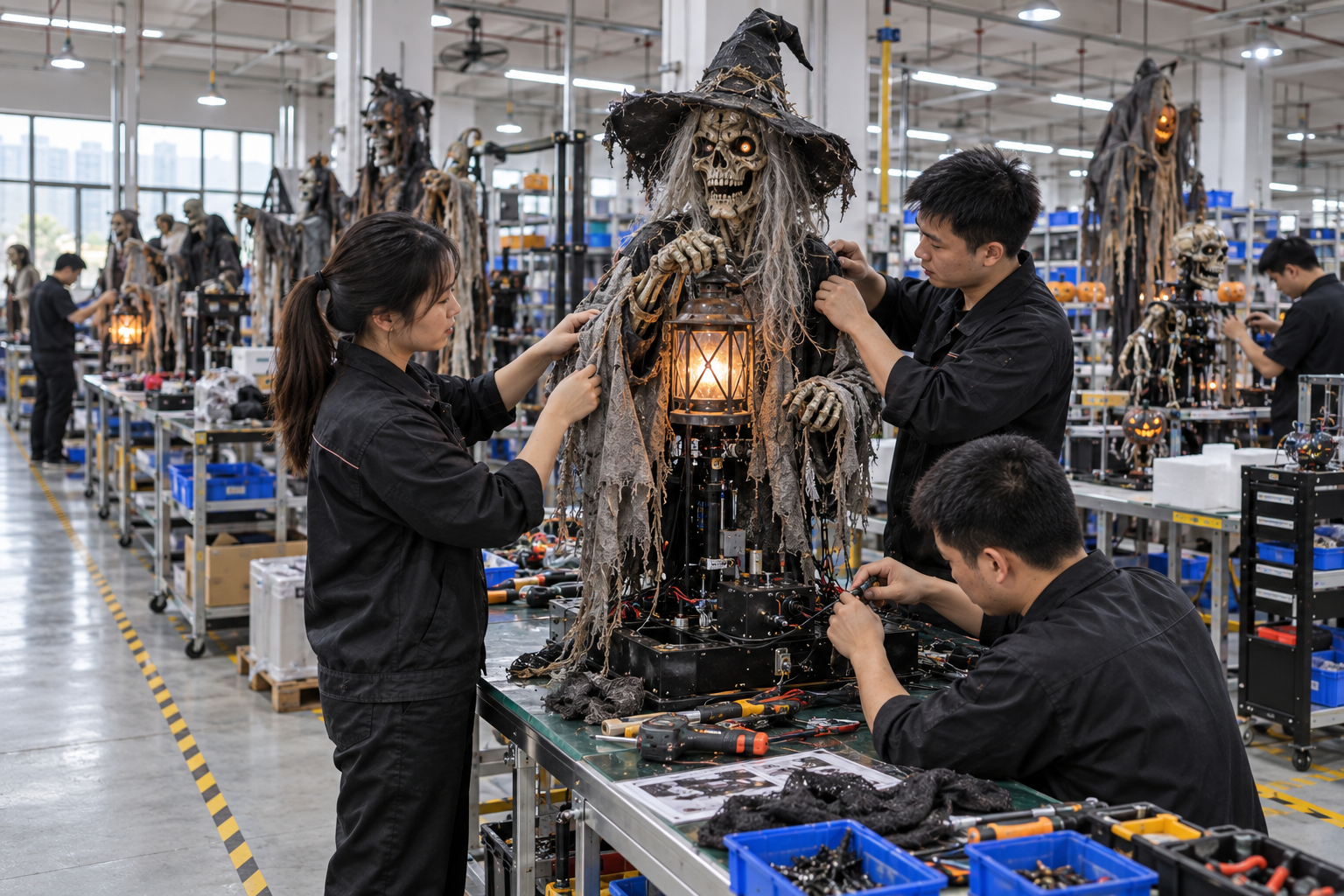
A replacement-part order often fails because the buyer and supplier use different names for the same component. 'The black cable' or 'the left hand' may describe several incompatible revisions. Seasonal displays are especially vulnerable because they are unpacked months later by a different team. Build a part-identification system when the original product is approved, not after a breakdown.
This guide addresses identity and compatibility, not spare-stock quantity. The GS1 Global Traceability Standard describes identifiers for assets and components in broader supply chains. A small manufacturer need not adopt a particular GS1 key for every prop part, but the principle is relevant: an item must be identifiable consistently across physical object, record and transaction. See the animatronic spare-parts guide for how to choose what to stock.
Decide what deserves its own identity
Create separate identifiers for parts that are ordered, replaced, inspected or have compatibility restrictions. Examples include a controller, sensor, motorized jaw, light module, painted face panel, left and right support, harness, remote and specialized bracket. Generic fasteners can be grouped by a clear specification and quantity; unique sculpted or electrical items need stronger traceability.
Use plain descriptions alongside codes. An identifier such as HH-104-B may be unambiguous in a database but useless to a venue unless the parts sheet says 'left cheek panel for 2026 wolf figure, revision B'. Include orientation and a photo with a scale marker. Avoid naming solely by colour; painted surfaces and replacement finishes can vary between batches.
Link part to parent product
Record which finished SKU and revision uses the part, whether it fits earlier versions, and which other parts must be changed with it. A revised connector on a replacement light module may require a matching harness. A replacement resin panel may fit physically but differ in finish. Both compatibility dimensions should be documented before the buyer orders a spare.
Build a photo and drawing record
Capture each serviceable part out of the product and in its installed position. Show connector shape, mounting hole pattern, left/right orientation and visible finish. Use the same unit ID or scale reference in the photos. A close-up of an isolated cable without its mating location can be misleading. For custom displays, an exploded view is often worth more than a dozen beauty shots.
Keep drawing revision and product version together. When a part changes, archive the previous record rather than overwriting it. The buyer may still operate older versions at another venue. If the manufacturer cannot support an older part, state the substitute and any conversion work. Do not mark a part 'compatible' merely because a new unit looks similar in a photo.
For electronic components, add controller or firmware dependency where relevant. A new sensor may need a different configuration. The show-file handoff article explains why a hardware replacement may also require a versioned digital package.
Make physical labels survive the lifecycle
Place labels where they can be found after installation without damaging the visual effect. A sticker under a base may be suitable; a paper tag exposed to weather may not survive. For tiny components, label the sealed spare package and reference the part in the assembly drawing. Decide who creates labels and who verifies them during packing.
Avoid permanent labeling in a way that weakens a part, conceals a defect or interferes with a seal. The product designer must choose the method. At factory testing, ask staff to identify a serviceable part from the installed unit, find it on the list and then locate the matching spare. This 'find-and-match' trial reveals whether the system works outside a spreadsheet.
At shipment inspection, compare part labels with the final BOM and replacement guide. A neatly printed code is not useful if the carton contains a different revision. For large orders, sample both initial production and later packed units, because substitutions can occur after the first approved batch.
Write a replacement enquiry that can be answered
The venue's request should include finished SKU, unit ID or batch reference, part ID if visible, close and wide photos, symptom, installation location and urgency. For a painted part, include approved finish or a colour reference. For electrical parts, state whether qualified personnel have isolated the unit; do not ask staff to test live connections for a photograph.
The supplier's reply should confirm compatibility, included accessories, shipping format, expected approval step and whether the old part must be returned. If the replacement requires a technician or firmware change, identify that before shipping. A fast parcel containing the wrong version is slower than a correctly specified order.
Illustrative maintenance example
Imagine two seasons of a witch figure. The current version has a revised hand mount but the face and costume are unchanged. A site asks for 'witch right hand'. Without a revision record, the supplier may send a part that looks correct but cannot attach. The example is hypothetical; it shows why the parent product, mounting interface and revision must travel together.

Keep the catalog usable at reorder and retirement
Review the part list after each season. Mark items that wore, broke, changed or became unavailable. Distinguish an obsolete part from a part that was merely not stocked last season. If a newer product supersedes an older one, plan whether sites can upgrade together or require separate support inventories.
For shared scenes across several venues, identify common parts and venue-specific parts. A common cable may be pooled centrally; a site-cut scenic panel may not be transferable. The touring asset-manifest guide helps track finished assets; the part register adds component-level clarity.
Price maintenance information in the original order. Ask whether the supplier will deliver the parts catalog, image record and revision notices. If technical drawings remain proprietary, agree the minimum information the venue needs to order correct replacements. Transparency does not require publishing every fabrication detail, but the buyer should not be stranded when a consumable part fails.
Build a compatibility matrix for mixed seasons
List every active product revision across venues and map it to supported part revisions. Use clear statuses: direct fit, fit with a named conversion kit, not compatible, or needs assessment. Avoid a vague 'probably fits'. For a part with a hidden connector or painted mating edge, a quick bench-fit test can clarify whether the newer part works with an older parent product. Document the test unit and any limits.
Record product location as well as revision. A central repair team may have two apparently identical witches installed in different years. If the order history does not identify which unit is at each venue, the part matrix cannot guide dispatch. Place a durable unit ID on the asset and link it to a purchase record and current configuration. During refurbishment, record any local changes that break original compatibility.
Where full interchangeability is impossible, decide whether to stock an old part, upgrade the affected unit or retire that repair route. Price each option with lead time and installation work. A replacement part that can be made only from a discontinued mold may be an expensive service promise. Tell the buyer early enough to plan, rather than saying 'spares available' without a realistic support horizon.
Test the service ordering journey
Create a mock enquiry from a venue with only the information it is likely to have: unit ID, photo and symptom. Ask the supplier's support desk to identify the candidate part and what additional evidence it needs. The exercise may reveal that the part number is hidden inside a sealed panel or that the venue cannot read a faint label. Fix the identification method while the product is still accessible.
Then pick and pack a sample replacement. Verify part revision, protective packing, included fitting hardware and instructions. A tiny component may need shaped protection or antistatic packaging depending on its actual design; the supplier should decide that for the specific part. Include a dispatch note naming the parent product revisions it fits. At destination, a qualified technician confirms fit and records the installed revision.
Finally, close the loop with a returned or photographed failed part where appropriate. The failure record may expose a recurring cause such as abrasion, moisture or wrong installation. The parts register should capture new findings and any design change. Otherwise the business may keep sending replacements without learning why they are needed.
Decision review: make the evidence comparable
Before selecting a quotation, write a one-page decision record for make replacement ordering unambiguous. Start with the customer requirement, not a supplier feature. The same installed dimensions, destination, display period and approval date should appear on every option being compared. If two offers use different product scope, record the difference as a separate alternate. Otherwise a cheap option may simply omit work that the other bidder included.
For this guide, the useful sample is a real old-and-new part pair fitted to the same parent unit. Ask for its revision and say what it can and cannot demonstrate. The critical inspection focus is connector, mounting, finish and firmware compatibility. Set the viewing or operating condition in advance, then photograph or record the outcome. The person approving the sample should know whether a visual result, a technical function or a packing action is being accepted. One attractive image does not cover all three.
The packing question is part ID and revision visible on protected replacement packaging. Measure or verify the proposed shipping unit rather than assuming an installed dimension will predict freight. At the site, the practical question is whether site staff can locate the part and understand authorized fitting. Ask the receiving and operations teams to answer it before the purchase is called complete. If they cannot answer from the supplier's proposed evidence, the project has an unresolved interface, not merely a documentation preference.
Keep a short decision log
Create columns for requirement, offered configuration, evidence, owner, approval status and unresolved risk. Mark evidence as a physical sample, drawing, supervised test, production record or professional site review. Those are not interchangeable. A factory test can validate a product function; it cannot approve unknown local conditions. Conversely, a site plan can show access but not prove the final batch matches the sample. Give each open item a person and date rather than leaving it in an email thread.
Challenge the proposal with a failure scenario
Imagine that a visually identical hand cannot mount on last season's frame. Ask what the operator would first observe, what should be stopped, which record identifies the affected unit and what corrective action can be checked. This is a stress test of the proposed purchase, not a claim that the failure has happened in a BooAri project. The answer may reveal a need for a revised sample, a clearer part ID, a different pack, or a local professional decision.
One viable route to examine is a documented conversion kit or a correct legacy part rather than forced fitting. It is an option to test, not a universal prescription. Estimate its effect on price, lead time, appearance, freight and maintenance. If the alternative changes the approved specification, issue a new revision and repeat the affected checks. Do not rely on verbal assurances that the change is minor. The buyer should be able to trace why the new option was accepted.
Close the record only when the buyer, supplier and destination owner agree what will be shipped and what remains a site responsibility. At shipment inspection, compare the production item and documents with that decision record. If the product arrives later with a changed component, the record tells the team which approval must be reopened. This discipline is more useful than a vague claim that a prop is 'commercial grade' because it ties the actual purchase to observable evidence.
Final parts-catalog release question
Pick one likely service request and try to complete it from the delivered documentation. Can the venue find the unit ID, choose the correct part revision, send enough evidence and understand who may install the replacement? If not, a polished parts spreadsheet is not yet an operational catalog. Revise the labels, photographs or support form while the production item is still available to inspect.
At season close, reconcile what was fitted at each site. A part replaced under urgent conditions may leave one unit on a newer revision than its siblings. The central register should show that difference before the next reorder. Otherwise, a future replacement shipment can repeat the same compatibility error despite having a part-number system in place.
Frequently asked questions
Can a photo alone identify a replacement part?
It helps but may not reveal a hidden connector, mounting change or finish revision. Use SKU, unit and part IDs with the photo.
Does a part number guarantee compatibility?
Only if the number is controlled and the compatibility record is accurate. Check the parent product and revision before ordering.
Should cosmetic and electrical parts use the same register?
They can be listed together, but fields differ. Electrical parts may need configuration data; cosmetic parts may need finish and orientation references.
When should labels be checked?
At sample approval, production, shipment inspection, receiving and every refurbishment or replacement event.
Conclusion
Replacement support begins with accurate identity. A small, maintained parts register can prevent long seasonal delays caused by ambiguous requests. Send BooAri the product revision, suspected part, photos and destination through Send Your Requirements to discuss a controlled replacement specification.
Further reading
Use these external resources alongside your local market, venue and professional safety requirements:
READY TO START A PROJECT?