

A Halloween prop can arrive in the correct number of cartons and still be impossible to install. The reason is often a missing accessory: one bracket, cable, remote, fastener bag or base plate. A buyer-facing bill of materials (BOM) should define what one complete, usable set contains and how every part is identified from sample approval through receiving.
This guide is narrower than a general mixed-SKU shipment plan. It focuses on the product set itself. The GS1 logistic label guideline distinguishes identification of logistics units and their contents; a unique pallet or carton identifier is useful, but the buyer also needs a product-level parts relationship. Do not confuse a counted carton with a verified installable set.
Define the sellable or installable unit
Decide what the customer receives when they buy one SKU. Is it a figure only, a figure plus base, or a complete scene with light, controller, bracket and printed backdrop? Write the answer in plain language. If optional accessories are sold separately, give them separate identifiers and state which configuration the product image shows. A photograph containing an optional fog machine can easily create an expectation that the basic prop does not meet.
For custom venues, the 'unit' may be a zone rather than a retail box. Break it into named subassemblies: gate left, gate right, crossbar, controller, lighting harness and hardware. The BOM should show quantity and revision for each item, not just a grand total. If two zones share identical bolts but different mounting plates, keep those plate numbers distinct.
Make the BOM usable outside the factory
Include a simple description, part number, photo or drawing reference, quantity per set, unit of measure, revision, supplier or buyer ownership, and pack location. A receiving clerk should be able to tell whether an unopened carton contains the missing accessory; an installer should find the correct part without phoning the workshop. Avoid labels like 'bag A' unless bag A is linked to a drawing and set number.
Reconcile the approved sample against the list
Sample approval should include a table of every item actually needed to operate or assemble the sample. Check the power adapter, cables, remote battery, mounting hardware, cosmetic covers and instructions. An impressive sample demonstration may rely on workshop equipment not included in the quote. Ask the supplier to identify what was borrowed for the demo and what will be shipped with each production unit.
Record parts changed after approval. A revised frame might need longer bolts or a different cable; the BOM must follow the revision. Do not update the visible sample without changing the pack plan. The SKU change-control article describes the broader version logic; the BOM is its practical component record.
A factory mock assembly is a strong test. Take one production set from finished stock, not a specially prepared prototype, and ask a tester to assemble it using the listed parts and instructions. If they need an unlisted tool, spacer or improvised fastener, the BOM is incomplete. Photograph the unpacked set and the completed assembly under the same unit identifier.
Plan packing around part retrieval
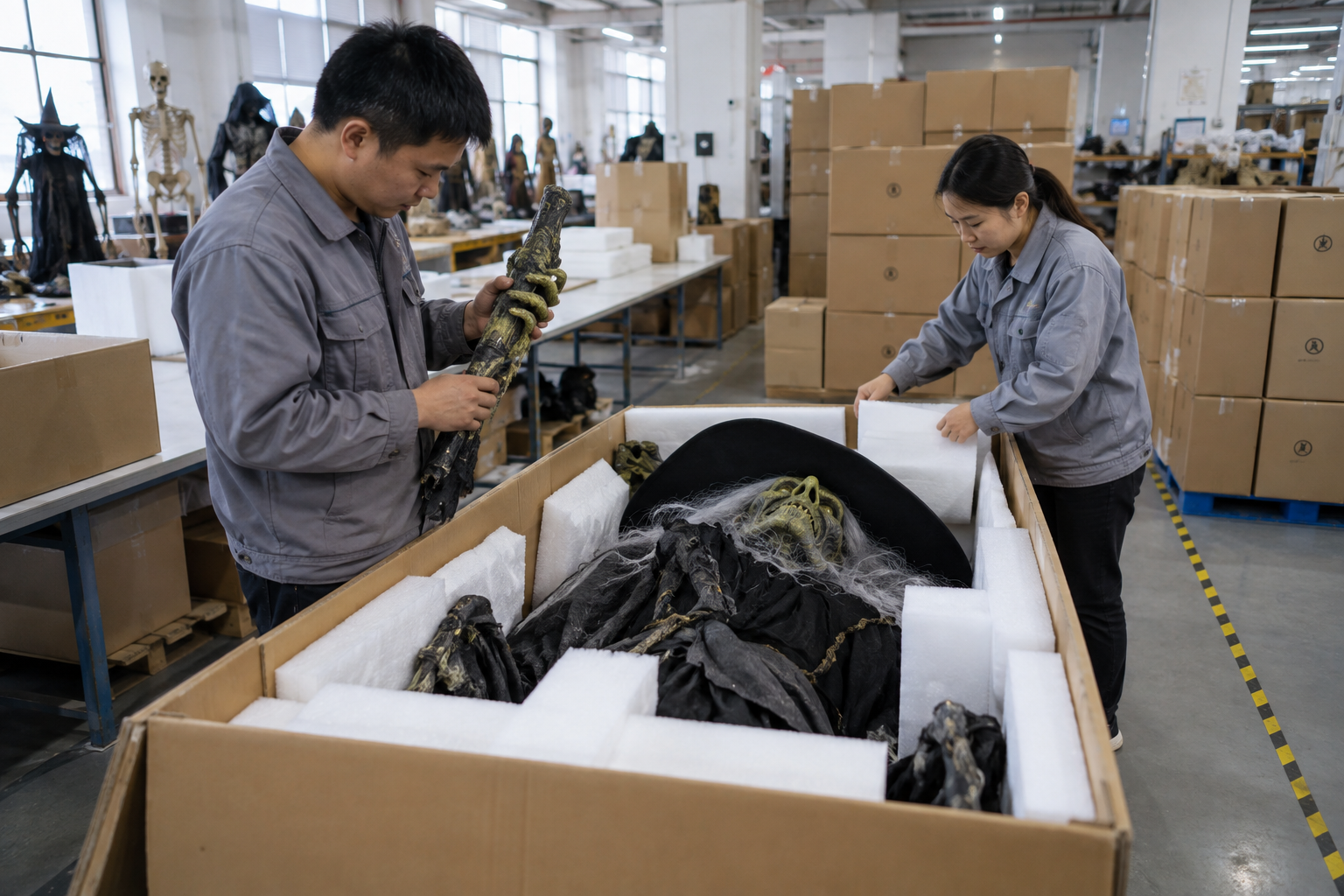
Small accessories need containment and identification. A loose screw inside a large sculpture can disappear during opening. Use a part bag or compartment with a label that links to the BOM. If several cartons form one installation set, mark each with the set ID, carton number and contents. Count both total cartons and complete sets. This is especially important when goods are allocated across several store or venue destinations.
Ask how the destination team will inspect without destroying the packaging. A clear accessory pouch or accessible checklist can help, but the pack must still protect the product. A carton with a perfect label yet a missing bracket is not acceptable. Use the export-packaging guide to align protection and receiving needs.
At shipment inspection, select complete sets according to the agreed plan. Compare physical parts with the BOM and approved sample, then repack. A partial count of hardware bags is not enough if bag contents have not been defined. If the inspector cannot safely open every box, identify the residual risk and use production records or targeted checks rather than claiming full verification.
Handle supplier-provided and site-provided items explicitly
Some items are legitimately not in the shipment: site anchors, venue power cable, locally sourced ballast or professional rigging hardware. They should appear in a separate 'by others' list with a named owner and required specification. Without this, a local installer may discover a missing dependency during load-in and assume the factory forgot it.
Do not let the product team specify anchors for unknown site conditions. It can provide product interface data; the qualified local party selects the site attachment. The BOM marks the boundary. For electrical props, distinguish the product harness from site distribution. For licensed artwork, distinguish the printed panel from rights to use supplied images.
An illustrative mall project might receive five identical pumpkin kiosks. If each kiosk needs two feet and one power adapter, a carton matrix of five kiosks is insufficient unless it also reconciles ten feet and five adapters by kit. This is a method example, not a reported BooAri shipment.
Use the BOM for replacements and reorder accuracy
When a venue requests 'another left hand', the supplier needs the figure SKU and revision, not only a photograph. The production BOM should connect each part to compatible configurations. If a replacement part changes, record whether it fits earlier units and whether a pair must be replaced together. This is developed further in the part-identification guide.
For seasonal reorders, compare the current BOM with last season's approved one. A new controller, changed paint or revised bracket may alter packing and instructions. The buyer should approve these changes rather than assume the old SKU label guarantees identical contents. Keep purchase-order and shipment documents aligned with the final revision.
A practical sign-off gate
Before production release, ask the owner of the creative brief, factory engineering, quality inspection, packing and destination installation to review the same BOM. Each should answer a different question: does it create the intended scene; can it be made; can it be checked; can it be packed; can it be installed? Resolve discrepancies in the list before printing labels or booking freight.
Resolve ambiguous parts before mass packing
Ask a person who did not build the prototype to identify every item in one finished set. Give them the buyer-facing BOM, physical parts and proposed carton labels. Note where they hesitate. If two near-identical brackets have different holes, add orientation marks and separate identifiers. If a controller and adapter are supplied by different vendors, show which one belongs to the SKU. This small trial is valuable because warehouse and destination teams will not have the design engineer standing beside them.
Create a discrepancy log for the trial. Each gap needs an owner: engineering may revise the drawing, packing may revise a bag label, sales may correct the quoted inclusions, and the buyer may approve a site-supplied item. Do not close a missing-part issue by adding an informal note to one carton if other copies will be packed from the same work instruction. Update the master BOM and verify a subsequent production set.
Consider optional and regional variants. One market may need a different adapter; one venue may buy a taller base. These should have controlled variant identifiers rather than a handwritten alteration to the main BOM. The packer must know what to pick, the inspector what to check and the customer what to expect. A variant matrix can be short, but it should show exactly which parts change and which remain common.
Reconcile records at three points
At sample approval, match the physical sample to the intended sellable configuration. At packing, match one complete production set to the final BOM and mark its carton locations. At shipment inspection, sample packed sets against the same revision. The checkpoints answer different questions. A sample proves the proposed configuration can work; a packing check proves the production workflow put those parts together; shipment inspection confirms what is ready to leave.
If the product is installed at multiple sites, add a destination allocation check. A central warehouse can receive the correct total number of components while one branch receives all the spare brackets and another receives none. Label by site and set, and provide the receiving team with a site-specific expected-content sheet. Reconcile exceptions before site crews are booked.
Keep a record of substitutions. If a fastener supplier changes, engineering should confirm equivalence and update the part reference when appropriate. If a controller or light module changes, retest the affected function and tell the buyer. A BOM is useful only when it represents the goods actually produced, not the original design intention.
Decision review: make the evidence comparable
Before selecting a quotation, write a one-page decision record for verify what one sellable set includes. Start with the customer requirement, not a supplier feature. The same installed dimensions, destination, display period and approval date should appear on every option being compared. If two offers use different product scope, record the difference as a separate alternate. Otherwise a cheap option may simply omit work that the other bidder included.
For this guide, the useful sample is one production-representative set assembled solely from listed parts. Ask for its revision and say what it can and cannot demonstrate. The critical inspection focus is hardware counts, adapter identity, orientation and component revisions. Set the viewing or operating condition in advance, then photograph or record the outcome. The person approving the sample should know whether a visual result, a technical function or a packing action is being accepted. One attractive image does not cover all three.
The packing question is all small bags reconciled to carton and set ID. Measure or verify the proposed shipping unit rather than assuming an installed dimension will predict freight. At the site, the practical question is whether installers can make one complete scene without borrowed workshop parts. Ask the receiving and operations teams to answer it before the purchase is called complete. If they cannot answer from the supplier's proposed evidence, the project has an unresolved interface, not merely a documentation preference.
Keep a short decision log
Create columns for requirement, offered configuration, evidence, owner, approval status and unresolved risk. Mark evidence as a physical sample, drawing, supervised test, production record or professional site review. Those are not interchangeable. A factory test can validate a product function; it cannot approve unknown local conditions. Conversely, a site plan can show access but not prove the final batch matches the sample. Give each open item a person and date rather than leaving it in an email thread.
Challenge the proposal with a failure scenario
Imagine that the hero figure arrives but its base brackets are allocated to another site. Ask what the operator would first observe, what should be stopped, which record identifies the affected unit and what corrective action can be checked. This is a stress test of the proposed purchase, not a claim that the failure has happened in a BooAri project. The answer may reveal a need for a revised sample, a clearer part ID, a different pack, or a local professional decision.
One viable route to examine is repacking by complete set and correcting the BOM before releasing the remaining order. It is an option to test, not a universal prescription. Estimate its effect on price, lead time, appearance, freight and maintenance. If the alternative changes the approved specification, issue a new revision and repeat the affected checks. Do not rely on verbal assurances that the change is minor. The buyer should be able to trace why the new option was accepted.
Close the record only when the buyer, supplier and destination owner agree what will be shipped and what remains a site responsibility. At shipment inspection, compare the production item and documents with that decision record. If the product arrives later with a changed component, the record tells the team which approval must be reopened. This discipline is more useful than a vague claim that a prop is 'commercial grade' because it ties the actual purchase to observable evidence.
Frequently asked questions
Is a packing list the same as a BOM?
No. A packing list describes shipment units and quantities. A BOM defines the components that make one product or installation set complete; the two records should reconcile.
Must every screw have a part number?
Not every commodity fastener needs a complex system, but the installer must know the correct specification, count and pack location. Critical or non-interchangeable hardware should be unambiguous.
How can a buyer check completeness remotely?
Request a labelled parts layout, representative unpack-and-assemble video and shipment inspection against the final BOM. Remote evidence reduces uncertainty but does not replace all physical checks.
What if the site supplies a component?
List it as an explicit dependency with owner, specification and deadline. Do not silently omit it from the installation plan.
Conclusion
A buyer-facing BOM connects the approved effect to a complete, installable set. It gives factory testing, shipment inspection and site receiving one common reference. Send BooAri your product configuration, destination count and installation responsibilities via Send Your Requirements to agree what belongs in each set before quoting.
Further reading
Use these external resources alongside your local market, venue and professional safety requirements:
READY TO START A PROJECT?