
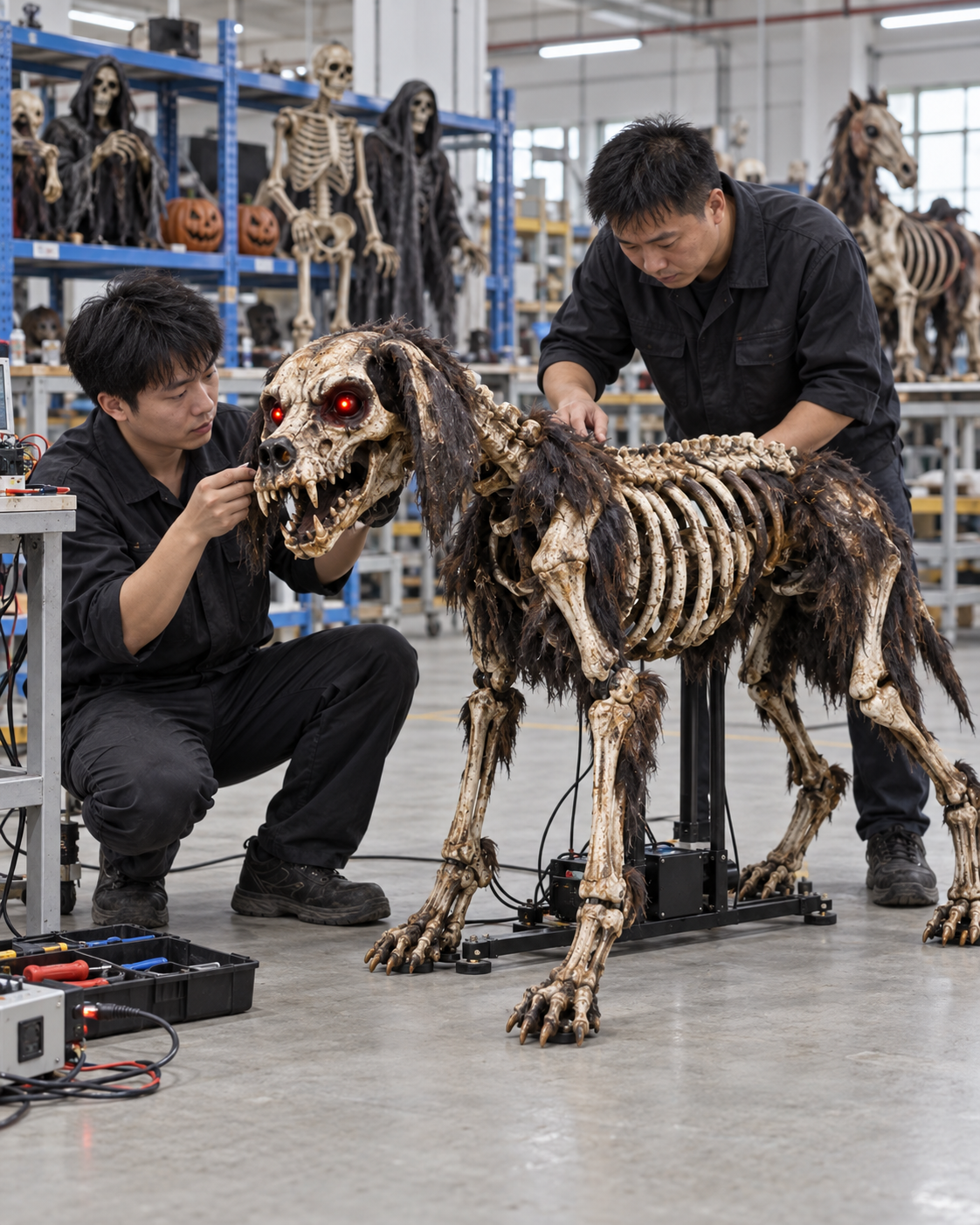
A damaged Halloween prop can be repaired, replaced, isolated for later work or retired. The right decision depends on what failed and who can verify the result. A paint chip on a removable decorative panel is different from a cracked support, damaged cable or unpredictable moving part. Buyers should not let an urgent opening date blur these distinctions.
This article proposes a decision tree for commercial buyers, not a repair manual or safety approval. The U.S. EPA materials-management hierarchy prioritizes reducing and reusing resources where appropriate; it does not mean every damaged object should be repaired regardless of risk. The venue's qualified technical team must decide whether the installed item is safe to use. For damage first noticed at delivery, see the arrival-damage evidence guide.
First classify the damage and isolate uncertainty
Record where the damage is, whether the prop is powered or moving, whether it supports load, and whether visitors can touch it. Take overview and close photos with a scale reference. Note the unit ID, product revision, date and operating context. If the condition may affect structure, electrics, moving parts or public access, follow the site's stop-use and isolation procedure. Do not perform a cosmetic touch-up to conceal a potentially unsafe defect.
Separate four categories: appearance only, replaceable noncritical component, functional failure, and structural or electrical concern. Some incidents span categories. A cracked decorative hand may be cosmetic if inaccessible behind a barrier; the same crack could be a sharp visitor-contact hazard in a photo zone. The site context changes the decision. Document who classified it and what evidence they used.
Keep customer and commercial records distinct
A damage photo supports technical assessment and may also support a freight or warranty discussion. Those processes have different rules and deadlines. Preserve packaging and shipment evidence where relevant, but do not delay making a public-facing area safe while a claim is prepared. Assign an owner for the operational response and an owner for the commercial claim.
Ask whether a repair can be verified
For a finish issue, request the original surface specification, compatible repair material and a small test area. A matched colour under work light may look obvious under show light. Define an acceptance viewpoint and approval person. If the surface is close to a camera or visitor, a replacement panel may give a more reliable result than a local patch.
For a damaged connector or moving mechanism, qualified personnel should assess the actual fault and use approved replacement parts and procedures. Do not suggest tape, glue or bypassing a safety device. A repaired electrical or mechanical system needs appropriate retesting before return to service. The buyer should ask what evidence will prove that both function and protection have been restored.
A large scenic shell may be repairable only if a technician can reach both sides of a damaged joint. An attractive exterior patch is insufficient if reinforcement behind it is compromised. The supplier can provide construction information, but the competent site or engineering team decides whether a structural repair is acceptable. When that evidence cannot be obtained, replacement or isolation may be the responsible option.
Compare replacement lead time with service interruption
Ask whether the exact part or whole unit is available, how it is packed, and whether it matches the installed revision. A replacement hand, panel or controller may ship faster than a complete prop, but only if compatible and installable. The part-identification guide explains how to avoid sending a visually similar but wrong component.
Calculate the real timeline: diagnosis, approval, part production or sourcing, transport, site access, installation and verification. A quoted dispatch date is not the date the display returns to operation. If the season ends before a replacement can be installed, consider a temporary scene adaptation approved by the venue rather than rushing an untested repair.
Price both routes with actual quotations. Repair may involve specialist labour, travel, shutdown and a less predictable finish; replacement may involve freight, lifting, disposal and new commissioning. Avoid a universal 'repair if under 50% of new cost' rule. The risk and remaining useful life may outweigh simple price arithmetic.
Use a documented decision tree
Step one: is there any unresolved safety or structural question? If yes, isolate and seek qualified review. Step two: is the damaged component individually replaceable and correctly identified? If yes, price and time that route. Step three: can an approved repair method restore the required appearance and function, and can the outcome be checked? If yes, compare it with replacement. Step four: if neither route supports the planned use, retire or redesign the scene.
The decision tree is not permission for untrained staff to decide technical safety. It tells the buyer which evidence to request and when to escalate. Record the chosen action, approver, work performed, retest and as-built change. Update maintenance and part records so next season's team knows the unit is not identical to its original factory state.
An illustrative comparison
Suppose a decorative pumpkin arrives with a chipped removable leaf but functions normally. The buyer may request a matching leaf and compare its fit and finish. If the same unit also has a cracked powered housing, the analysis changes: a qualified assessment and safe isolation take priority. This is a hypothetical example, not an actual BooAri claim.
Plan a field-repair capability before the season
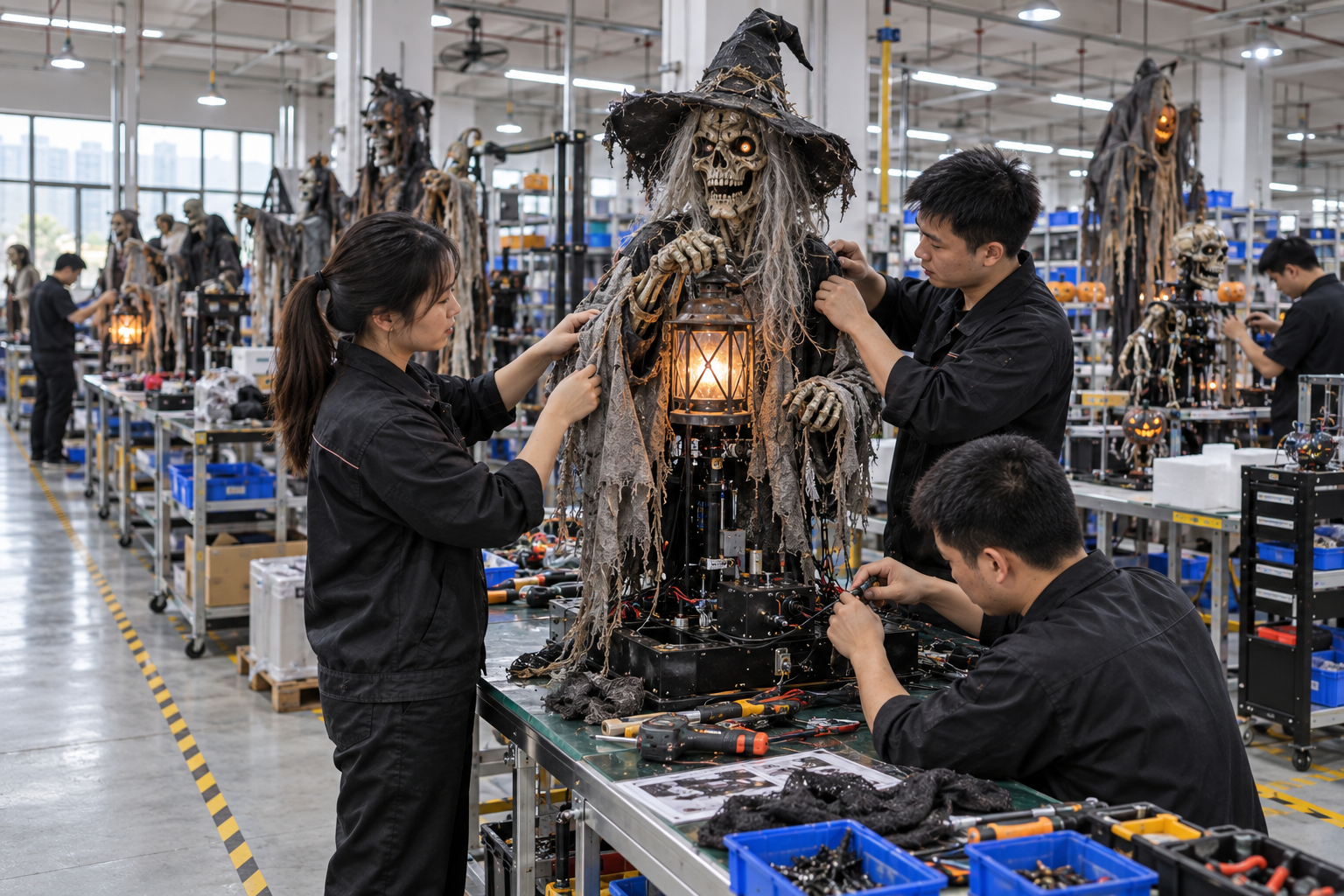
Identify likely cosmetic wear points and ask the manufacturer for approved materials, small spare panels or touch-up references. Train the team that will use them. Keep powered or structural work under qualified authority. A field kit should be deliberately limited to repairs that can be performed and verified at the venue, not a box of miscellaneous glues.
At factory approval, ask whether critical parts can be removed and reinstalled without damaging the rest of the scene. A short replacement demonstration can reveal if an access panel is hidden after installation. Shipment inspection should verify supplied spare parts and instructions against the approved BOM. The installer handover guide is a place to define the service boundary.
After any repair, photograph the restored surface and repeat the relevant functional and safety checks. The record should say who did the work and whether the prop may return to public use. A painted patch that looks good in a close photo does not by itself close a safety issue.
Learn from the damage pattern
One incident may be accidental; repeated damage at the same joint or carton corner suggests a design, packing or handling problem. Compare affected unit IDs, circumstances and photos before concluding cause. If the pack is responsible, revise protective contact points and consider a transit test. If the site route is responsible, change placement or barriers. If a component repeatedly fails in operation, revisit the technical design.
Bring this evidence to the next reorder brief. Do not silently replace the same vulnerable part year after year without asking why it fails. A warranty claim can resolve a transaction while the underlying design issue remains. Distinguish commercial remedy from product improvement.
Compare recovery choices with a visible approval table
For a real incident, put four options on one page: continue after qualified assessment, make an approved repair, replace a component or retire the unit. Record time to restore service, parts availability, transport, local labour, visible quality, remaining uncertainty and the person authorized to sign off. Do not hide an unresolved structural question in an 'appearance' column. If the venue must close a route during work, include that operational cost. The cheapest workshop action may not be the cheapest or safest event outcome.
Add a time horizon. If the prop is scheduled for only two more event nights, a temporary approved scene adaptation may be preferable to an expensive emergency full-unit replacement that cannot arrive before closing. If the asset is intended for several seasons, a controlled repair or new module might create lasting value. These are commercial considerations after the qualified safety decision, not arguments to keep a questionable prop in public use.
Use clear evidence status. A photo is an observation; a supplier diagnosis is an opinion until tested; a completed repair record states work performed; a site acceptance records return to use. The buyer should know which stage has been reached. If there is no qualified person available to assess a moving or powered fault, the honest status is 'isolated pending review', not 'probably fine'.
Review the first repair as a design test
When a planned field repair is performed for the first time, observe how easily the damaged part can be reached and removed. Did the technician have to damage another surface, cut a hidden cable tie or remove an unstable scenic section? If so, the repairability promise was incomplete. Feed this back into the next design revision and service instructions. A repair can solve the immediate problem while exposing a better future construction.
After work, inspect appearance under both work and show light and run the relevant function checks. Keep a before-and-after record tied to unit ID and revision. If a replacement panel has a different colour or a controller has different firmware, document it. The next season's team needs to know which units are no longer identical to the original batch. This is especially important when several venues share spare parts.
Close the commercial claim separately. Determine whether freight, workmanship, site damage or unknown cause is at issue under the actual contract and evidence. A supplier can provide parts without admitting every allegation; a buyer can make a site safe before a claim is settled. Keeping the two processes coordinated but separate helps both move faster.
Decision review: make the evidence comparable
Before selecting a quotation, write a one-page decision record for make a safe and economic recovery decision. Start with the customer requirement, not a supplier feature. The same installed dimensions, destination, display period and approval date should appear on every option being compared. If two offers use different product scope, record the difference as a separate alternate. Otherwise a cheap option may simply omit work that the other bidder included.
For this guide, the useful sample is a damaged component reviewed in isolation and in the complete installed prop. Ask for its revision and say what it can and cannot demonstrate. The critical inspection focus is cosmetic, functional, electrical and structural implications. Set the viewing or operating condition in advance, then photograph or record the outcome. The person approving the sample should know whether a visual result, a technical function or a packing action is being accepted. One attractive image does not cover all three.
The packing question is replacement or repair kit protected for the actual destination route. Measure or verify the proposed shipping unit rather than assuming an installed dimension will predict freight. At the site, the practical question is whether qualified staff can verify a return to public use. Ask the receiving and operations teams to answer it before the purchase is called complete. If they cannot answer from the supplier's proposed evidence, the project has an unresolved interface, not merely a documentation preference.
Keep a short decision log
Create columns for requirement, offered configuration, evidence, owner, approval status and unresolved risk. Mark evidence as a physical sample, drawing, supervised test, production record or professional site review. Those are not interchangeable. A factory test can validate a product function; it cannot approve unknown local conditions. Conversely, a site plan can show access but not prove the final batch matches the sample. Give each open item a person and date rather than leaving it in an email thread.
Challenge the proposal with a failure scenario
Imagine that a visible touch-up hides a crack at a load-bearing interface. Ask what the operator would first observe, what should be stopped, which record identifies the affected unit and what corrective action can be checked. This is a stress test of the proposed purchase, not a claim that the failure has happened in a BooAri project. The answer may reveal a need for a revised sample, a clearer part ID, a different pack, or a local professional decision.
One viable route to examine is isolation and competent assessment rather than an appearance-only repair. It is an option to test, not a universal prescription. Estimate its effect on price, lead time, appearance, freight and maintenance. If the alternative changes the approved specification, issue a new revision and repeat the affected checks. Do not rely on verbal assurances that the change is minor. The buyer should be able to trace why the new option was accepted.
Close the record only when the buyer, supplier and destination owner agree what will be shipped and what remains a site responsibility. At shipment inspection, compare the production item and documents with that decision record. If the product arrives later with a changed component, the record tells the team which approval must be reopened. This discipline is more useful than a vague claim that a prop is 'commercial grade' because it ties the actual purchase to observable evidence.
Frequently asked questions
Can a chipped prop be left on display?
Only after the venue assesses whether the damage is truly cosmetic and does not create a visitor or functional risk. Context matters.
Is a repaired prop equivalent to a new one?
Not automatically. The repair method, workmanship and verification must be appropriate for the damaged function and intended use.
When is a replacement part better than a full unit?
When it is correctly identified, compatible, installable and the remainder of the prop is sound. Consider site labour and verification.
Who approves a structural repair?
A competent professional under the venue's requirements, supported by accurate product construction information. A general blog cannot make that approval.
Conclusion
Repair is valuable when the restored result can be verified; replacement is appropriate when it cannot, or when time and risk favour a new component. Send BooAri the unit identity, damage photos, application, destination and deadline via Send Your Requirements to discuss the information needed for a responsible recovery decision.
Further reading
Use these external resources alongside your local market, venue and professional safety requirements:
READY TO START A PROJECT?