
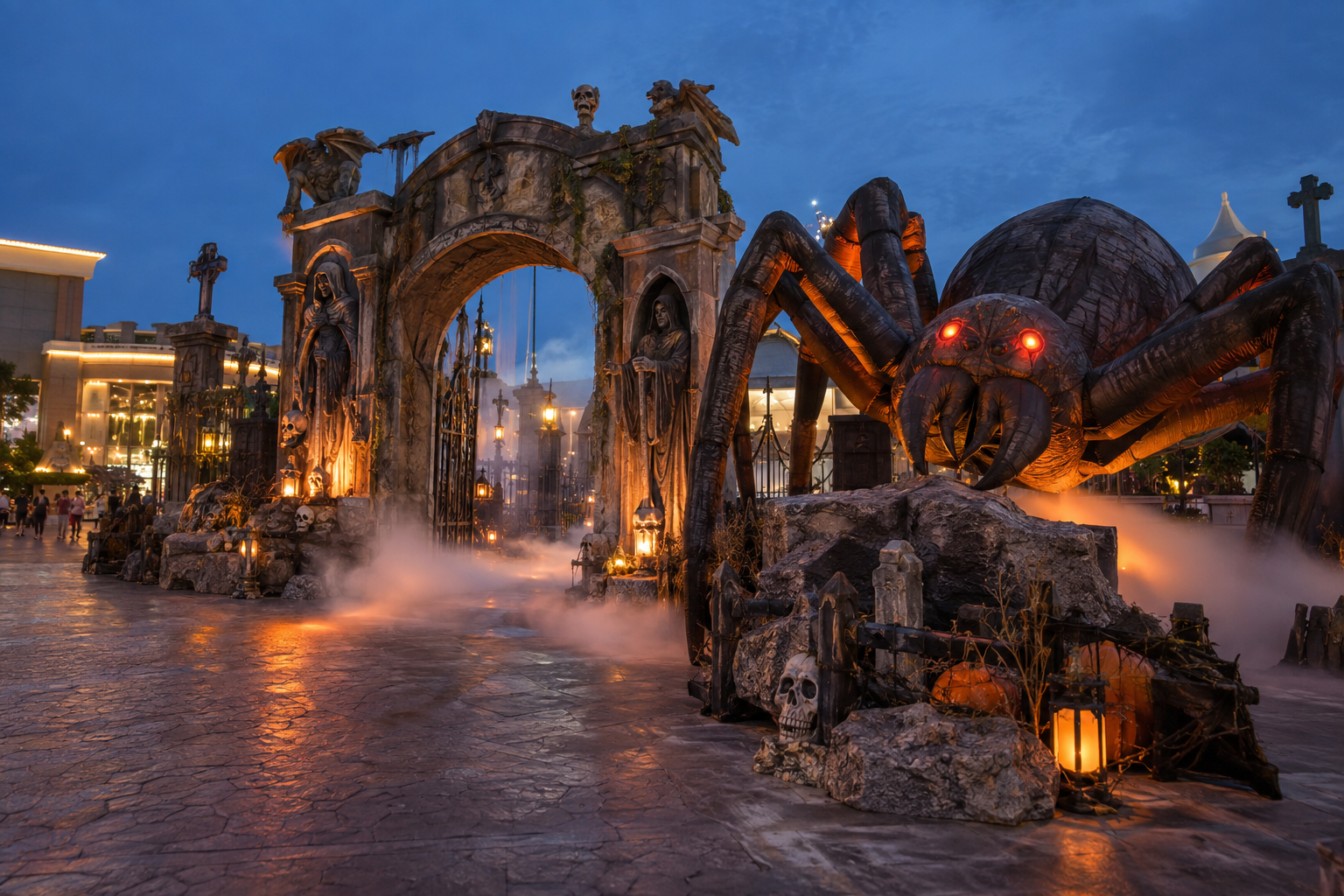
Printed scenic flats and sculpted Halloween props serve different visual and operational roles. A printed wall can establish atmosphere over a broad area; a three-dimensional figure can change the scene as visitors move. In commercial buying, the choice affects sightlines, lighting, packing, setup, storage and what a buyer must approve. Many strong installations combine both rather than treating them as substitutes.
This guide is for retail display, attractions and temporary events, not an assertion that one format is universally cheaper. Use accurate approved images and dimensions throughout the order. The GS1 product image standard emphasizes that images and associated product data work together; a mood render alone cannot convey a physical scenic format. For a broader display plan, see the commercial retail display guide.
Begin with viewing angle, not artwork
Draw the visitor path and mark where people first see the scene, where they pause and whether they can walk past it at an angle. A flat image can work convincingly when seen from a controlled front position. It may reveal its thinness or support on a side approach. A sculpted element maintains volume around changing viewpoints, but it occupies more floor area and may require a base or barrier.
Record how close visitors will get. From a long queue, large silhouette and contrast may matter more than fine texture. At a photo spot, a shallow print may look flat in side-lit images, while a sculpted figure can cast useful shadow. A printed backdrop can still be the correct choice when the photo framing is fixed and the site cannot accept a bulky prop.
Map the critical camera position
Ask the creative team for two or three reference photographs from actual visitor height, including at least one oblique view. Place a temporary mock panel or cardboard mass in the intended area. The buyer can then judge whether depth adds useful visual information and whether a scenic flat will expose its edge. This simple site trial often resolves the format question before tooling or print production.
Compare physical depth and foreground work
A flat can carry a large image efficiently, but may need separate foreground objects to create parallax and scale. A sculpted tombstone, branch or doorway can be a focal object while a printed cemetery wall extends the world behind it. Specify the intended layers and their distances. Without that plan, a buyer may purchase a costly sculpt that does not read from the viewing point or a wide print that looks empty at the foreground.
For printed panels, define substrate, panel size, finish, edge treatment and joining method. Check how the print behaves under show light, not only on a monitor. For sculpted props, specify installed dimensions, surface treatment, base, weight, transport split and repair method. The two quotes must cover the same scene role before comparing cost. A panel priced without its frame is not equivalent to a free-standing sculpture with a base.
Avoid implying that a printed image is an actual customer photograph if it is conceptual art. In an editorial or sales page, label AI imagery as illustration. In production, require the approved artwork version and rights to use it. The custom artwork handoff guide describes how file versions and print proofs should be managed.
Approve colour and texture in the installed light
Ask for a print proof at meaningful scale and a finished surface sample for the sculpt. Compare both under the same lighting colour and direction. A saturated screen render may not survive the chosen substrate and event lighting. A sculpted surface can cast shadows that alter painted colour. Note whether the scene must look credible in daylight, work light and show light.
Inspect potential glare. Glossy printing can reflect a spotlight into the camera. A highly textured sculpt can create black patches under severe side light. The solution may be a different finish, repositioned light or revised geometry. Make a controlled decision using sample pieces rather than relying on a generic 'matte' instruction.
For large installations, mark visible seams in the approval drawing. Printed panels may need registration across sections; sculpted pieces may have joint lines that require site touch-up. A mock assembly should reveal whether the final image and silhouette remain continuous after the pack has been opened and reassembled.
Calculate installation and storage separately
Printed panels may pack flatter, but they can still need large frames, edge protection and careful handling. Sculpted props may ship in modular sections and need more set-down space. Ask for measured packed units, lifting points, assembly sequence and packaging reuse plan. A flat panel with a vulnerable printed face can be expensive to repair after an abrasion even though its carton is compact.
At the venue, identify who owns backing structure, wall fixings, freestanding support or barrier. Do not let a scenic artwork quote implicitly promise site engineering. Local qualified personnel must review fixings and public access. If a backdrop crosses an exit route or conceals venue signs, the scene design must change before production. This is a venue decision, not a print-shop detail.
Storage is also different. Large panels need flat or vertical support without bending, while sculpted sections need shaped supports for projections. If the installation is seasonal, ask how surfaces can be cleaned, protected and reinstalled. A combination of replaceable print panels and reusable sculpted hero pieces can offer flexibility across campaigns.
Use an approval matrix for the scene
Create rows for distant view, side view, photo view, floor footprint, packed volume, assembly hours, maintenance, replacement and storage. Rate each option against the actual venue rather than a universal score. The decisive factor may be public space, transport lift, visual depth or future reuse. Document whose budget pays for backing and lighting, since those costs can invert the apparent material comparison.
A hypothetical mall team with a shallow window may choose printed flats behind a single sculpted pumpkin. A walk-through attraction may invest in more dimensional foreground pieces and use printed extensions only beyond reach. Neither example is a BooAri customer case; each illustrates how the same visual theme can be built for different sightlines and handling conditions.
Factory and shipment inspection
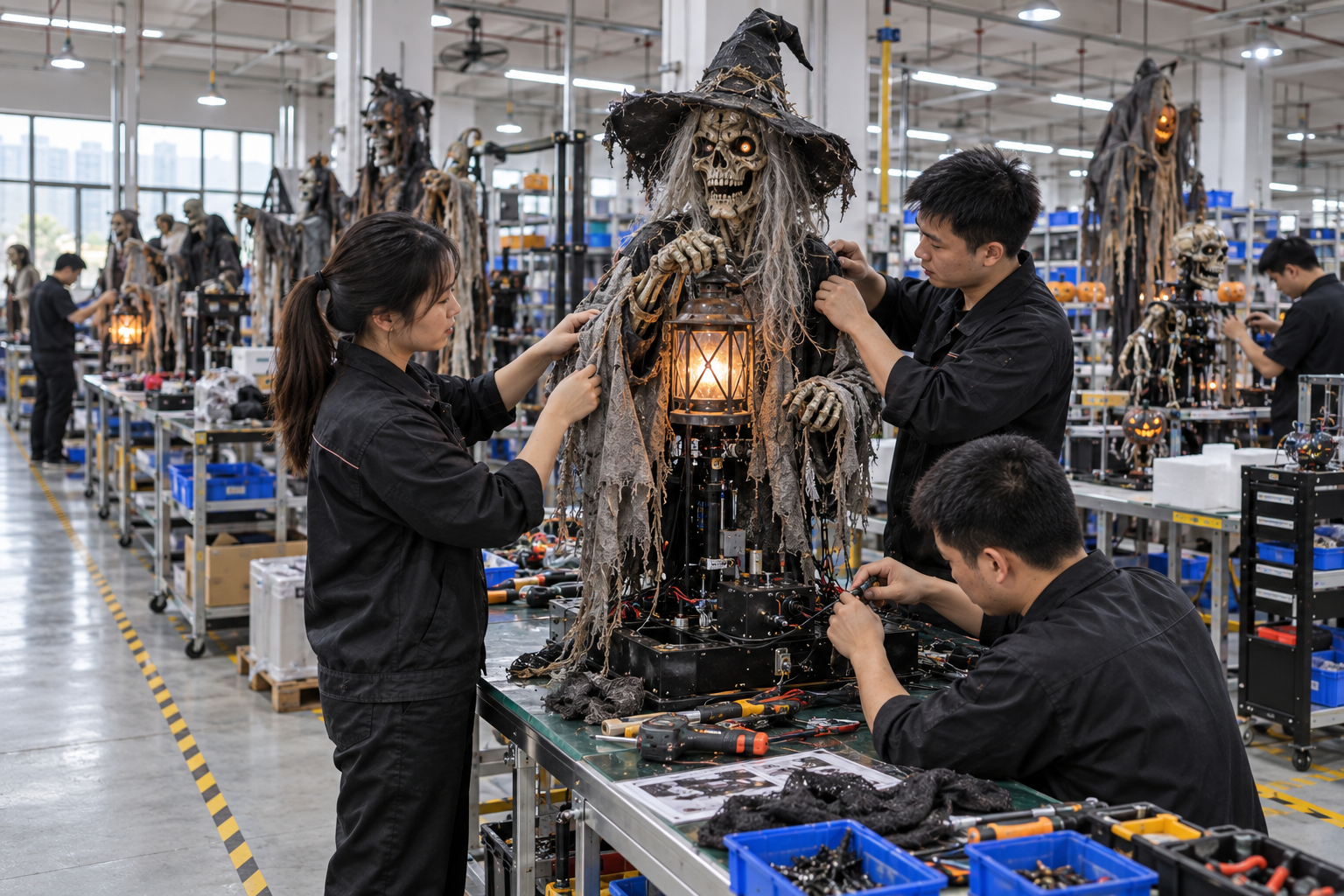
For printed work, inspect legibility, colour proof, image alignment, edge quality, panel count and protected faces. For sculpted work, check geometry, seams, paint, base, detachable parts and pack supports. For a mixed scene, assemble the layers at least once using the intended sequence. Number each component and provide a site plan showing which panel and prop belongs in each position.
At shipment inspection, verify that the approved artwork revision and physical prop revision match the packing list. A correct number of cartons does not prove the scene is complete. The buyer's installation team should be able to identify each layer without opening every carton at random.
Prototype the view corridor, not only the artwork
Tape the proposed panel boundary and sculpt footprint onto the actual floor or a scaled venue mock-up. Stand at the entrance, the queue pause and the photo position. Record what foreground element blocks a seam and what side angle reveals the back of a flat. If a person can walk around the scene, a printed wall may need a finished return or a separate three-dimensional side piece. These observations should be written into the RFQ before quoting square metres of print or sculpt hours.
Use temporary cardboard shapes or neutral-colour blocks to judge volume before final art. This isolates geometry from colour and theme. A large sculpture can overwhelm a narrow shop window while a shallower relief may provide enough shadow. Conversely, a flat at a dramatic attraction turn may fail because visitors see it edge-on before they see the printed image. A mock-up is not a promise of final aesthetic quality; it is a cheap way to reject poor format decisions.
Control the hybrid scene as one product
When flats and sculptures are combined, define the hierarchy. Which piece carries the primary story? Which print creates depth beyond it? Where do lighting and visitor photographs place the focal point? Request a plan and elevation showing every layer, its dimensions, panel or prop identifier and installation order. A buyer should not approve a foreground sculpture in one meeting and a backdrop in another without checking the two together.
At sample approval, use a combined mock assembly with the actual or representative print finish and sculpt surface. Check sightlines under show light and work light. Record any image registration that crosses panels and any colour transition where paint meets print. The printer and sculptor may use different colour processes, so a shared screen reference is not enough. Agree which surface is the colour anchor, and keep a physical proof for later inspection.
The pack plan should preserve the scene grouping. Label panel A, prop A1 and base A1 as one zone, not as unrelated warehouse inventory. If a panel is reprinted later, verify its revision against the unchanged sculpt. If a sculpt is refurbished, check that its new finish still fits the scene. The set-completeness guide provides the component-control logic for this handoff.
Reuse and replacement trade-offs
A printed panel can be a planned replaceable campaign layer over a reusable support. A sculpted hero prop can be a long-lived asset if its finish, frame and storage are maintained. These are possibilities, not universal life-span claims. Compare the cost of replacing a graphic after one season with the storage and repair burden of keeping a large sculpture. If the venue changes its brand campaign yearly, separable graphics may protect the reusable investment.
At end-of-season removal, photograph the scene before it is broken down and record panel condition and sculpt damage separately. Store flat surfaces without unsupported bending and sculpted pieces with protection around projections. Provide the next team a versioned scene map so it does not pair an old print with a revised prop. A buyer who plans replacement and reuse before ordering can avoid both overbuilding temporary graphics and underprotecting expensive dimensional pieces.
Decision review: make the evidence comparable
Before selecting a quotation, write a one-page decision record for choose a scene-production format. Start with the customer requirement, not a supplier feature. The same installed dimensions, destination, display period and approval date should appear on every option being compared. If two offers use different product scope, record the difference as a separate alternate. Otherwise a cheap option may simply omit work that the other bidder included.
For this guide, the useful sample is one print proof and one sculpted mock element viewed from the planned route. Ask for its revision and say what it can and cannot demonstrate. The critical inspection focus is side-angle depth, light glare and colour continuity at the shared edge. Set the viewing or operating condition in advance, then photograph or record the outcome. The person approving the sample should know whether a visual result, a technical function or a packing action is being accepted. One attractive image does not cover all three.
The packing question is flat-panel protection and shaped supports for dimensional pieces. Measure or verify the proposed shipping unit rather than assuming an installed dimension will predict freight. At the site, the practical question is whether the scene blocks signs or creates an unplanned footprint. Ask the receiving and operations teams to answer it before the purchase is called complete. If they cannot answer from the supplier's proposed evidence, the project has an unresolved interface, not merely a documentation preference.
Keep a short decision log
Create columns for requirement, offered configuration, evidence, owner, approval status and unresolved risk. Mark evidence as a physical sample, drawing, supervised test, production record or professional site review. Those are not interchangeable. A factory test can validate a product function; it cannot approve unknown local conditions. Conversely, a site plan can show access but not prove the final batch matches the sample. Give each open item a person and date rather than leaving it in an email thread.
Challenge the proposal with a failure scenario
Imagine that a camera angle exposes the edge of an otherwise convincing printed backdrop. Ask what the operator would first observe, what should be stopped, which record identifies the affected unit and what corrective action can be checked. This is a stress test of the proposed purchase, not a claim that the failure has happened in a BooAri project. The answer may reveal a need for a revised sample, a clearer part ID, a different pack, or a local professional decision.
One viable route to examine is adding a shallow return, shifting the viewing position or using one sculpted foreground element. It is an option to test, not a universal prescription. Estimate its effect on price, lead time, appearance, freight and maintenance. If the alternative changes the approved specification, issue a new revision and repeat the affected checks. Do not rely on verbal assurances that the change is minor. The buyer should be able to trace why the new option was accepted.
Close the record only when the buyer, supplier and destination owner agree what will be shipped and what remains a site responsibility. At shipment inspection, compare the production item and documents with that decision record. If the product arrives later with a changed component, the record tells the team which approval must be reopened. This discipline is more useful than a vague claim that a prop is 'commercial grade' because it ties the actual purchase to observable evidence.
Frequently asked questions
Are printed scenic flats always cheaper than sculpted props?
Not necessarily after frames, fixing, finishing, transport and replacement are included. Compare complete installed scene scopes.
When is a sculpted piece most valuable?
When visitors move around it, photograph it at close range or need convincing depth. Define the role before paying for dimensional detail.
Can printed and sculpted pieces be combined?
Yes. A printed background can establish scale while a few dimensional foreground pieces create parallax and contact points.
What should an approved sample show?
A print proof under show light, a sculpted finish sample, key seam or joint detail and a plan for the full scene layers.
Conclusion
Choose the scenic format by visitor viewpoint and operating constraints, not by whether a catalogue image looks dramatic. A layered solution often makes the best use of budget. Send BooAri a venue plan, camera positions, intended scene depth, quantity and delivery window via Send Your Requirements to define a reviewable production brief.
Further reading
Use these external resources alongside your local market, venue and professional safety requirements:
READY TO START A PROJECT?