
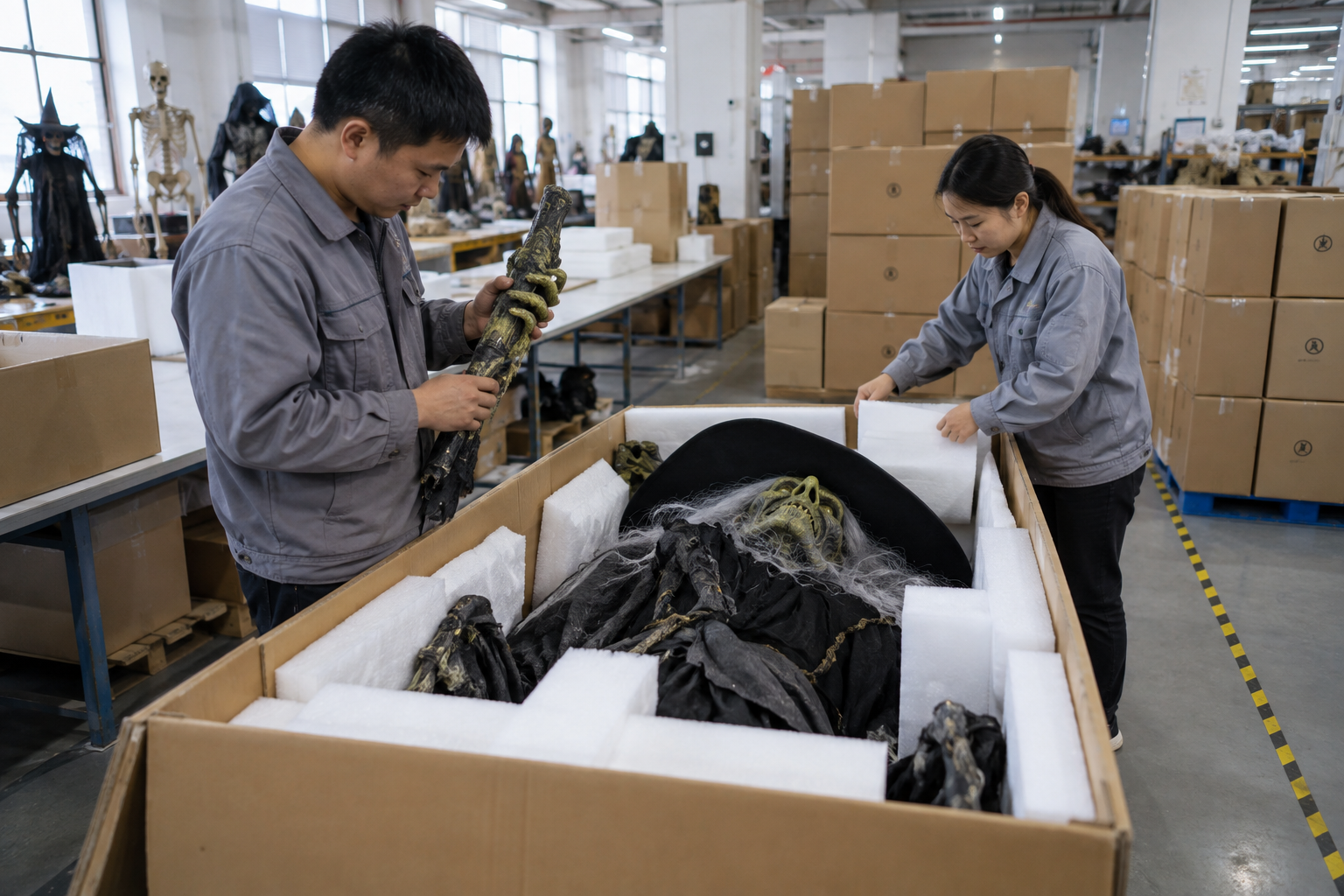
Halloween prop rental return inspection is the bridge between one successful event and the next usable deployment. A display may return complete but with hidden configuration changes, loose accessories or packing that no longer protects it. Rental operators need a defined return process rather than a quick glance at the main character.
The commercial objective is to identify condition, decide what work is required and release the equipment with a traceable record. This differs from initial shipment inspection, which asks whether a new order matches its specification. Rental returns must account for use, handling and the operator's service scope.
This guide explains how to plan component tracking, inspection and refurbishment for commercial Halloween displays. It is not a rental contract template or a universal repair manual. Technical work and legal charging terms should be handled by qualified personnel and appropriate advisers.
Establish the dispatch baseline
A return inspection needs a record of what left the warehouse. Identify the product revision, component list, configuration and visible condition before dispatch. Include accessories, cables, instructions and reusable packing, not only the main scenic body.
Photograph the assembled and packed condition where useful. Use consistent views that show relevant surfaces and identifiers. A promotional photograph may be attractive but insufficient for comparing a damaged connection point or missing accessory.
Record known pre-existing wear separately from new observations. This helps the operations team interpret the return and avoids assuming every mark occurred during the latest booking. It also supports a fair review of any customer charge under the agreed terms.
State the permitted product application and handling scope. If the rental includes installation by the operator, the customer's responsibilities differ from a dry hire. Do not leave setup, dismantling and repacking responsibilities implicit because the product appears easy to assemble.
Track components as practical rental assets
Halloween rental component tracking should match how the scene is actually handled. Assign identifiers to major assemblies and meaningful groups of small parts. Individually tracking every low-value fastener may be unnecessary, while failing to identify a unique controller can create serious confusion.
Keep component labels readable without damaging the finish or interfering with function. Agree appropriate positions and methods with the manufacturer. A decorative surface is not automatically a suitable place for an adhesive inventory label.
Distinguish product identity from booking identity. The same prop may serve several events, but its maintenance history should remain connected to the asset. The booking record then identifies the destination, dates and responsible handoff.
Connect spare components to supported revisions. The animatronic spares guide explains why similar appearance does not establish interchangeability. A hurried return team should not replace a missing part with an unverified item from another kit.
Separate intake from release inspection
Intake establishes what has returned and whether anything needs isolation or urgent attention. Check identities, carton count and obvious issues before mixing the goods into available stock. Record discrepancies while the booking context is still clear.
Release inspection determines whether the prop is ready for another deployment after appropriate assessment and work. It may include cleaning, repair, reassembly and functional checks. A returned asset is not automatically available because it is physically back in the warehouse.
Use clear statuses such as received pending inspection, under assessment and released. The wording can vary, but the operational distinction should be unmistakable. Prevent unverified equipment from being selected for the next booking by mistake.
For suspected technical damage, follow the manufacturer's and operator's procedures. Do not energize equipment simply to see whether it works after an incident involving water, impact or an uncertain connection. Authorized personnel should decide the safe inspection sequence.
Define wear and damage review criteria
Halloween decor rental damage records should describe observations, not jump immediately to blame or charges. Record location, extent, affected function and comparison with the dispatch baseline. Distinguish dirt, cosmetic wear, missing parts and suspected structural or technical damage.
Define expected wear for the rental scope where appropriate. A reusable packing carton may show ordinary handling marks without losing its protective function. A loose mounting or damaged cable requires a different assessment. Treat consequences and repair needs separately from visual severity.
Use photographs with context and close detail. Include an identifier or reference position so another team member can locate the observation. Avoid a cropped image that makes a tiny mark look like extensive damage or hides the surrounding assembly.
Commercial charging should follow the agreed contract and applicable law. This article does not prescribe penalty amounts or assume that an observation establishes customer responsibility. Preserve evidence and have the authorized team review it consistently.

Inspect packing as well as the product
Repeated transport can change the protective system. Check inserts, straps, cases and component separators against the approved packing method. Missing protection may not damage the returned prop immediately but can increase risk on the next trip.
Record whether the customer followed the return-packing instructions, where that responsibility was part of the hire. If the method was unclear, improve the instructions rather than treating every mistake as carelessness. Photographs of the correct packed arrangement are often useful.
Ask the manufacturer which packaging components are intended for repeated use and what replacement criteria apply. An export carton designed for a defined shipment should not be assumed suitable for unlimited rental cycles without evaluation.
For complex kits, test repacking during sample acceptance. The knock-down prop guide considers assembly and packing trade-offs. A format that saves first-shipment space may create more loose-part handling during frequent rentals.
Plan cleaning and refurbishment separately
A haunt rental refurbishment plan should separate routine care from repair or modification. Cleaning may restore appearance, while repainting, replacing a costume or repairing a mechanism can change the product's supported configuration. Obtain manufacturer guidance for the relevant work.
Use the approved material-specific method. The cleaning-trial guide explains how to evaluate compatibility without claiming disinfection. A return process should not encourage aggressive chemicals simply because the next booking is close.
Record work performed and any changed components or settings. If a surface is touched up, compare it with the retained finish reference. If a controller is replaced, follow the approved technical procedure and configuration record. Ready appearance does not imply verified function.
Set an approval route for work outside routine care. The operations team should know when to consult the supplier, obtain a repair quotation or withdraw the asset. This prevents well-intentioned warehouse improvisation from becoming an undocumented product change.
Verify the complete scene before redeployment
A Halloween rental reset checklist should cover the assembled configuration required for the next booking. Confirm completeness, supported connections, relevant function and the updated condition record. Identify any booking-specific differences such as approved soundtrack or costume variant.
For an animatronic, use the manufacturer's check sequence with competent personnel. Include full cycle and return behaviour where relevant, not just a brief movement. The cycle-timing guide helps buyers ask whether restored settings match the intended visitor flow.
Check documents and accessories. A product can be functional but unusable for the next customer if instructions, supported controls or necessary assembly hardware are missing. Include them in the release record rather than leaving a separate team to discover the gap during loading.
Retain the release decision with the asset history. Identify who completed the checks and what configuration was approved. If any limitations remain, ensure they affect booking availability and customer communication appropriately.
Example: a character returns before another booking
Imagine a hypothetical rental company receiving a character shortly before a second event. The main body looks intact, but intake finds a missing costume accessory and a damaged packing insert. The dispatch record makes both differences visible.
The return team assigns the asset a pending-inspection status. It does not immediately load it for the next booking. A technician reviews the supported configuration, while the warehouse team checks the remaining components against the contents list.
The accessory can be replaced with a confirmed compatible spare. The insert requires replacement before transport. Cleaning follows the existing approved method and includes the defined drying condition. These actions are recorded separately so the team can see what was done and why.
During the release trial, the technician discovers that the repeat-trigger setting differs from the dispatch baseline. The setting is restored according to the approved procedure and the complete cycle is verified. The problem would not have been visible in an exterior photograph alone.
The next booking receives a complete, identified kit and an updated condition record. Any commercial review of the earlier return proceeds through the rental agreement separately. The operational release is based on readiness, not on whether a customer charge has been settled.
Budget for turnaround rather than optimistic availability
Rental availability should include transport, intake, assessment, care and release work. Do not count every returned asset as rentable immediately. Use actual operator records to estimate turnaround rather than publishing a universal refurbishment time.
Consider reserve capacity for critical scenes. A replacement prop, compatible spare assembly or alternative display may provide a practical fallback. The right choice depends on the booking commitments and the operator's resources, not a fixed reserve percentage.
Track recurring issues by asset and component. If the same joint or insert repeatedly needs attention, review the handling method and product design with the supplier. Evidence can support a more suitable rental configuration instead of repeated emergency repairs.
Use BooAri's custom-project enquiry to explain repeated transport, installation responsibility and turnaround expectations. Ask for a product proposal with service access, repacking references and supported replacement options. Do not infer that every catalogue product is designed for rental use.
Buyer worksheet: prove a rental asset is available
Use one returning asset to rehearse the complete intake-to-release sequence. Compare its identity, contents and condition with the dispatch baseline. Record missing accessories, finish observations, functional concerns and the state of protective packing separately. A returned body that looks intact may still have an unverified controller configuration or a missing hardware bag. Give the asset a status that prevents accidental selection for another booking until checks are complete.
Assign each observation an owner and next action. Routine approved cleaning, a compatible spare, specialist assessment and commercial damage review are distinct processes. Do not make an unqualified warehouse worker resolve an uncertain electrical issue to meet a schedule. Equally, do not leave a purely cosmetic mark unresolved because no one knows who can approve it. A short decision register can show what is pending, which evidence was reviewed and when the asset was released.
Check the packing system before the next trip. Inserts can be missing or crushed, cases can lose labels and loose parts can migrate between kits. Ask the manufacturer which components are designed for repeated transport and what replacement guidance applies. A successful first export shipment does not prove endless rental cycles. Photograph the approved repacked state and confirm that instructions and identifiers remain with the correct product revision.
Finish with a complete supported function check where applicable and a release sign-off by authorized personnel. Record the next booking's configuration and any approved changes from the previous one. If the asset cannot meet the next deadline, choose an agreed substitute or change the booking plan rather than erasing the pending status. The operational benefit is a reliable inventory picture, supported by evidence that the prop is ready for its next specified use.
Questions to close on rental availability
Require an intake status for returned props and keep it separate from release status. Inspect against the previous dispatch record, including accessories and protective packaging. Photograph observations with enough context to identify the affected assembly.
Assign supported care and repair work. A missing costume trim, a damaged insert and uncertain controller function are different issues. Only authorized personnel should assess technical concerns. Record the replacement part revision and any settings restored during service.
Before the next booking, use the current kit list and operating instructions for a full relevant check. Confirm the packing system can support the next transport. ISTA's test-procedure overview can help scope packaged-product evidence for a revised rental transport system; no initial test proves unlimited trips. If an asset remains under assessment, make the availability list reflect that fact and plan a substitute. Honest inventory status is more useful than an optimistic calendar entry.
Decision example: cosmetic repair or asset withdrawal
Consider a fictional rental pumpkin that returns with a visible scuff and a slightly loose base fitting. The scuff may be within the operator's agreed cosmetic tolerance, but the fitting requires competent assessment before the prop is available again. One return can therefore have two separate outcomes. A photograph of the front surface cannot settle the technical question.
The intake record identifies both observations and keeps the asset pending. The care team applies only the approved surface method. An authorized technician checks the base against the manufacturer's procedure and records the result. If a supported repair is completed, the team repeats the relevant assembly and stability review for the next booking. If it cannot be resolved in time, the operator offers a documented substitute.
The commercial review of any customer charge is handled separately under the rental agreement. Operational release depends on the final condition and supported checks, not on assigning blame. This example helps a buyer specify service access and replacement parts before the first rental, when there is still time to select a more practical design.
Frequently asked questions
Is rental return inspection the same as shipment inspection?
No. Shipment inspection checks a new order against agreed requirements. Rental return inspection compares used assets with dispatch records and determines assessment, care and release needs. The records can share identifiers but serve different decisions.
Should every surface mark stop the next rental?
Not automatically. Evaluate the mark against the agreed condition criteria and product application. Cosmetic observations, missing parts and technical damage have different consequences. Authorized personnel should make the release decision using the relevant checks.
Can packing materials be reused indefinitely?
Do not assume so. Inspect protective components and follow supplier guidance for the intended transport pattern. Replace damaged or missing protection before redeployment. Repeated-use suitability should be part of the procurement brief.
What should a release record contain?
Identify the asset, configuration, completeness check, work performed, relevant verification and person approving release. Include any limitations affecting use. Keep the record connected to the asset history rather than only to the latest booking invoice.
Conclusion
Rental readiness is a documented condition, not simply a return date. Establish a dispatch baseline, separate intake from release and inspect protection as well as the prop. Supported care and revision-aware replacements help the operator prepare a reliable next deployment.
Send BooAri your rental format, transport pattern and local service capability through the enquiry form. Request a product and packing proposal that addresses repeated handling, component tracking and refurbishment access.
Further reading
Use these external resources alongside your local market, venue and professional safety requirements:
READY TO START A PROJECT?